

With the Automatic Fuel Adjustment (AFA) rate climbing to +3.59 sen/kWh for July 2026 – and TNB’s own three-month outlook projecting it to more than double to over +8 sen/kWh by September – you might be wondering whether there’s a legitimate way to escape the surcharge entirely.
There is: it’s called the Green Electricity Tariff (GET), and subscribers are exempted from AFA on the green energy units they use. Here’s how GET works, whether it actually makes financial sense right now, and how to apply.
What is the Green Electricity Tariff (GET)?
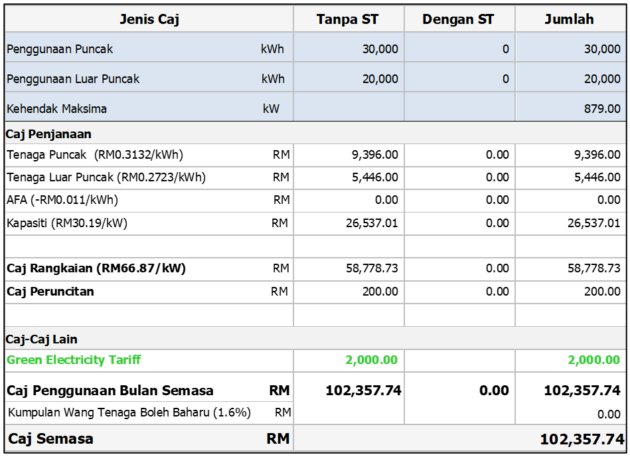
GET is a government-introduced, subscription-based programme that lets any TNB customer – residential or business – buy low-carbon electricity from the grid without having to install their own solar rooftop or other renewable energy system.
The renewable energy behind GET comes from solar plants under the Large-Scale Solar (LSS) programme, TNB’s hydropower stations, and other renewable plants approved by the Energy Commission.
In return, subscribers get three things:
An AFA exemption
Customers who subscribe to GET retain the AFA exemption for the actual green energy units they consume. AFA replaced the old Imbalance Cost Pass-Through (ICPT) from July 1, 2025, and GET subscribers who were previously ICPT-exempt carry that exemption over to AFA. In plain terms, the units you cover with GET blocks don’t get hit by the monthly AFA surcharge.
1.6% KWTBB (Kumpulan Wang Tenaga Boleh Baharu exaemption
GET subscribers are also exempt from the 1.6% Kumpulan Wang Tenaga Boleh Baharu (KWTBB) renewable energy fund levy on the actual green energy units consumed. This is a second saving on top of the AFA exemption. Note that KWTBB is charged as 1.6% of the bill rather than a flat sen/kWh figure, and doesn’t apply to domestic users consuming 300 kWh or less a month in the first place.
Malaysia Renewable Energy Certificates (mRECs)
At the end of each calendar year, subscribers receive mRECs certifying the green electricity they consumed – useful for companies chasing ESG or carbon-reduction targets. Note that this is a bundled mREC programme, so you can’t pick the specific renewable source.
Crucially, GET isn’t a discount on your normal bill. You still pay the standard tariff for your monthly consumption, plus a GET premium on top. The trade-off is that the premium is fixed and known, whereas AFA moves every month.
How much does GET cost?
Following the July 1, 2025 tariff restructuring, the old category-based premium rates (10 sen/kWh for domestic and low-voltage, 20 sen/kWh for medium/high-voltage) were scrapped in favour of a single-tier structure with premiums cut by up to 80%. The longer you commit, the cheaper the rate:
- 1-year subscription: 5 sen/kWh
- 2-year subscription: 4 sen/kWh
- 3-year subscription: 3 sen/kWh
These rates apply to all customer categories under the new single-tier structure.
Does it actually make sense to switch to GET?
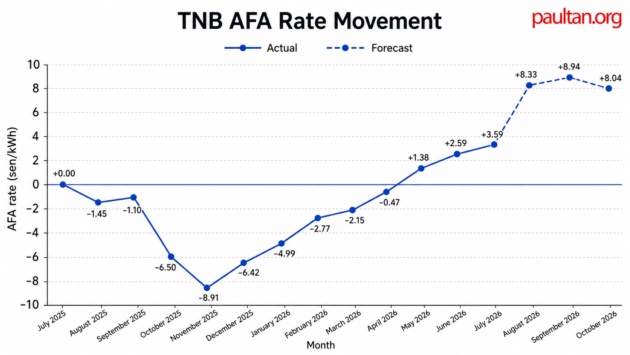
This is the important part. For most of 2025, the answer was a clear no – AFA was deeply negative (a rebate), bottoming out at -8.91 sen/kWh in November 2025. Paying a GET premium to avoid a charge that was actually paying money back to consumers made no sense.
That calculus has flipped. Here’s the math at current rates:
July 2026 AFA is +3.59 sen/kWh. A three-year GET subscriber pays a 3 sen/kWh premium but avoids that 3.59 sen surcharge – a net saving of around 0.59 sen/kWh. This is the first month the cheapest GET rate has undercut AFA.
If TNB’s projection holds and AFA hits +8.94 sen/kWh in September 2026, a three-year subscriber avoiding an 8.94 sen surcharge while paying a 3 sen premium would be roughly 5.94 sen/kWh ahead.
So on paper, GET looks compelling right now. But there’s a significant catch: GET is a one-to-three-year lock-in, and you’re betting that AFA stays high for the entire period.
AFA is volatile and directly tied to global coal and gas prices. If fuel prices fall and AFA swings back into rebate territory – as it did for most of last year – GET subscribers get the worst of both worlds: they keep paying the fixed premium and forgo the AFA rebate that non-subscribers enjoy.
You also can’t simply exit; terminating mid-subscription incurs a 2 sen/kWh penalty on the remaining balance.
There’s also two more things to keep in mind. Low-usage households shouldn’t bother, as AFA is already waived for total consumption of 600 kWh and below per month, so there’s nothing to save by subscribing to GET. GET only makes economic sense for higher-consumption households and businesses that actually pay AFA. And unlike AFA, which can be positive or negative, the GET premium is always a cost.
In short: at July 2026 rates and given the rising outlook, GET is – for the first time – a break-even-to-favourable proposition for higher users who believe fuel prices will stay elevated. But unless you specifically want your electricity consumption to be from green sources, it’s a hedge, not a guaranteed win. Anyone weighing it up should treat it as a multi-year bet on fuel prices rather than a guaranteed monthly saving.
Who is eligible?

GET is open to all TNB consumers. You subscribe in blocks of 100 kWh for residential customers, and blocks of 1,000 kWh for non-residential. The minimum is one block, and you can subscribe up to 130% of your average monthly consumption, as determined by TNB.
Total subscriptions across all customers are capped by the published GET quota, and TNB reserves the right to review your subscription if your actual consumption falls well below what you’ve subscribed for, to keep the limited quota fairly shared.
How to apply for GET, step by step
- Log in to the myTNB portal at mytnb.com.my. If you don’t have an account, register first.
- Add your contract account to the portal if it isn’t already linked.
- Navigate to the GET subscription section and start a new subscription.
- Choose your number of blocks – minimum one block (100 kWh residential / 1,000 kWh non-residential), up to 130% of your average monthly usage.
- Select your subscription period – 1, 2 or 3 years, which fixes your premium rate at 5, 4 or 3 sen/kWh respectively. Longer terms are cheaper but lock you in for longer.
- Submit and enter the GET agreement. Applications are processed on a first-come, first-served basis, subject to TNB’s assessment and quota availability, and are typically reviewed within about five working days. Once approved, you’ll enter into a GET contract with TNB.
Your existing TNB meter is used to measure consumption, so there’s no new hardware to install. A full step by step guide has been published by TNB.
GET won’t suit everyone – and for low-usage households it makes no sense at all – but for higher-consumption homes and businesses staring down an AFA rate that’s projected to keep climbing, it’s now a genuine option worth running the numbers on.
Looking to sell your car? Sell it with Carro.




WTF! Why cant just reduce electric price lah bodo PH Gomen! Solve the root cause not the symptom.
hihi my house has solar power plus backup batteries