
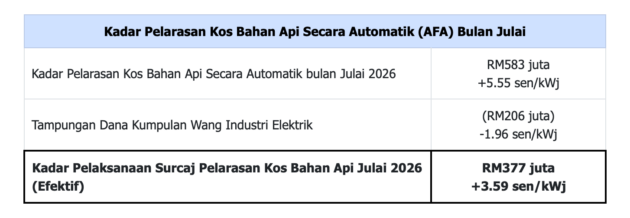
The Energy Commission’s (ST) Automatic Fuel Adjustment (AFA) rate for July 2026 has been set at +3.59 sen per kWh, which is up from +2.59 sen/kWh in June 2026.
Just like the case in June 2026, the real AFA is actually 5.55 sen/kWh (RM583 million) but Kumpulan Wang Industri Elektrik (KWIE) funds have covered 35% of the increased cost (i.e. RM206 million, equivalent to 1.96 sen/kWh). This is the third month that AFA has been positive, and also the third month that KWIE has subsidised the AFA surcharge.
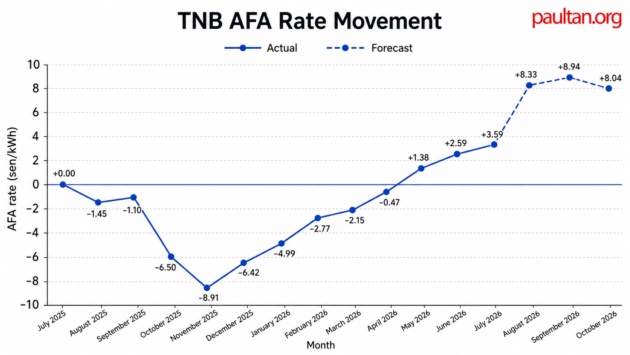
Here’s a list of the monthly AFA rates so far and a forecast for the next 3 months:
- July 2025: 0.00 sen/kWh
- August 2025: -1.45 sen/kWh
- September 2025: -1.10 sen/kWh
- October 2025: -6.50 sen/kWh
- November 2025: -8.91 sen/kWh
- December 2025: -6.42 sen/kWh
- January 2026: -4.99 sen/kWh
- February 2026: -2.77 sen/kWh
- March 2026: -2.15 sen/kWh
- April 2026: -0.47 sen/kWh
- May 2026: +1.38 sen/kWh
- June 2026: +2.59 sen/kWh
- July 2026: +3.59 sen/kWh
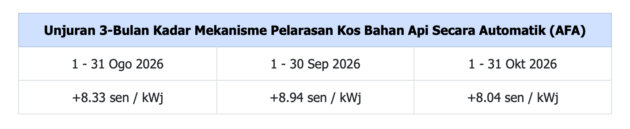
AFA outlook from August to October 2026 is projected to range from +8.04 sen/kWh to +8.94 sen/kWh – more than double the July rate, so brace for higher bills in the months ahead.
However, do note that the eventual actual AFA paid by the consumer might be lower than the forecasted amount because of the KWIE subsidy that has been historically applied whenever it is positive.
What has contributed to a rising AFA?
According to Single Buyer’s website, fuel prices in July 2026 are higher than the baseline prices used in tariff setting, resulting in an overall increase in generation costs.
Coal price for July 2026 is recorded at 122.37 USD/MT (Base price: 97 USD/MT), while Tier 2 gas price for July is recorded higher than the Base price: 75.58 RM/mmBTU (Base price: 46 RM/mmBTU). Tier 1 gas, on the other hand, is actually below base at 27.00 RM/mmBTU (Base price: 35 RM/mmBTU).
A stronger ringgit is softening the blow somewhat. With the July 2026 exchange rate at 3.9455 RM/USD (against a base rate of 4.307 RM/USD), that USD-denominated coal price of 122.37 USD/MT translates to just 22.12 RM/mmBTU – not far above the 19.14 RM/mmBTU base – so forex is partly offsetting the higher fuel cost.
What is Automatic Fuel Adjustment (AFA)?
AFA is a component of your electricity bill. To recap, AFA replaces the previous Imbalance Cost Pass-Through (ICPT) and is automatically calculated as either a surcharge or discount of up to 3 sen/kWh depending on fuel prices – this is revised monthly, with any larger changes (beyond 3 sen) requiring cabinet approval.
Introduced as part of the Electricity Tariff Restructuring that took effect from July 1, 2025, the AFA is one of five components or ‘charges’ used to calculate your electricity bill:
- Generation charge: 27.03 sen/kWh for total consumption of 1,500 kWh and below per month or 37.03 sen/kWh for total consumption more than 1,500 kWh per month. This covers the actual cost of generating electricity from power plants.
- Capacity charge: 4.55 sen/kWh. This covers the cost of maintaining sufficient electricity supply capacity.
- Network charge: 12.85 sen/kWh. This covers the cost of operating and maintaining the grid and the local network to deliver electricity.
- Retail charge: RM10/month; waived for total consumption of 600 kWh and below a month. This is a fixed cost for metering, billing and customer service.
- AFA rate: +1.38 sen/kWh for the month of May 2026; waived for total consumption of 600 kWh and below a month.
You can use our TNB Bill Calculator tool to get a rough estimate on how much your electricity bill will be for the month. Essentially, if you use over 1,500 kWh a month, you add the generation, capacity and network charges (totalling 54.43 sen/kWh) to retail charge (RM10) and the AFA rate (-0.47 sen/kWh for April 2026; negative number, so it’s a discount).
Alternatively, if your usage is below 1,500 kWh a month, it’s 44.43 sen/kWh plus the retail charge and AFA rate. For total consumption of 600 kWh and below a month, it would only be 44.43 sen/kWh – retail and AFA charges are waived.
Domestic consumers who use less than 1,000 kWh a month can enjoy a discount called ‘Insentif Cekap Tenaga’ or ‘Energy Efficiency Incentive’. The discount provided is relative to consumption (higher usage, lower incentive), with the maximum discount being 25 sen/kWh.
Domestic users who have smart meters also have option to enter the Time of Use (ToU) scheme, allowing them to change their electricity usage patterns and take advantage of lower tariff rates during off-peak hours to enjoy savings on their monthly bill.
The scheme has two time zones, with off-peak timings being from 10pm to 2pm from Monday to Friday and throughout the day (24 hours) for weekends. Peak hours are from 2pm to 10pm on weekdays. Here are the energy charges under this scheme:
For usage of 1,500 kWh and below per month
- Peak tariff: 28.52 sen per kWh
- Off-peak tariff: 24.43 sen per kWh
For usage above 1,500 kWh per month
- Peak tariff: 38.52 sen per kWh
- Off-peak tariff: 34.43 sen per kWh
Is there a way to escape from paying AFA?
Yes actually, there are two ways.
Firstly, you can use use less electricity. AFA is waived for total consumption of 600 kWh and below a month.
Secondly, there is something called Green Energy Tariff (GET) which you can opt for. This exempts you from AFA. However, GET itself costs 5 sen/kWh if you lock in for a 1 year subscription, 4 sen/kWh for 2 years, and 3 sen/kWh for 3 years, thus it only makes economic sense to subscribe to it if AFA is more than what GET costs across the entire period that you subscribe it for.
Looking to sell your car? Sell it with Carro.




all the T20 are crying now because charging their EV has become more expensive , cannot enjoy budi95.