• Spoon and Mugen toy with the Honda CR-Z

    The Honda CR-Z has all the basics to look like a hot compact coupe, but seeing the production car for the first time in Geneva, I thought that it looked very tame. The hi-tech feel, driver centered dashboard gets our thumbs up, though. But there’s nothing a good tuner can’t fix, especially for a brand like Honda with top notch outfits like Mugen and Spoon in the wings.

    The picture above is of a lowered, kitted and mildly modded CR-Z by Spoon. The more purposeful stance comes from a front coilover kit and rear spring/shock kit that lowers ride height by a substantial 50 mm. Other parts being tested are the N1 exhaust, ECU, and “twin-block” calliper and slit rotor brake upgrade. There’s also an attention grabbing set of Spoon CR93 alloys in blue. Working on the ECU and brakes will have to take into account that these are vital components in the CR-Z’s hybrid drivetrain, though.

    And this is Mugen’s idea of how the CR-Z should look like. Full bodykit (lower front bumper reminds us of the Modulo kit for the Honda Accord), dramatic rear spoiler and diffuser, Mugen GP wheels in bronze and LEDs on the front grille are added. The suspension, exhaust system and air filter have been uprated too, while the cabin gets a unique gear knob, extra gauges and floor mats with logos.

    View live images from Geneva of the CR-Z and Spoon/Mugen versions after the jump.

    Source
    Read more ›

     
  • Pininfarina’s Alfa Spider proposal is impossibly sleek

    Alfa Romeo and Pininfarina have a long history of over 70 years working together to create some of the most seductive cars ever seen. The famous carrozzeria designed and assembled the beautiful original Alfa Spider “Duetto” back in 1966, and also penned the next Spider of 1995 along with its fixed roof GTV sister. Pininfarina also had a hand in today’s Spider, although the Brera on which it’s based on is a Giugiaro design.

    Named the 2uettottanta, this roadster concept marks its maker’s 80th anniversary and is also a tribute to Alfa Romeo, which celebrates its centenary this year. Described as “a car that can make people dream and excites even after many years” the 2uettottanta is a “simple 2-seater” proposed with a 1,750 cc turbo engine placed longitudinally – a reference to the 1750 Veloce of the 70s. Measuring 4,213 mm long with a 2,500 mm wheelbase, the concept is slightly more compact than today’s car.

    The car’s cabin has a minimalist driver-oriented configuration starring Alfa Romeo’s trademark “tubes” that contain the instruments (which has been copied by about everyone by now). It’s all very realistic too, Pininfarina even incorporated Alfa’s DNA switch into the design. The centre tunnel that runs through the cabin has a cutout to expose the carbon fibre chassis beneath.

    Judging from how impossibly sleek and sexy this proposal for the next Spider is, we won’t be surprised if Alfa bosses sealed the deal with Pininfarina immediately. There was talk before the Geneva show that all three big Italian design houses were to come up with one concept each for Alfa Romeo’s birthday, proposing a new design direction for the marque’s future mid-sized range. Pininfarina has this, Bertone has the Pandion, but all Italdesign had for Geneva was for Proton! Perhaps Signor Giugiaro decided that EMAS is a better investment!

    You MUST check out the live and official images of this beauty. It’s after the jump.
    Read more ›

     
  • Renault Wind – CC with the fastest folding roof!

    The Renault Wind only takes 12 seconds to transform from coupe to convertible, which should make it the fastest of its kind (the Peugeot 207 CC needs about 25 seconds to strip). This is thanks to a simple central pivot setup instead of the regular hinge system, which also ensures that the Wind’s boot volume of 270 litres remains whether the roof is up or down. Interestingly, that figure is 40 litres more than the standard Twingo hatchback, which the Wind is based on. It’s also said that the boot opens with no more effort than would be needed for a conventional saloon.

    The Wind looks tiny in the metal, and it’s 3830 mm overall length is quite a bit shorter than the 207 CC, which goes past four metres. The car will be launched in Europe this summer with two of the Twingo’s engines: a 133 bhp/160 Nm 1.6-litre from the Renaultsport model and a 100 bhp/152 Nm 1.2-litre TCe engine. Renault says that it paid particular attention to the acoustic tuning for the former, which has a “telltale, fiery pitch”.

    Renault plans to offer a wide range of options including a rear diffuser with twin tailpipes, front foglamp backing plates, chrome exterior mirror housings and a chrome finish for the rear bumper. Inside, customers can choose from different instrument housing designs and door pulls, plus an alternative gear lever knob or pedal set.

    Live images and the official gallery is after the jump.
    Read more ›

     
  • Audi A8 Hybrid – the limo that won’t cost the earth

    The Audi A8 is the newest limo on the block and this is the A8 hybrid which aims to be the greenest in the segment. Shown at the Geneva show for the first time, the A8 hybrid’s drivetrain consists of two propulsion units – a 2.0 TFSI internal combustion engine and an electric motor – that develop a total output of 245 bhp and 480 Nm of torque. This enables a 7.6-second 0-100 km/h time and a top speed of 235 km/h, done in Transporter style coolness.

    A hydraulically operated wet clutch links the TFSI with the electric motor (with 45 bhp and 211 Nm), which makes available its grunt from standstill. In the boot lies the Audi’s lithium-ion battery pack, which still leaves 400 litres of luggage space. Subsystems that operate on engine power in a regular car have been modified to run entirely on electric power in the A8 hybrid, such as the air-con compressor, electromechanical steering system and brake booster, all managed by a “pulse control inverter” system. All these will appear in the Audi Q5 hybrid, to be introduced later this year.

    This A8 is capable of fully electric-powered driving up to 65 km/h and for a distance “exceeding 2 km”. Normally, both work in tandem but above 65 km/h, the combustion engine propels the car alone, while the electric motor supplies ancillaries and recharges the battery. The TFSI is disconnected from the drivetrain when the driver chooses to coast. The e-motor also functions as a generator to recoup energy from braking and replenish the battery.

    Green credentials? The A8 hybrid’s average fuel consumption is 16.1 km/l while CO2 emissions is 144 grams per km. These figures compare very well with the Mercedes-Benz S400 Hybrid, which does 12.7 km/l and 186 g/km. Launched last year, the car from Stuttgart pairs a V6 with electric motors for a combined 299 bhp/385 Nm, and was the first production hybrid to use lithium ion batteries.

    Live images from Geneva and the official gallery is after the jump.
    Read more ›

     
  • Production Hyundai i-flow planned for 2011; showcar previews diesel hybrid system and new eco ideas

    The Hyundai i-flow is one of the significant concept cars at Geneva, not just because it looks dramatic, but because under that heavily sculpted skin is a range of latest tech that could appear in Hyundai’s next generation of cars.

    Powering the i-flow is the company’s first diesel-electric hybrid powertrain consisting of a U2 1.7-litre oil burner with two-stage turbocharging and Hyundai’s lithium ion-polymer battery. Coupled to a six-speed, dual-clutch transmission, the drivetrain is capable of 33.3 km/l and a low CO2 output of 85g/km.

    The i-flow is also a test bed for new energy harvesting ideas, ranging from a flexible solar panel roofing to a thermo-electric generator developed in partnership with leading chemical company BASF. One such idea is thermal engine encapsulation, which ensures that the engine reaches optimum operating temperature more quickly by retaining heat when the car is idle. Hyundai says that this translates into fuel savings and emissions cuts of 5% during summer and up to 9% in winter. The thermo-electric generator meanwhile recaptures energy from hot exhaust gases and converts it to electrical energy to help power auxiliary systems.

    Designed at Hyundai’s European studio in Russelsheim, the i-flow sports the firm’s “fluidic sculpture” design language. With an overall length of 4,780 mm and a 2,800 mm wheelbase, the i-flow is a Honda Accord sized D-segment contender that is set to hit the market in 2011. It remains to be seen how much of the i-flow’s styling is retained for production, but things look promising with the recent Korean realisation that advanced design is as important as making competent cars.

    Live pictures from Geneva and official images are after the jump!
    Read more ›

     
  • Citroen DS3 Racing – anti retro Mini Cooper S rival!

    The first ad I noticed once touching down at the Geneva airport was one for the Citroen DS3, which had the headline “anti-retro”. We all know that the DS3 is pitched as a rival to BMW’s Mini, and the ad is clearly a jibe in the direction of the bug-eyed car.

    I understand the DS3′s appeal for those who either don’t “get” the Mini’s retro looks or simply look at it as a fashion fad. With creative design typical of Citroen and a modern, classy cabin, we reckon that it will do very well in Europe.

    At the Geneva show, Citroen Racing (Citroen’s STi/RalliArt) paraded the DS3 Racing that’s set to go on sale in the second half of 2010. Limited to 1,000 units, the DS3R comes with plenty of carbon trim – on the front bumper, lower body trim, wing extensions, door side mouldings and spoiler, to be exact. The grey showcar was nicely contrasted with orange on the roof, wing mirrors, grille and rims (18-inch, looks really wicked) and wore some funky decals. Orange and carbon are also repeated in the cabin, which has a high-quality feel to it.

    Citroen took the 1.6 THP engine (as found in our Peugeot 308 Turbo) and boosted output to 200 bhp, while torque is up from 240 Nm to 275 Nm. The gains were achieved by “optimising powertrain components”, modifying the turbo, remapping the ECU and adding a sports exhaust system. With these figures, the DS3R will outpace a Mini Cooper S, but will it outpoint the Brit in the bends?

    For starters, the standard front and rear tracks have been widened by 30 mm and the DS3R sits lower by 15 mm. Stiffer springs, retuned shock absorbers and “specific steering mapping” for a more precise helm have been added as well. To cope with the added grunt, Racing spec brakes have been installed – four-piston calipers up front and drilled discs for the back. Also, the switchable ESP system has been tuned for “extra vitality, sportiness and driving pleasure” – in other words, it’s less restrictive.

    We’re bound to see more of the DS3 in the sports pages, as it will replace the C4 as Citroen’s WRC machine – the French brand is a five-time WRC champion and is defending both driver and constructor crowns with rally king Sebastien Loeb.

    Live images from Geneva and official gallery after the jump!
    Read more ›

     
  • Toyota FT-86 concept gets a proper family portrait

    The Toyota FT-86 Sports Concept made its European debut in Geneva, and although it was tucked away in a corner, received plenty of attention. I observed a young boy looking at the rotating FT-86 longingly for a good 20 seconds, and wondered “there’s no reason why Toyota would not want to produce this car” especially after the great reception it got for the AE86′s spritual successor.

    Compact dimensions, lightweight, boxer engine, six-speed manual, rear-wheel drive – there’s little not to like for the enthusiast, and Toyota adds to the yum factor by showing us a family portrait of the FT-86 with past masters such as the Supra, Celica GT-Four and of course, the AE86. Those cars have no decendent in today’s Toyota lineup, which has nothing to entice enthusiasts, something Akio Toyoda himself is intent of changing. I personally hope that the present troubles the company is facing won’t derail its plan to bring “fun” back into driving.

    For now, enjoy the official images of the FT-86 after the jump; some of them look good as wallpapers!
    Read more ›

     
  • Sexy Alfa Romeo Giulietta says ciao to Selespeed!

    The 147 replacement Alfa Romeo Giulietta will be without doubt the most sensational looking five-door hatchback in the market when it goes on sale in Italy later this month. Making its world debut in Geneva, the first right-hand drive models will go to the UK in June. Sime Darby Auto ConneXion, how about this for a 2010 Christmas present for the Malaysian market?

    The Giulietta takes on Alfa’s current long headamps as seen on the Mito supermini, but with a strip of four LED driving lamps residing within them. Alfa’s famous shield grille sits inside a larger triangle while the lower bumper is very sculpted. The profile features a strong shoulder line that “disappears” in the middle before emerging again on the rear doors, which handles are hidden like the 147′s (there won’t be a three-door variant). The Giulietta’s rear end sports a distinctive LED pattern in the taillamps and a diffuser-style rear bumper with two exhaust tips. To sum it all up in one word – sexy.

    Four turbo engines are available at launch, all Euro5 compliant and with Start/Stop tech: two petrols (120 bhp 1.4TB and 170 bhp 1.4TB MultiAir) and two second-gen MultiJet diesels (105 bhp 1.6 JTDM and 170 bhp 2.0 JTDM). All these powerplants come with a 6-speed manual gearbox, but a dual-clutch transmission will be coming soon as the automatic option – with this, we can bid farewell to Alfa’s frustrating Selespeed ‘box. Ciao!

    Also coming soon is a hot 235 bhp 1750 TBi Cloverleaf version. This engine is said to have “performance comparable to – or better than – that of many 3.0-litre engines while still delivering fuel consumption typical of a compact four cylinder unit,” says Alfa Romeo. The Italian firm also pointed out that at 134 bhp/litre, specific output is the highest ever achieved by an Alfa Romeo engine. Max torque of 340 Nm (at 1,900 rpm) is much more than what the VW Golf GTI produces, so performance should be superb, and we’re guaranteed a good soundtrack from Alfa too. We’re salivating already thinking of it!

    Live pictures from Geneva after the jump!
    Read more ›

     
  • Bufori Geneva is “only 50 per cent complete”

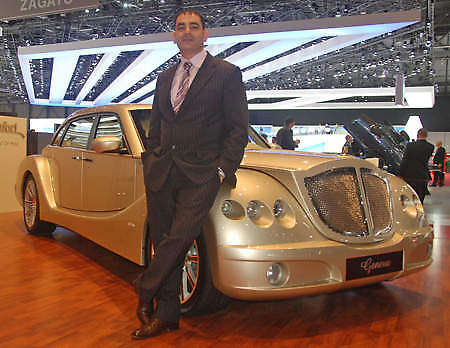
    Bufori’s luxury saloon that was unveiled in Geneva “is only 50 per cent complete” according to company founder, managing director and the car’s designer Gerry Khouri. The Geneva (the car is named after the city it’s launched in) will cost from RM1.3 million when production begins in June this year, but by then some things would have been changed from the car shown in Switzerland.

    The only significant change to the Geneva’s structure will be a 100 mm increase in wheelbase length to make 3,427 mm. As comparison, a long-wheelbase Mercedes S-Class has a wheelbase of 3,165 mm. Length, width and height is 5,340 mm, 1,925 mm and 1,520 mm, respectively. To recap, the Geneva’s swoopy body is crafted from a mixture of carbon fibre and kevlar, bonded together by Vinylester resin (commonly used in the marine industry for its high corrosion resistance and ability to withstand water absorption), while the chassis is made from top grade stainless steel.

    The Geneva’s air-suspended four-seat cabin feels intimate and luxurious, but ingress and egress isn’t the most effortless – calves will brush against the running boards that characterises the car, for instance, but the doors on the production car will feature gas struts and 90-degree openings. Better seats will be fitted and there will be changes to the interior design, too. The stereo and air-con units in the show car will also make way for bespoke items, according to Khouri.

    We will continue to follow the developments on the Geneva as Bufori puts the final round of improvements to its luxury saloon. For more details, live images from Geneva and the official gallery, click here to link to our previous post.

     
  • Bertone Pandion for Alfa Romeo – a beautiful mess!

    After a two year absence from the international scene, Bertone returns with a bang by unveiling one of the most memorable cars of this year’s Geneva show – the Pandion concept, as a tribute to Alfa Romeo’s’ 100-year anniversary and also a proposal for the future look of the brand.

    The first car penned by Mike Robinson in his new role as Design and Brand Director at Bertone, the Pandion is named after the Pandion Haliaetus, a scientific name for the Osprey sea hawk. And it’s this bird’s wings that inspired the Pandion’s most striking feature – those spectacular doors that open upwards to the air. They incorporate the car’s front and rear fenders and stand exactly 90 degrees straight from the centre of the rear wheels. In the event of a rollover, the doors are designed to fall off for easy exit, says Bertone.

    Apparently, the bird’s face also influenced the Pandion’s front design, which its creator describes as looking like the “helmet of ancient warriors” while still recognisable as an Alfa. More interesting is the rear, which sports blades in various width and length intertwined randomly. Bertone designers call this “dematerialization”, which makes the car looks like it’s moving even when standing still. This randomness continues in the cabin that is nestled in “vines”. All very messy, but somehow very beautiful.

    Motor shows are about eye candy (we’re not just talking about the ladies), and the dramatic Bertone Pandion is a very sweet example in a store full of increasingly predictable concept cars. Live and official images after the jump!

    PS: If you’re wondering who is that old lady in the gallery, she’s Lili, widow of Nuccio Bertone, legendary designer and son of the company’s founder.
    Read more ›


Archives