
Everyone seems to be betting on electric as the future of cars, and while no one knows if or when that will come to pass, it’s too big a risk to dismiss the trend. Even Toyota, which has focused on hybrid for today and fuel-cell for tomorrow, is now scrambling to get an EV plan on track. Hyundai, another believer in fuel-cell tech, is also slightly behind the curve in EVs.
Seeking to address investor concerns that it is lagging rivals in the battery-powered green car race, Hyundai said today that it will launch a long-range electric vehicle with a range of 500 km per charge after year 2021, Reuters reports.
Hyundai and Kia also have plans to roll out 31 eco-friendly models by 2020, up from a previously intended 28. The new models will include three plug-in hybrid vehicles, which come on top of eight full EVs and two fuel-cell vehicles.


As previously reported, an EV version of the new Hyundai Kona compact SUV will debut in the first half of 2018, and it will come with a range of 390 km. That’s a big improvement from Hyundai’s previous and first mass-market battery-powered car – the Ioniq Electric with a range of 169 km, far below the range touted by the likes of GM with the Chevrolet Bolt and Tesla.
The newswire also said that Hyundai has confirmed its report that the Korean carmaker is developing its first dedicated electric vehicle platform, which will allow the group to produce multiple models with longer driving ranges per charge.
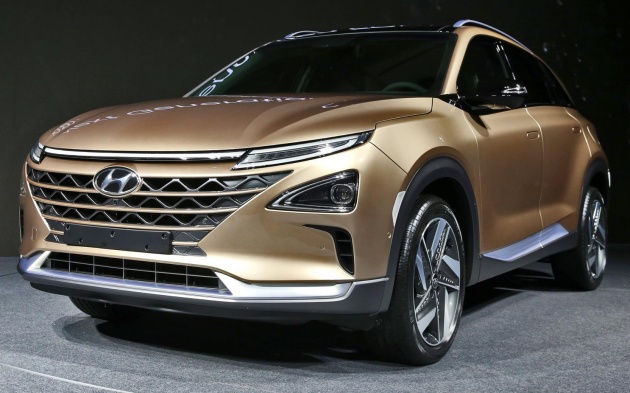
But all of the company’s efforts on hydrogen fuel-cell electric vehicles has not gone to waste. Hyundai has unveiled a near production version of an FCEV SUV with a zero-emissions range of more than 800 km per charge, nearly double the 415 km of its current Tucson FCEV. The futuristic mid-size SUV will be launched in Korea early next year, followed by the US and Europe. A FCEV sedan is also being planned. Fantastic tech, but fuelling remains a hurdle.
 Hyundai Ioniq 5 N
from RM443,888
Hyundai Ioniq 5 N
from RM443,888  Hyundai Ioniq 6 N
from RM449,888
Hyundai Ioniq 6 N
from RM449,888  Hyundai Santa Fe
from RM225,000
Hyundai Santa Fe
from RM225,000  Hyundai Tucson
from RM143,888
Hyundai Tucson
from RM143,888  Hyundai Staria
from RM179,888
Hyundai Staria
from RM179,888 
i’m not impress of any EV car until all car maker standardised the battery and can be swap at any charging station. why must wait few hour just to charge the car. for that long i could drive few hundred km already.
wow, every car manufacturer have moved towards EV, PHEV and Hybrid. Infact, not only that, they are now trying to improve on distance.
In Malaysia, we are still lost. Hybrid, which is 10 year old technology also our 2 national cars tarak ada.
EV will come in 2050
You drive 24/7 non stop for 365 days a year?
Do you eat in your car while driving?
Do you pee or poo in your car while driving?
Do you sleep in your car while driving?
The point is you have to stop the car at some point for long period of hours. That the time you can charge the battery in 30 mins to 1 hour to full.
Wow thats actually a pretty darn good idea.
Unfortunately our current technology is not on par with your idea YET. Sadly, the size of an EV battery unit comprises 70-80% of the base of EV vehicle. That’s too huge to make it portable to swap. And it is heavily protected to prevent explosion in the event of a crash.
Till the day when they can shrink an EV battery to the size of a regular car battery under the bonnet only then your idea would work perfectly.
ya i suppose you right, maybe in the future. or maybe the vehicle it self can be charge while moving, like wireless charging, same like u get on samsung phone now a days. but again we must look at massive project to embed or install the power grid on our road. everything has it’s pros and cons.
Wireless charging would be a massive project, although other advance countries are working on it, I don’t see a need for Malaysian to have it now, 1st, the number of EVs in here and not sure wireless charging is waterproof, FLOOD yo!
Charging on-the-go being tested in France.. upto 100km/h.. worry not, it will catch up soon.
But I cant say the say for our national cars though..
Don’t play play man. Hyundai plan to launched an EV with 500 km range by 2021. That is a BIG claim by anyone in today standard.
Is is not too far fetch or bold for Hyundai to say/claim in just 4 years, they will be able to have an EV that can go 500 km?!
For that alone, I want to say Bravo Hyundai, U have BALLS of Titanium to dare give a statement where no one dare say.
On the contrary debuting 500km percharge by 2021 is actually already late in the game meh. Tesla already achieved that range today, the Japanese and the Germans sure don’t want to wait that long to launch theirs.
Hyundai ma, coming from one of the biggest battery producing nation > Kimchiland. Their supplier, “LG Chem” are the one supplying them with EV batteries, which also supplies to Renault, Volvo & Ford
LG oso provided EV system for Iriz EV.
Wow great, how can I get one?
Charging FCEV? Not filling hydrogen?
Trust me guys …by the time thix gets here most of yall would hve migrated to MARS…