
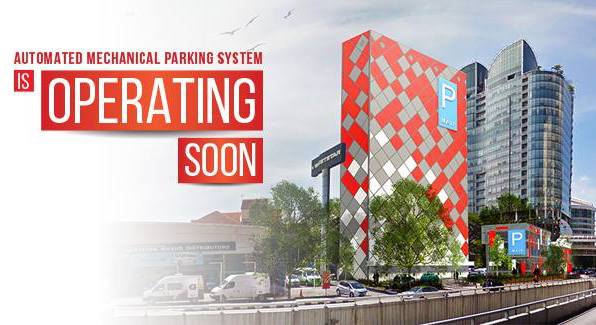
The heart of Kuala Lumpur is set to receive a premier parking tower on Jalan Tun Razak soon, aimed at solving the perennial shortage of parking spaces in the city centre. The Mechanical Automated Parking System (MAPS) towers will be able to meet the needs of consumers with the diversity of services offered, said M.A Intelligent Parking (MAIP) chief executive officer Datuk Seri Dr Muhammad Isa Kasim.
The multi-storey car park uses an integrated multi-level parking system from Japan, and includes valet services, as well as provision for seasonal parking and premier parking. The multi-level parking system consists of an array of hoists which allows parked cars to be stacked one atop another, thereby populating the car park vertically in a more space-efficient manner.
When the parking tower opens to the public within two months, parking rates start from RM13 per entry, and RM2 for each subsequent hour. The parking tower has 199 parking bays and operates 24 hours. Efficiency of space is an advantage of the parking tower, as this particular building takes up just one acre of land, Isa said.
“We will use our expertise, as well as our counterpart in Japan to implement the system all over the country. The project revolves around places like hospitals and shopping malls where parking is in demand,” he added, saying his company has already started similar multi-level parking building projects in Kedah, Perlis, Pahang and Terengganu. According to Bernama, MAIP aims to build 20 MAPS in the country next year, at an investment of RM1.8 billion.

 engdau
on
engdau
on 

 john
on
john
on  Mike Sim
on
Mike Sim
on  Rightwinger
on
Rightwinger
on  Camtakpro
on
Camtakpro
on  Money Come
on
Money Come
on  john
on
john
on  Autobahn
on
Autobahn
on  Roland
on
Roland
on  peja508
on
peja508
on  Nasser
on
Nasser
on  Hamdan
on
Hamdan
on  Ghaffar
on
Ghaffar
on  Salleh
on
Salleh
on  Shanmuga
on
Shanmuga
on  Ismail
on
Ismail
on  Lim See Ong
on
Lim See Ong
on  Gibrain
on
Gibrain
on  Harun
on
Harun
on  tiadaid (Member)
on
tiadaid (Member)
on  Joey zuriani
on
Joey zuriani
on  Md Rashidee
on
Md Rashidee
on  Steven Chia
on
Steven Chia
on  ali
on
ali
on  Malaysia Got Free Parking
on
Malaysia Got Free Parking
on  lima minit je tuan
on
lima minit je tuan
on  balldisc
on
balldisc
on  KT
on
KT
on  loler
on
loler
on  12yrsold
on
12yrsold
on  Gary
on
Gary
on  Film asspert
on
Film asspert
on  hai
on
hai
on  james
on
james
on  huh?
on
huh?
on  camtakpro
on
camtakpro
on  Rizal
on
Rizal
on  NAP
on
NAP
on  longjaafar
on
longjaafar
on  Imma park in tha middle road
on
Imma park in tha middle road
on  lilytan
on
lilytan
on  Medic
on
Medic
on  pengayuhbasikal
on
pengayuhbasikal
on  Eternalgl0ry
on
Eternalgl0ry
on  chewke
on
chewke
on  Dollah
on
Dollah
on  LOL
on
LOL
on  great but mahal
on
great but mahal
on  C. P. MOHAN
on
C. P. MOHAN
on  piupiu
on
piupiu
on  Lcians
on
Lcians
on  JessieCCY
on
JessieCCY
on  Rawreng
on
Rawreng
on  chia sun meng
on
chia sun meng
on
AI-generated Summary ✨
Comments show mixed reactions to the Mechanical Automated Parking System in KL, with some praising its potential for freeing up parking space and reducing congestion, while others criticize the high costs, parking rates, and location. Several commenters express frustration over the expensive fees, perceived lack of affordability for the average Malaysian, and poor planning compared to international standards. There’s also concern about political and economic implications, along with a desire for better public transportation options to mitigate parking issues.