
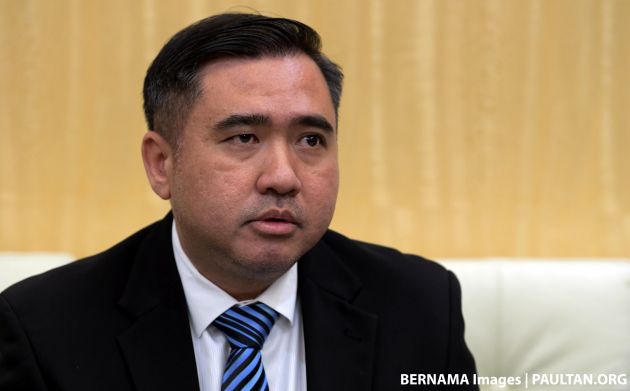
The transport ministry is looking at new ways to plug revenue leakages from road tax collection, transport minister Anthony Loke said, adding that the ministry is also holding discussions with the JPJ to ensure the mechanism selected would not burden the people, especially those living in rural areas.
“We will look at other initiatives as such the integration of customs information system with mySIKAP information system as well as amendments to tighten the laws to conduct enforcement and prosecution on vehicle owners who renew their road tax outside their registration areas,” he told the media, reported by Bernama.
Earlier this week, JPJ revealed that leakages in revenue collection from road tax renewal exceeded RM50 million from January to August this year, with more than 50% of the renewal transactions made in Sabah, Sarawak, Labuan and Langkawi involving vehicles registered and used outside of the states. Road tax is lower in those areas than in Peninsular Malaysia.
“While we are still studying the platform to renew road tax, such transactions could still be carried out as usual,” said Loke.
This is reiterating the earlier order from the ministry to review JPJ’s move to stop road tax renewals at post offices for vehicles with engine capacity of 2,000 cc and above at all post offices in Sabah, Sarawak, Langkawi and Labuan. The move caused some difficulty for East Malaysian vehicle owners, especially those living in rural areas with no nearby access to JPJ offices.

 panjang
on
panjang
on 

 Ikhwan Ramli
on
Ikhwan Ramli
on  redpilled
on
redpilled
on  sam123
on
sam123
on  Amran
on
Amran
on  rynn
on
rynn
on  mpowr
on
mpowr
on  The Truth Always Prevails
on
The Truth Always Prevails
on  Paul Tan
on
Paul Tan
on  Gary
on
Gary
on  Avenger
on
Avenger
on  Logical Deduction
on
Logical Deduction
on  ganniey
on
ganniey
on  msia driver
on
msia driver
on  Tom
on
Tom
on  choha
on
choha
on  Calvin
on
Calvin
on  kadazan warrior
on
kadazan warrior
on  Ghani
on
Ghani
on  Henry
on
Henry
on  Lolwhut?
on
Lolwhut?
on  panjang
on
panjang
on  Ah Chong
on
Ah Chong
on  st3wp1d
on
st3wp1d
on  Rosman
on
Rosman
on  Norlia
on
Norlia
on  Not Toyota Fan
on
Not Toyota Fan
on  Sumerah
on
Sumerah
on  Ben Yap
on
Ben Yap
on  Does He Care?
on
Does He Care?
on  Amran
on
Amran
on  kereta_lembu
on
kereta_lembu
on  Asmadi
on
Asmadi
on  puppy
on
puppy
on  Bod
on
Bod
on  jojo
on
jojo
on  J.Lee
on
J.Lee
on  Az
on
Az
on  Dain
on
Dain
on  Kuek vijin
on
Kuek vijin
on  vVivi Zurianti
on
vVivi Zurianti
on  Sohai
on
Sohai
on  Vedder
on
Vedder
on  stastasta
on
stastasta
on
AI-generated Summary ✨
Comments express frustration over the inconsistency of road tax rates across states, especially involving Sabah and Sarawak plates used by high-end vehicle owners to evade higher taxes. Many suggest standardizing road tax nationwide, linking it to vehicle value or emissions, and closing loopholes exploited by wealthy elites and AP holders. There's strong sentiment that corruption, lack of government action, and unequal taxation contribute to revenue loss, with some advocating for a fair, uniform system based on vehicle impact and ownership to reduce leakages.