
Toyota has sold ESG (environmental, social and governance)-labeled debt in dollar-denominated sums for the first time in two years as it aims to increase its production of electric vehicles and compete with American EV maker Tesla, Japan Times has reported.
The manufacturer has priced US$1.5 billion (RM6.8 billion) in sustainability bonds in three parts, the report cites a person with knowledge of the matter as saying. Book orders were said to be valued at over US$6 billion (RM27.4 billion) as of last Thursday, according to the source.
According to a Nikkei Asia report, the three parts of the sustainability bonds will be in three-year, five-year and 10-year terms, with yields of 5.275%, 5.118% and 5.123%, respectively; these bonds received an A1 credit rating from Moody’s Investors Service, the Nikkei Asia report added.
Toyota has issued its sustainability bonds under the Woven Planet Bond banner since 2021, the proceeds from which it plans to use to support environmental and social projects, in addition to the aforementioned development and production of electric vehicles.
In 2021, Toyota issued 430 billion yen (RM14.1 billion at today’s rate) in sustainability bonds, and this issuance was split between dollar- and yen-denominated notes.
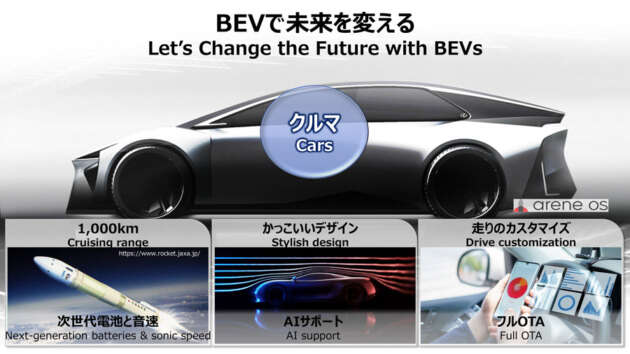
The Japanese manufacturer announced in May that it will establish BEV Factory, a new outfit dedicated to accelerating EV development and its businesses, the month before having pledged to debut 10 new EVs by 2026. Last month, it held the Toyota Technical Workshop, during which it announced a host of technologies that will support its transition into a mobility company.
 Toyota Yaris Cross
from RM99,900
Toyota Yaris Cross
from RM99,900  Toyota Hilux
from RM226,300
Toyota Hilux
from RM226,300  Toyota Urban Cruiser
from RM198,000
Toyota Urban Cruiser
from RM198,000  Toyota bZ4X
from RM220,000
Toyota bZ4X
from RM220,000  Toyota GR Yaris
from RM315,600
Toyota GR Yaris
from RM315,600  Toyota GR Corolla
from RM368,950
Toyota GR Corolla
from RM368,950  Toyota Camry
from RM221,800
Toyota Camry
from RM221,800  Toyota Corolla Cross
from RM133,800
Toyota Corolla Cross
from RM133,800  Toyota Alphard
from RM548,000
Toyota Alphard
from RM548,000 
too little, too slow, Toyota.
So what happened to the revolutionary hydrogen engine that claimed to be the real efficient and sustainable vehicle than EV? Why change strategy again to join thr bandwagon? Shouldn’t Toyota focus what is deemed right for changing the market as previously so ambitiously claimed? We are waiting for your revolutionary technology to shake the market!
This does not sound well for the company. A bit too slow to adapt… another Nokia in the making?