
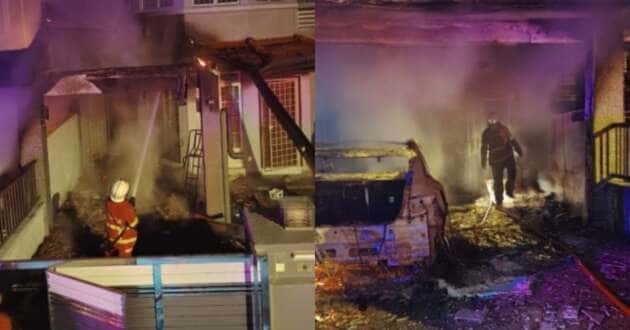
The fire and rescue department (Bomba) may introduce safety guidelines for electric vehicle (EV) charging at private homes, NST reports. This comes after an EV being charged was believed to have caused a fire that destroyed a two-storey terrace house in Alam Damai, Cheras on Sunday (August 16, 2026).
According to the department’s director-general, Datuk Seri Nor Hisham Mohammad, there were currently no specific guidelines governing EV charger installations at private homes, adding that current guidelines only focus on commercial premises. “We will raise this issue with the relevant authorities. For homes, we don’t have one yet. Our controls at the moment are for commercial premises,” he said.
Nor Hisham noted the investigation into the August 16 fire in Cheras is still ongoing and it has yet to be known if the EV was the cause. Witness accounts, including from the house owner, had led investigators to consider several possible causes involving the EV charging system. “These included the vehicle itself, its charging equipment or the electrical wiring connected to the charger. We cannot conclude yet. We have to wait for the investigation to be completed,” he said.
Over the past three years, about 25 fire cases involving four categories of EVs have been recorded. Nor Hisham said the number is relatively stable each year rather than showing a significant increase, although he acknowledged that the number of EVs on Malaysian roads was also growing and the department had yet to analyse fire incidents against the increase in the EV population.
Homeowners using EV chargers are advised to ensure the equipment complied with recognised safety standards, especially if the chargers were purchased separately rather than supplied as part of a vehicle package. “Particular attention should be paid to the size and suitability of electrical wiring as well as the miniature circuit breaker (MCB) system. This was important because EVs could be continuously charged for seven to eight hours, creating an electrical fire risk if the installation or wiring was unsuitable,” said Nor Hisham.

GB 38031-2025: Zero fire/explosion during thermal runaway.
GB 18384-2025: Mandatory physical one-touch high-voltage power-off switch.
Any plan for Malaysia to want to implement this standard?
As I always said, SOHAI only buy EV , BECAUSE cannot claim back your paid tax duty ~100% (sohai EV buyer get con by no tax, evidence shown actual is 2x double price in Malaysia compared origin country China price); now Sohai EV buyer even get your house burned without insurance cover beside paid 100% tax (China sell ~90k, Mesia sell ~180k)
Ko keje miti ke bang? Sampai kilat ko jilat jubo boss ko… Yg kaya boss ko je… Ko still pakai axia
AI said no financial sense
to drive EV in Malaysia
with cheap Budi95
So when an ICE catches fire you gonna ban all fuel station as well ? Best you just sit down, stay silent and watch your cartoon. Keep you opinion to yourself and Stop barking already.
Immediately bans all EQE on the road and prohibited there plugs into charger.
MITI must ban all EV including BYD, Tesla, Proton & Perodua to protek rakyat from getting burn alive in house
tabung kan otak kau
Nope, the next time a burn happens I’ll be sure to put you in that fire. You can choose the source of the fire, EV, ICE explosion or Hydrogen fuel cell explosion.
Lepas hangus baru mau buat guideline. Woi lu semua tidur ka. In any other sane place fire safety regulations would have been promulgated by the relevant bodies before sales and installation were allowed. But as usual…Malaysia boleh
the chances of a car crash and total lost is higher than an EV car catching fire. so no worries… life move on.
Not the first time a MB ev on fire in malaysia, I think this batch of MB eq vehicles have a problem
Most malaysian invested 20 years study + 20 years hard working + 30 years installments just for a house property. If this happened, your whole life efforts ruined in 1 night because of an EV.
the house is not totally gone, can still repair .