
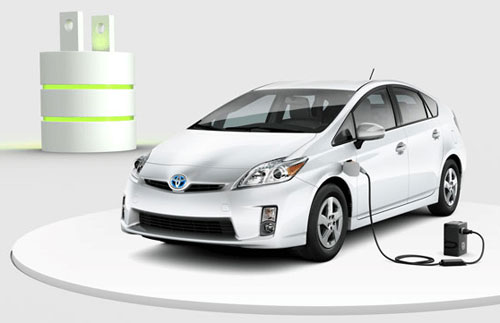
Toyota is finally ready to launch its Prius Plug-in Hybrid, which will make its debut in Frankfurt in production form. The user rechargeable Prius is Toyota’s first plug-in hybrid electric vehicle (PHEV) to go on sale, and also its first to use a lithium ion battery. In case you’re wondering, this is a Prius that you can plug in to your home’s wall socket to recharge, like a full EV and your mobile phone.
Calling it the “next major milestone in Toyota’s ongoing, 40 year quest for sustainable mobility and the ultimate eco car”, the Prius Plug-in Hybrid features the latest development of the company’s modular Hybrid Synergy Drive full hybrid platform, which has clocked some 200 billion kilometres of driving worldwide.
The new compact lithium-ion battery has been developed to “meet Toyota’s rigorous standards for reliability”. The Prius PHEV’s extended EV cruising range enables it to achieve remarkable fuel efficiency of just 2.2 l/100 km, while CO2 emissions drop to an unprecedented 49 g/km. Other than that, Toyota gives little away than to say that “affordability of its proven HSD technology will make it widely accessible.”
Looking to sell your car? Sell it with Carro.
 Toyota Yaris Cross
from RM 99,900
Toyota Yaris Cross
from RM 99,900  Toyota Hilux
from RM 226,300
Toyota Hilux
from RM 226,300  Toyota Urban Cruiser
from RM 198,000
Toyota Urban Cruiser
from RM 198,000  Toyota bZ4X
from RM 220,000
Toyota bZ4X
from RM 220,000  Toyota GR Yaris
from RM 315,600
Toyota GR Yaris
from RM 315,600  Toyota GR Corolla
from RM 368,950
Toyota GR Corolla
from RM 368,950  Toyota Camry
from RM 221,800
Toyota Camry
from RM 221,800  Toyota Corolla Cross
from RM 133,800
Toyota Corolla Cross
from RM 133,800  Toyota Hiace
from RM 169,000
Toyota Hiace
from RM 169,000 
 alldisc
on
alldisc
on 

 Expatriate VN
on
Expatriate VN
on  Mohd
on
Mohd
on  Critique
on
Critique
on  vw_fan
on
vw_fan
on  kelvin
on
kelvin
on  Wisdom
on
Wisdom
on  kington
on
kington
on  hanssen
on
hanssen
on  Dudu
on
Dudu
on  go saga
on
go saga
on  MsiaPriuslover
on
MsiaPriuslover
on  Citroen Zx
on
Citroen Zx
on  yippi33
on
yippi33
on  _xXx_
on
_xXx_
on  Carl Wong
on
Carl Wong
on  Chris
on
Chris
on  Ben
on
Ben
on  M0Faz
on
M0Faz
on  Jolo
on
Jolo
on  kingjoke
on
kingjoke
on  shin
on
shin
on  MsiaPriuslover
on
MsiaPriuslover
on  sukasuki
on
sukasuki
on  droll
on
droll
on  asdas
on
asdas
on  azt
on
azt
on  Mask Ryder
on
Mask Ryder
on  kelvin
on
kelvin
on  Traling Duck
on
Traling Duck
on  skiborne
on
skiborne
on  tkw60
on
tkw60
on  cheng
on
cheng
on 


AI-generated Summary ✨
Comments highlight the environmental benefits of hybrid and plug-in hybrid vehicles, emphasizing their efficiency and advancements like lighter lithium-ion batteries. Concerns raised include the sustainability of electricity generation, battery recycling, and the environmental impact of battery production and disposal. Some express skepticism about the true "greenness" and cost-effectiveness, while others praise Toyota's progress. Overall, opinions are a mix of support for technological progress and concern about full environmental implications.