
After a very soft month in September, in which car sales plunged following the end of the tax holiday, things expectedly picked up in October as a result of stocks being replenished. The reintroduction of the sales and services tax (SST) didn’t really blunt vehicle purchasing, especially with CKD prices being lower than – or identical to – that with GST.
Sales in October totalled 47,273 units, an increase of 11,032 units or 35% over the 31,241 units recorded in September. Year-on-year, October’s numbers were a shade ahead of that managed during the corresponding month in 2017, being 232 units or 0.5% higher.
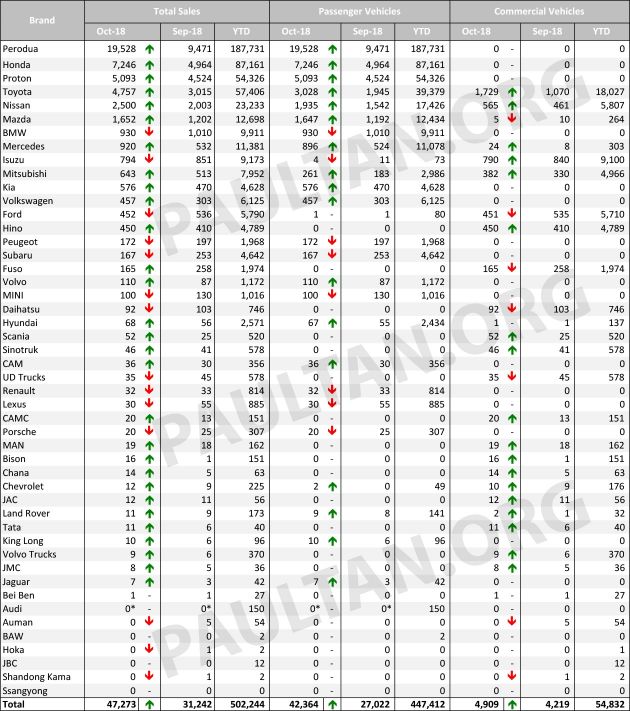
Here’s a quick breakdown of how most brands peformed in October. The swell in sales meant that there were plenty of gainers. Market leader Perodua topped that chart for the month, with a 106.2% increase. Second-placed Honda recorded a 46.0% increase, while third-placed Proton saw a relatively small 12.6% hike in sales for the month, with Toyota (+57.8%) and Nissan (+24.8%) rounding off things positively for the top five for the month.
Other gainers were Mazda (+37.4%) and Volkswagen (+50.8%), while brands that saw a drop included Ford (-15.7%), Peugeot (-12.7%) and Subaru (-34.0%).
In the premium segment, Mercedes saw a steep rise (+72.9%), but it ended just below BMW (-7.9%) for the month, while Volvo also had a positive October with a 26.4% gain. Elsewhere, things were not as rosy for MINI (-23.1%) and Lexus (-45.5%). Audi’s sales figures were not reported.
Click on the chart below to view a larger version.
Looking to sell your car? Sell it with Carro.

 John Minum Teh 8X
on
John Minum Teh 8X
on 

 john
on
john
on  5yrsold
on
5yrsold
on  Axxx
on
Axxx
on  Fullamark
on
Fullamark
on  Stop Innovating
on
Stop Innovating
on  John Minum Teh 8X Fake News
on
John Minum Teh 8X Fake News
on  Oh My Matematik !
on
Oh My Matematik !
on  IGP mom
on
IGP mom
on  Dylan Ch'ng
on
Dylan Ch'ng
on  M.K
on
M.K
on  kami
on
kami
on  First Gen Proton Saga
on
First Gen Proton Saga
on  JCK
on
JCK
on  Not Toyota Fan
on
Not Toyota Fan
on  sam123
on
sam123
on  hudoh
on
hudoh
on  John Minum Teh 8X Lingerie
on
John Minum Teh 8X Lingerie
on  newme
on
newme
on  yawnz
on
yawnz
on  Sam 'Ohwai' Loo
on
Sam 'Ohwai' Loo
on  conti lover
on
conti lover
on  Faiz
on
Faiz
on  Avatar
on
Avatar
on  DK
on
DK
on  Atoque
on
Atoque
on  Not getting better
on
Not getting better
on  kolos
on
kolos
on  Dude
on
Dude
on  panjang
on
panjang
on  john
on
john
on  dr.Ice
on
dr.Ice
on  Shaman
on
Shaman
on  MEIji
on
MEIji
on  Rush hour
on
Rush hour
on  John Minum Teh 8X
on
John Minum Teh 8X
on  Ultimate Rugal
on
Ultimate Rugal
on  Sharizal
on
Sharizal
on  Danny Ong
on
Danny Ong
on  Why no Projohn in the list?
on
Why no Projohn in the list?
on  M & M
on
M & M
on  old dog
on
old dog
on  Old horse
on
Old horse
on  Katak
on
Katak
on  camtakpro
on
camtakpro
on 


AI-generated Summary ✨
Comments predominantly discuss the car sales data, highlighting Perodua's leading sales, Proton's struggle to reach last year's figures, and declines in Toyota's market share. Several comments compare prices and resale values, often criticizing specific brands like Toyota and Honda. There is skepticism about certain manufacturers' performance and marketing approaches, with some humor and mockery towards brands like Audi and Toyota. Overall, sentiments reveal concern over declining sales and brand competitiveness in the Malaysian automotive market.