

At the Proton Chinese New Year media appreciation dinner today, CEO Li Chunrong shared a few updates regarding the national carmaker’s future plans. Notably, these included a surprising announcement concerning its homegrown models, reinforcing the notion that its lineup won’t be entirely replaced by Geely-based models.
Li confirmed that Proton will be setting up a new R&D centre in Hangzhou, China specifically for the development of its homegrown models, currently consisting of the Saga, Persona and Iriz. This presumably means that it will benefit from closer cooperation with Geely, which is also based in Hangzhou.
As yet, it’s unclear if the new models will be a development of the current cars or be based on Geely’s platforms – like the B-segment Modular Platform (BMA) that underpins the X50 and S70.
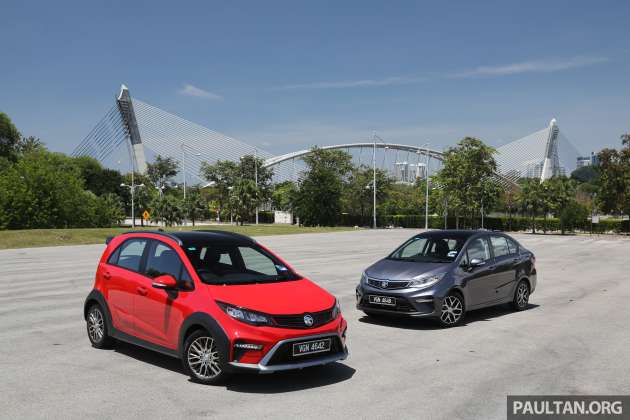
Whichever route Proton takes, we can safety assume these cars won’t simply be rebadged versions of existing Geely models and will have considerably greater local input. Also unclear is the timeline for the introduction of these new homegrown cars, which has been intentionally left open for debate.
It’s also been confirmed that Proton will be introducing a New Energy Vehicle (NEV, think hybrid or electric vehicle) based not on a Geely platform, but on the Saga/Persona/Iriz platform. This will likely be a mild hybrid model that uses the 1.5 litre turbocharged three-cylinder engine and 48-volt belt starter-generator (BSG) from the X90.
AD: Drive the Proton model of your dreams. Submit your details and Proton PJ will get in touch with you.
Looking to sell your car? Sell it with Carro.
 Proton X90
from RM 106,800
Proton X90
from RM 106,800  Proton S70
from RM 73,800
Proton S70
from RM 73,800  Proton eMas 7 PHEV
from RM 109,800
Proton eMas 7 PHEV
from RM 109,800  Proton X70
from RM 106,800
Proton X70
from RM 106,800  Proton Saga
from RM 38,990
Proton Saga
from RM 38,990  Proton eMas 5
from RM 59,800
Proton eMas 5
from RM 59,800  Proton X50
from RM 89,800
Proton X50
from RM 89,800  Proton eMas 7
from RM 103,800
Proton eMas 7
from RM 103,800  Proton Persona
from RM 47,800
Proton Persona
from RM 47,800 
 Peppa
on
Peppa
on 

 anton
on
anton
on  Celup King
on
Celup King
on  John Gagal
on
John Gagal
on  Alex
on
Alex
on  Daim-ler
on
Daim-ler
on  Raja Celup
on
Raja Celup
on  Anonymous
on
Anonymous
on  seitha
on
seitha
on  Hantu Raya
on
Hantu Raya
on  Anonymous2
on
Anonymous2
on  Mudahlupa Wuhan
on
Mudahlupa Wuhan
on  Jangan Lupa Endia sokong Yahudi
on
Jangan Lupa Endia sokong Yahudi
on  Frankc
on
Frankc
on  John Doe
on
John Doe
on  Where is john and tokmoh
on
Where is john and tokmoh
on  Albert Yong
on
Albert Yong
on  Bob Mal
on
Bob Mal
on  opmanmy
on
opmanmy
on  jebon
on
jebon
on  Bigboytoy
on
Bigboytoy
on  WC Ong
on
WC Ong
on  Fadzli
on
Fadzli
on  Ben Yap
on
Ben Yap
on  aaaaa
on
aaaaa
on  albag
on
albag
on  mechanicnextdoor
on
mechanicnextdoor
on  @NotBruceWayne
on
@NotBruceWayne
on  AkooIm
on
AkooIm
on  Betrayed by Bass Tak Malu
on
Betrayed by Bass Tak Malu
on  Just Admit IT
on
Just Admit IT
on  Veneno
on
Veneno
on  4GR-FSE
on
4GR-FSE
on  adv driver disturbance sys 3.0
on
adv driver disturbance sys 3.0
on  hazri
on
hazri
on  Robins
on
Robins
on  P owner
on
P owner
on  random guy
on
random guy
on  Improve ur english
on
Improve ur english
on  Robins
on
Robins
on  Da Vinci
on
Da Vinci
on  Fake national car
on
Fake national car
on  Lol
on
Lol
on  Tak kisah
on
Tak kisah
on  Kalbu
on
Kalbu
on  Syaiful Nizam Hassan
on
Syaiful Nizam Hassan
on 


AI-generated Summary ✨
Comments suggest skepticism about Proton's R&D moving to China, fearing loss of Malaysian innovation and local originality. Many emphasize that current Proton models like Saga, Persona, and Iriz still involve Malaysian engineers and R&D, but some believe the shift to Geely's platforms indicates reduced local development. There's frustration over Proton's perceived decline from a national icon, with some advocating for stronger local R&D and protectionist policies. Overall, feelings are mixed, leaning towards disappointment and concern over national identity and quality control.