
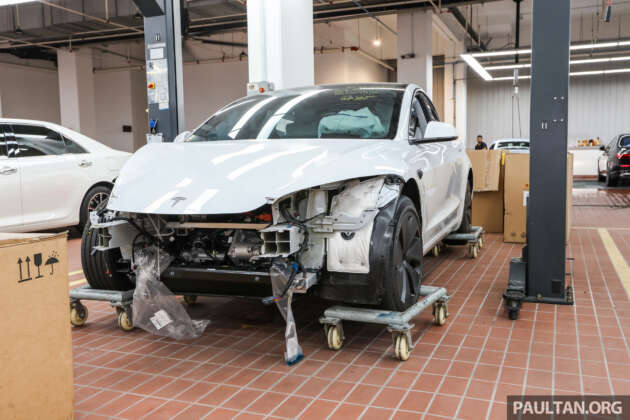
The General Insurance Association of Malaysia (PIAM) has found that accident damage on electric vehicles can be a lot more complex and expensive to repair, the New Straits Times reported. In fact, depending on the location of the damage, the cars may have to be written off.
“When there’s an accident in the wrong area of the car, sometimes the vehicle can’t be repaired at all,” said CEO Chua Kim Soon at a media briefing on the industry’s 2025 first-half performance yesterday.
The organisation has studied data from more mature EV markets such as China to see how these vehicles would fare over time. It concluded that as EVs age, driving habits change, depreciation accelerates and repairs become more costly.
From their falling resale values to the way they are repaired, EVs are fundamentally different from regular combustion-powered vehicles, Chua said. This presents a unique risk profile that insurers must adapt to, as steep depreciation complicate insurance claims for ever-costlier repairs.
The findings reflect the challenges insurers face as EV adoption accelerates. Sales of battery-powered vehicles, driven by tax incentives, soared 91.4% in the first half of the year, making up 3.4% of all new car sales in Malaysia.

And while those incentives will expire at the end of the year for CBU EVs, those for CKD locally-assembled ones are set to continue until 2027, with most popular brands already committing to building their cars here. Chua said that the rising popularity of EVs is great for sustainability but highlights the urgent need for insurers to adapt to new risks and the operational realities of insuring these cars.
One of those realities is the need to build competency in EV repair, especially for the batteries that make up the vast majority of an electric car’s cost. “We need to build a whole ecosystem of battery repair networks in Malaysia and at the moment, it’s still not mature,” Chua said.
In response, PIAM is collaborating with the road transport department (JPJ) on standards and compliance requirements for EV workshops, which require specialised skills and strict safety protocols. “You actually need electrical engineers to fix these cars,” Chua said. “A normal mechanic can’t do it and it’s dangerous if done incorrectly. So this entire ecosystem has to be built up properly.”
Malaysian EV owners are currently cushioned from higher insurance premiums as they are still somewhat regulated by the government, given that the country is in a phased liberation stage for motor insurance. However, this does not reflect what is happening in more mature and open markets, where EV insurance costs are significantly higher due to greater risks and expenses associated with repairs and parts replacement, said Chua.
“That hasn’t happened here yet, and we’re trying to manage it so we don’t have to raise premiums. But if you look at other markets, that’s the reality.”
Looking to sell your car? Sell it with Carro.

if EV cannot repair after accident then why bother paying insurance at all ? just follow the example led by VVIPs and stop buying insurance.
And give excuse I drive short distance only ma as long as I have driving license OK lah kan others belakang table kira.
btulx3 as we know EV can only charge up to 80% to protect battery health and if we exceed highway speeds the range will cut in half so real world range is only less than 200km.
ahem…
3rd party liablity.
I was this close to jumping into a Tesla Model 3, and this article slammed on my brake pedal. What if next year I need to pay 3x higher insurance premium?
rollsroyce and rangerover owners dont pay insurance. why should you?
lol don’t buy insurance then total loss you continue paying the loan with no car? What logic!
This article is not correctly reporting the facts, it may be true for one EV brand but not the others. It is a paid propaganda by some interested party.
It’s okay. EV owners are all rich, can afford to be guinea pigs.
emas7 and dolphin owners looking at you in confusion
Everyone know it. And insurance premium is higher for EV. Most just doesn’t want to talk about it because They want join the trend to push for EV.
Thats why EVs are scams, the disposability of them negates the ‘environmentally clean’ BS we are fed to
In china, the country with mostly EV for new registration for the past few years , the insurance cost of EV is higher than han ICE, because of the newer technology and less common part. But why insurance company in Malaysia didn’t use the data from China when they offer car insurance to EV.
malaysian cant use china data because most of civil servants and gomen politician dont read mandarin because didnt attend srjkc
Use chatgpt lorrrr
Insurance premium is generally higher for EV everywhere, not just china. And it’s because EV are prone to total loss more than ICE car and not due to new tech.
there is a myth about ev saying that if you langgar until airbag deploy, the car will be considered as total loss because no workshops dare to store the car scared night suddenly battery catch fire, and no workshops have the expertise to confirm that the battery is 100% safe for use after the exterior of the car is successfully repaired.
There are numerous cases where brand new EV catching fire in middle kingdom. This year alone the EV fire in Morning Midas ship sank, bringing down more than 3000 cars with it.
Malaysia car insurance is a scam anyway. Time to follow the lead of other countries and make it more transparent
similar to smartphone concepts, if it’s water or drop damaged consider as total loss, previous we have insurance coverage for smartphone, for ev car accidents no where to be repaired as it need well trained engineers to do it. Waste of time also, and how long does it take to get it done
Always fun reading views from people anti ev. I drive a Merc now and my next car will confirm be an EV.
2nd hand ev. I’ve never bought a new car
Because of if the ignorant uninformed anti ev who can’t understand data and information, the used car value will keep being low so it’s good for me that they never learn hehe
Ev can be repair..but the way you repair are different
In Pakistan everything can be repair..even ironman