
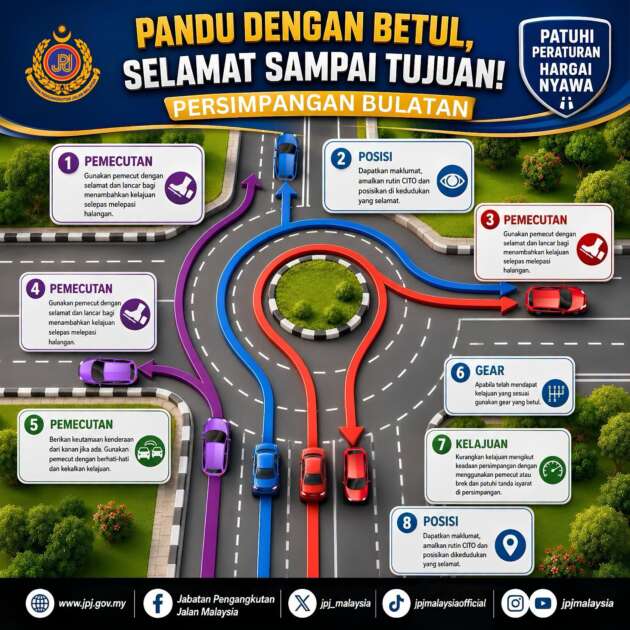
The fact that the road transport department (JPJ) feels the need to remind motorists how to correctly use a roundabout speaks volumes about Malaysian drivers (and our driving schools) in general. We may not have as many of these as countries like the UK do, but I will admit this is something I feel quite strongly about, because I live near a roundabout and encounter clueless roundabout users almost daily.
First and foremost – and this is the number one rule – vehicles already in the roundabout always have the right of way. This means that as you approach the roundabout, you must give way to vehicles coming from the right.
Even if you want to take the 9 o’clock/left/first exit (this appears to be a common mistake in Malaysia), you do not have the right of way and cannot just power through blindly (unless there’s a dedicated left-turn slip road bypassing the roundabout, which obviously means you’re not entering the roundabout at all). You must first slow down upon entry, indicate left and check for oncoming vehicles. If there are any, let them go first.
For the 12 o’clock/straight ahead/second exit, on a three-lane roundabout as depicted above, you may use either the left or middle lanes. On a two-lane roundabout as pictured below, you may use either lane, but using the left lane is safer because it helps avoid clashing with any vehicles in the outer-most lane of the roundabout when it’s time to exit.
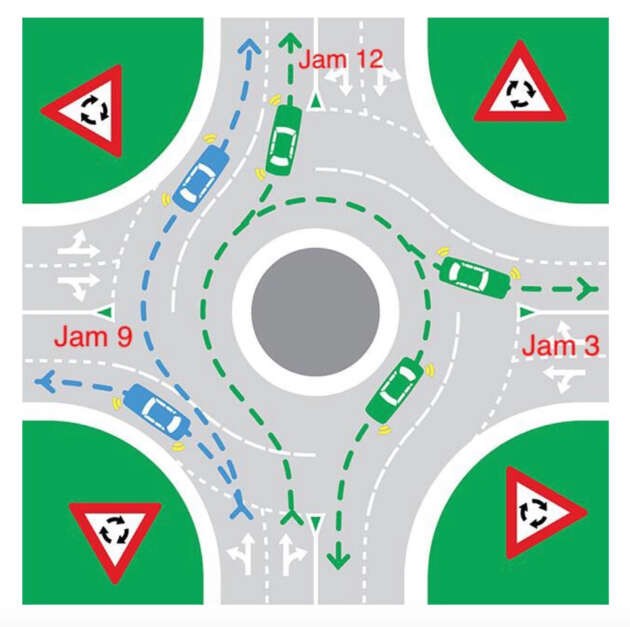
You do not need to indicate upon entry (because you’re going straight ahead), but once you have passed the 9 o’clock/left/first exit, check your mirrors and indicate left before you exit.
For the 3 o’clock/right/third exit or the 6 o’clock/U-turn/fourth exit, use only the right-most lane, regardless of whether it’s a two- or three-lane roundabout. You will be cutting across lanes to enter the inner-most lane of the roundabout, so exercise care. Once you have passed the 12 o’clock/straight ahead/second exit (or the 3 o’clock/right/third exit if you’re doing a U-turn), check your mirrors and indicate left before you exit.
It is good practice to get into the outer-most lane of the roundabout once you have passed one (1) exit before the one you want to take (just like how you get into the left-most lane before your highway exit). Doing this not only makes you more visible to vehicles waiting to enter the roundabout but avoids you having to abruptly cut across lanes to exit. This would also mean that you leave the roundabout on the left-most lane.
Now that you’ve read all this, can you tell who’s at fault in the video below? And how would you navigate a roundabout shaped like this?
budak budak tiktok ramai yang taktau rules roundabout. pic.twitter.com/zprOBNb9m4
— doosik (@sakaramona) September 20, 2023

Great…everyone please learn this, or else more and more roundabout will change into traffic lights to control the dumbs, indirectly slow down traffic causing traffic jam.
Read the comments, you can identify certain drivers still think it’s pointless to do so. Can’t argue with stupid.
East Malaysians doesn’t need this
In the first pic with 3 colors, it seems the red car have to cut across 2 lanes to get into the most inner lane and he have to do it before the west exit. Now imagine it’s busy roundabout, this will cause honking by other cars that are already in the roundabout or entering from the north/east entrance. this will also slow traffic down just to let the red car go to the most inner lane. if not the red car will have to wait forever until all 3 lanes are clear before he can enter. For a smooth flow of traffic, it is better for a car to merge into existing traffic almost parallelly & at the same speed of the existing traffic, not abruptly 90 degrees like the red or blue car.
the picture only shows cars entering from one entry(south) only, now superimpose the same rules for all entry points(west/north/east) and you will see a lot of intersecting lines which will cause chaos.
the red, should slowly merge to the 2nd in the roundabout. like you say, ini mcm will just cause lane 1/2 to stop for lane 3 to cross over, because other sections of the roundabout also have cars coming into the roundabout
If the red car slowly merge from the outer most lane to the inner most lane to follow the rules of the picture, then by the time he gets the the inner most lane he would not have time to merge out back out 3 lanes to his exit as he will already be at the south exit location(or at 4 or 5 o’clock) by then, or he already missed his exit as he spends too much time merging to the inner most lane in the first place. Even if the red car still have enough time to merge back out to his exit, I feel it’s a waste of time where the red car spends so much effort just to stay in the inner most lane for a few seconds only.
This creates a dangerous and highly inefficient “weaving” maneuver where the driver spends 100% of their time inside the roundabout frantically changing lanes, creating blind-spot conflicts for every other car around them.
I think it is better for the red car to remain in the outer most lane or the middle lane until his exit.
Some idiot stop at smaller roundabout to give way …
Is JPJ seriously proposing that drivers exit from the innermost lanes, instead of gradually moving from the innermost lane, to the middle lane and finally exiting safely without cutting across 3 lanes in one go?
Can Paultan please clarify what the actual traffic rules are? Personally, I have been using roundabouts by making gradual changes instead of abruptly exiting…but maybe I’ve been wrong? It just seems more sensible.
JPJ is right… as you make the 3o’clock turn from the innermost lane, you shud be exiting at the most outer right lane not left (or middle if it’s 3 lanes).
You shud only have one or no car to worry if you’re make that 3 o’clock turn coz the one car will take the left most lane.
PS: If a car from the 9 or 12 o’clock lane decided to shoot out instead of waiting for their turn, rules of defensive driving is let them past b4 exiting. If you think you’re faster or balls/boobs of steel, you take the exit faster than those car could cut or block you.
Malu JPJ, buat Ai photo salah arah pulah, the blue and red car are obviously terbalik, the headlight should be in front, not at the back. No one check ke?
Look closely, thats the rear end, not the front. Take note of the side mirrors.
In Sarawak, we have to go roundabout in driving test, that’s is how to pass our test besides parking, up hill and signal.
peninsular also had roundabout during test exam, but that was 20 years ago when i took it. not sure about now .
Need built a big big signboard & station at every roundabouts to educate nowadays drivers …
or is it nowadays driving school didn’t teach how to take roundabout is it?
Malaysia drivers really need to learn this, there are a lot of drivers on most left lane try to take 3rd exit, or even 6 o’clock exit. On top of it, cars in the queue to go in roundabout should always give way to cars in the roundabout 1st.