
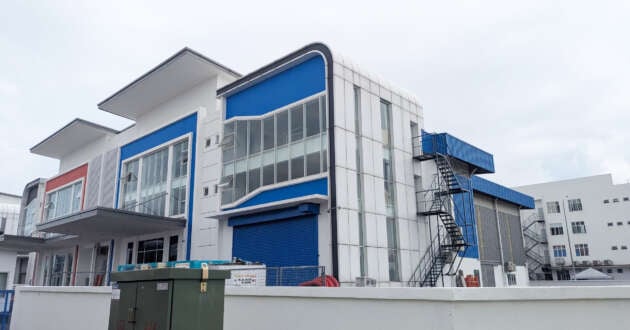
In July this year, it was reported that NanoMalaysia Berhad (NMB) would begin small-scale production of homegrown graphene-enhanced lithium-ion batteries for use in electric vehicles (EVs). This will be carried out by its subsidiary, Gigafactory Malaysia Sdn Bhd (GMSB), at factory spanning 15,000 square feet in Suria Industrial Park in Sepang.
The company has now provided more details of its EV battery business following a tour of its Sepang facility that took place on the final day of the fourth ASEAN Battery Technology Conference (ABTC) running from August 19-21.
In a FAQ released to us, NMB said GMSB, which was established in 2022, is not merely assembling or rebadging imported batteries. Instead, the graphene-enhanced lithium-ion battery technology, including intellectual property, materials development, cell engineering, product development and manufacturing know-how, is the result of long development pathway that began with the National Graphene Action Plan 2020 (NGAP 2020) launched in 2014.
This is a strategic initiative launched by the government via NMB (an agency under the ministry of science, technology and innovation (MOSTI) that aimed to make Malaysia a global graphene innovation hub.

Next came the NanoMalaysia Energy Storage Technology Initiative (NESTI) launched in 2021 to develop and commercialise advanced energy storage systems. The NESTI programme saw the development of graphene-based lithium-ion pouch cells, water-based aluminium-ion batteries as well as sodium-ion alternatives, with the Hydrogen Electric Vehicle Battery Centre (HEBATT) serving as a dedicated R&D and fabrication hub.
In addition to the technologies mentioned, NMB also has solid-state, metal-organic framework and redox flow batteries in its pipeline. Today though, the past efforts are culminating in production of graphene-enhanced lithium-ion batteries.
As part of this initiative, GMSB is working with Khon Kaen University (KKU) in Thailand, which provides manufacturing support. Another regional partnership is with Indonesia’s National Battery Research Institute (NBRI) that saw the launch of Bateri Nusantara that combines GMSB’s downstream battery technology and manufacturing capabilities with NBRI’s expertise in battery materials.
Starting at a smaller scale, GMSB’s initial production capacity at the Sepang facility is approximately 1 MWh, or about 92,000 battery cells, per year. The company says its initial focus will be on electric two-wheelers (motorcycles) and based on indicative 5 kWh battery pack, its annual output would be enough for approximately 200 electric two-wheeler battery packs. This is part of an initial commercialisation phase that will also see an exploration into portable energy devices.

Given the company’s name, 1 MWh annually is a bit of an irony but the company says this is merely a starting point as part of a RM20 million cumulative investment. With increased customer demand, commercial commitments, strategic partnerships and further investments for improved manufacturing capacity, GWh-scale annual production is the target scale the company has in mind.
Initial production in 2026 is expected to serve primarily domestic demand under a build-to-order model, with overseas shipment likely to commence in 2027. On the matter of demand, GMSB says it has secured an order for 25 kWh of battery capacity from an undisclosed local organisation.
The graphene-enhanced lithium-ion batteries use a nickel manganese cobalt (NMC) chemistry instead of lithium iron phosphate (LFP), with the company explaining that the former “continues to offer advantages in energy density for applications where battery weight, space, range and power performance are important considerations.”
Graphene is incorporated into both electrodes to enhance the performance characteristics of the established NMC chemistry while maintaining commercial manufacturability and scalability. While this technology is the immediate priority for now, the company says it is evaluating other chemistries as well.

Based on internal testing, the graphene-enhanced NMC batteries have managed to exceed 1,000 charge-discharge cycles while retaining over 90% of their original capacity. The company notes it is progressing towards independent third-party testing and verification as part of the next phase of product validation, which will also cover battery safety.
The raw materials are sourced from domestic and international suppliers, with the company looking into making its supply chain more robust as demand builds. A strategic cooperation with nickel-rich Indonesia is being touted along with NMB’s nickel phytomining research in Sabah, local production of graphene and graphite as well as end-of-life battery recycling for a circular economy approach.
On the broader EV ecosystem, NMB is developing local capabilities in EV components, energy storage, charging systems and ICE-to-EV conversion through its Enabling Mobility Electrification for Green Economy (EMERGE) and Rapid Electric Vehicle Innovations Validation Ecosystem (REVIVE) initiatives.

ccp copies everything , now they even copied the name “gigafactory” from tesla, elon should sue them for copyright infringmenet. oops sorry i got confused.
Semua cina made? Ini u cal gigafactory? Macam badminton court
Gigafactory is a dumb name and these guys adopted it. Elon’s level of exaggeration and overpromise-underdeliver puts the entire Indian subcontinent to shame, and these people want to scam others to associate them with Elon, of all things.
Jaguh kampong
Sounds good progress. Just like the last time that bullcrap water hydrogen engine car project to reduce oil dependence. Whatever happen to it LOL!!!
Sarawak champion of hydrogen also laosai
Looking at ANOTHER … “Pipe Dream” of a venture with FUNDING from RAKYAT. Graphene is not an EASY Material to Make. Ask the Chinese with BILLIONS of YUAN and Hundreds of THOUSANDS of Scientist ( Universities, Lab, Private sector, etc ). …..
If finding a genuine name for the company also that difficult, what other dumps are U want to talk about.