
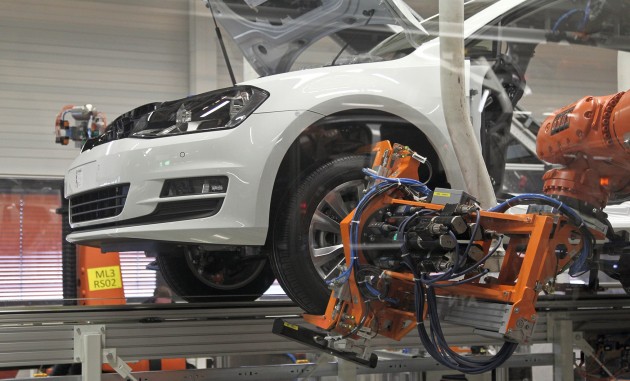
Volkswagen has finally received the go-ahead from Thailand’s government to build a manufacturing plant near Bangkok, Reuters reports. A VW spokesperson has told the news agency that the carmaker will now assess the situation, and that no firm decision has been made yet on whether to build the factory.
Previous reports indicate that the one-billion euro (RM4.1 billion) plant could produce up to 300,000 vehicles a year at full capacity, and will build 1.4 litre petrol engined cars. If the latter is true, then the investment may not fall under the Eco Car Phase 2 programme as previously speculated, because the scheme requires (for petrol) engines displacing 1.3 litres and under.
But the German carmaker has wanted to do this for the longest time – we reported its intention as early as 2008, before it applied to set up a Thai plant early last year.
Volkswagen already produces its Passat, Polo and Jetta models in Malaysia in conjunction with DRB-Hicom, while a new plant in Indonesia will take advantage of growing demand there.
 Volkswagen Tayron
from RM190,660
Volkswagen Tayron
from RM190,660  Volkswagen Golf R
from RM338,812
Volkswagen Golf R
from RM338,812  Volkswagen Golf
from RM185,990
Volkswagen Golf
from RM185,990  Volkswagen Golf GTI
from RM244,012
Volkswagen Golf GTI
from RM244,012  Volkswagen Touareg
from RM384,972
Volkswagen Touareg
from RM384,972  Volkswagen Arteon
from RM291,012
Volkswagen Arteon
from RM291,012 
 Same L0rrrr
on
Same L0rrrr
on 

 kzm (Member)
on
kzm (Member)
on  MAI what are you doing?
on
MAI what are you doing?
on  drMpower
on
drMpower
on  alldisc
on
alldisc
on  Bising Apa KZM?
on
Bising Apa KZM?
on  Joey
on
Joey
on  TSI
on
TSI
on  Arell
on
Arell
on  TheAnonymous
on
TheAnonymous
on  mzma
on
mzma
on  nz
on
nz
on  OMG
on
OMG
on  Burong
on
Burong
on  Dandy
on
Dandy
on  VWsuperfans
on
VWsuperfans
on  muya
on
muya
on  semau mau bang kok
on
semau mau bang kok
on  Name
on
Name
on  John
on
John
on  Sankar
on
Sankar
on  Mohd
on
Mohd
on  KK
on
KK
on  car-fans
on
car-fans
on  wajib
on
wajib
on  C.P.MOHAN
on
C.P.MOHAN
on  Pasiu
on
Pasiu
on  No one must know
on
No one must know
on  kl fella
on
kl fella
on  Nexus
on
Nexus
on  longjaafar
on
longjaafar
on  iskhalifah (Member)
on
iskhalifah (Member)
on  BLT_Club
on
BLT_Club
on  sense
on
sense
on  BNCronyAreSux
on
BNCronyAreSux
on  Bkk Car Guy
on
Bkk Car Guy
on  Pla
on
Pla
on
AI-generated Summary ✨
Comments express mixed sentiments about VW's decision to establish a factory in Thailand, citing attractive tax schemes and cheaper labor costs as reasons. Some believe this move reflects Thailand’s stability and growth potential, while others criticize Malaysia's policies, especially the AP system and high costs, for driving investment away. Several comments lament the loss of jobs, foreign investment, and manufacturing opportunities in Malaysia, blaming government policies and Proton’s protection for the decline, with some suggesting Proton remains Malaysia’s best option.