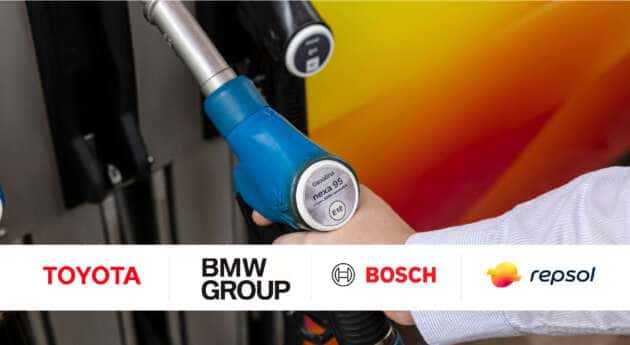
BMW has partnered with Toyota, Bosch and Repsol for a six-month pilot project to demonstrate how existing vehicles can operate exclusively on 100% renewable petrol under rear-world conditions.
The pilot, which started in July in Spain, serves to show the potential of vehicles running exclusively on eligible fuels (VEEF), which refers to renewable and low-carbon fuels that comply with sustainability criteria under the European Union’s (EU) Renewable Energy Directive (RED) and deliver significant greenhouse gas emissions reductions on a well-to-wheel basis compared to traditional fossil fuels.
Through the partnership, around 20 Toyota and BMW vehicles will run on Nexa 95, Repsol’s 100% renewable petrol, with Bosch providing support in the form of advanced digital fuel tracking technology. The H12 Concept engine from Horse Powertrain (a Geely-Renault joint venture) also runs on Repsol’s 100% renewable fuel.
“Technology openness is a key pillar of the BMW Group strategy – at the same time our goal is always to have more environmentally friendly and efficient vehicles on the road. Our vehicles as a part of this future oriented pilot, will help to gain valuable data helping us to offer our global customer the best and most efficient powertrain also in the future.” commented Stefan Heller, head of development of the VEEF programme at BMW Group.
In its release, BMW pointed out that Repsol is currently the only provider of 100% renewable petrol at public fuel stations in Spain. It also said Bosch’s ‘Digital Fuel Twin’ system will be used to bring transparency to the entire fuel value chain by reliably tracking and verifying renewable fuels from the moment they enter the market right down to the end consumer. Renewable petrol is different from synthetic petrol, with the former being manufactured from organic waste such as used cooking oils, agricultural and forestry residues as well as other sustainable biomass.
“With EU policy currently focused predominantly on electrification, the project aims to demonstrate that renewable fuels can play a complementary and scalable role in reducing CO2 emissions, the company said.
“We believe renewable fuels can play a key role alongside electrification in reducing CO2 emissions. As the transition progresses, it is becoming clear that there is a growing risk that 100% zero-emission vehicles by 2035 may not be fully achieved,” said Pascal Ruch, vice president corporate and governmental affairs at Toyota Motor Europe.
“In such a scenario, renewable fuels can help bridge the gap to deliver carbon neutrality, especially when combined with hybrid and plug-in hybrid technologies. This pilot aims to demonstrate how renewable fuels can make a meaningful and sustainable contribution to decarbonisation today, for both new and existing vehicles,” he added.
Looking to sell your car? Sell it with Carro.
 BMW iX1 L
from RM 252,800
BMW iX1 L
from RM 252,800  BMW iX
from RM 425,800
BMW iX
from RM 425,800  BMW X3
from RM 325,800
BMW X3
from RM 325,800  BMW M5
from RM 1,188,800
BMW M5
from RM 1,188,800  BMW M4 Coupe
from RM 878,800
BMW M4 Coupe
from RM 878,800  BMW 2 Series Gran Coupe
from RM 218,800
BMW 2 Series Gran Coupe
from RM 218,800  BMW 3 Series
from RM 265,800
BMW 3 Series
from RM 265,800  BMW 3 Series M
from RM 388,800
BMW 3 Series M
from RM 388,800  BMW i4
from RM 294,800
BMW i4
from RM 294,800