
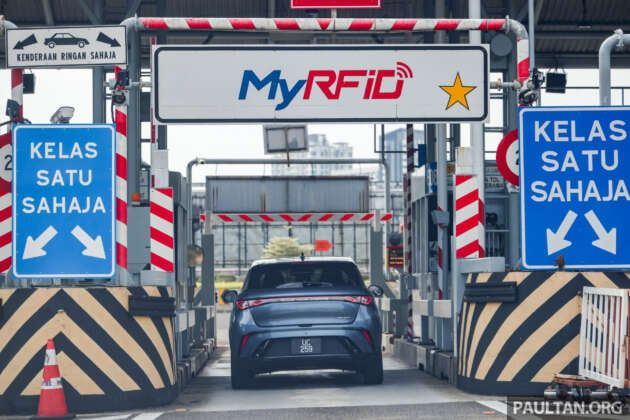
It’s a scene familiar to most motorists, slow moving queues at toll plazas from having to tap a card for gantry access or lane sangkut, because someone is having an issue with payment. The eventual move to a multi-lane fast flow (MLFF) toll collection system aims to change that, and while it doesn’t mean that motorists will not face traffic subsequently, it will at least ensure that no one is stuck managing the required toll payment.
No decision has yet been made on a system for this, and with highway concessionaires now having the ability to shop around for a solution, it looks like it will boil down to which of the competing systems being trialled works best for them, both from a cost and operational perspective.
Touch ‘n Go is one of the providers looking for its solution to be picked up by concessionaires. The company says its Enhanced RFID Lane toll fare collection system provides the perfect first-step solution towards a MLFF without gantry barriers and one day in the future, no toll plazas.
It has been running a proof of concept example of this for around a year now, on a gantry at Alam Impian along the Kemuning-Shah Alam Highway (LKSA). The pilot system retains the use of RFID tags the company currently utilises, but newer and more modern equipment enables the reading of tags to be done more accurately and reliably.
Now, the project has introduced a second, newer, pilot on the Ampang-Kuala Lumpur Elevated Highway (AKLEH). Operational for a few months now, it has the same elements of the LKSA POC, minus one component. The company says the system allows for a freer, smoother flow of traffic out of toll plazas and represents a significant step in the journey towards a full MLFF format. Does it live up to the promise? We’ve tried it out, and here’s what we found.
Ensuring improved read, each and every time
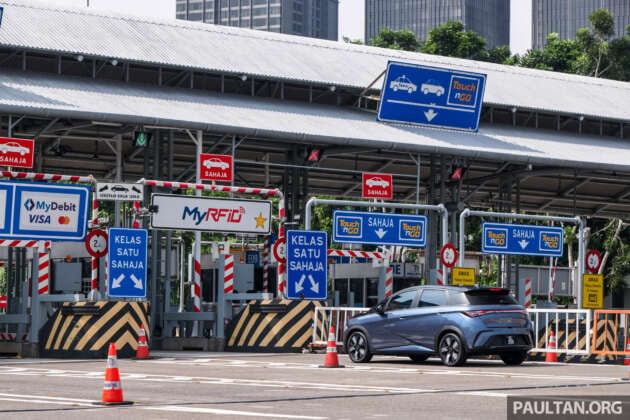
In general, the current system for RFID hasn’t been very consistent – sometimes, read times can be fast, but there are many instances where it has been slow, so usually most people crawl down almost to a stop to make sure it works. Because of that, you’ll often see long queues at RFID lanes.
The Enhanced RFID Lane solves the issue by detecting RFID chips quicker, and with more accuracy, so drivers don’t have to slow down as much, translating to a faster flow of cars through the toll plaza. According to TnG data, the Enhanced RFID Lane saw a usage uplift of over 30% every hour compared to a conventional RFID one.
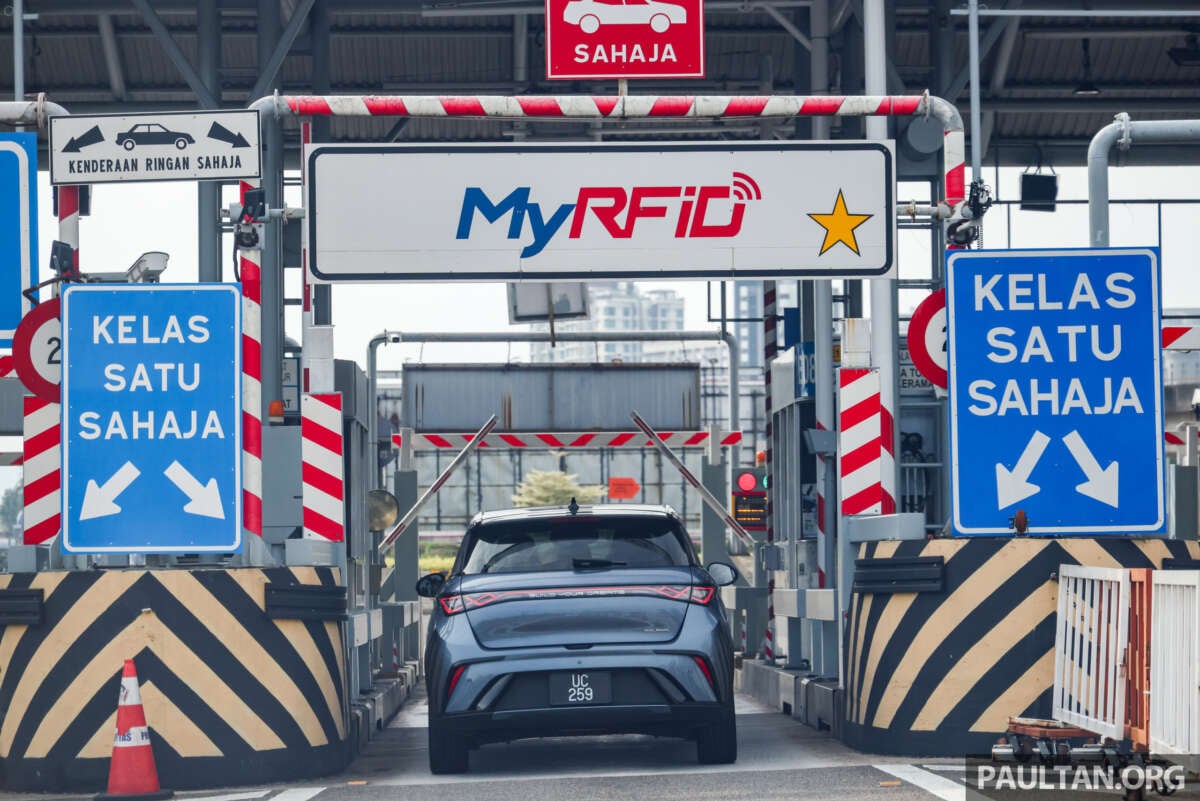
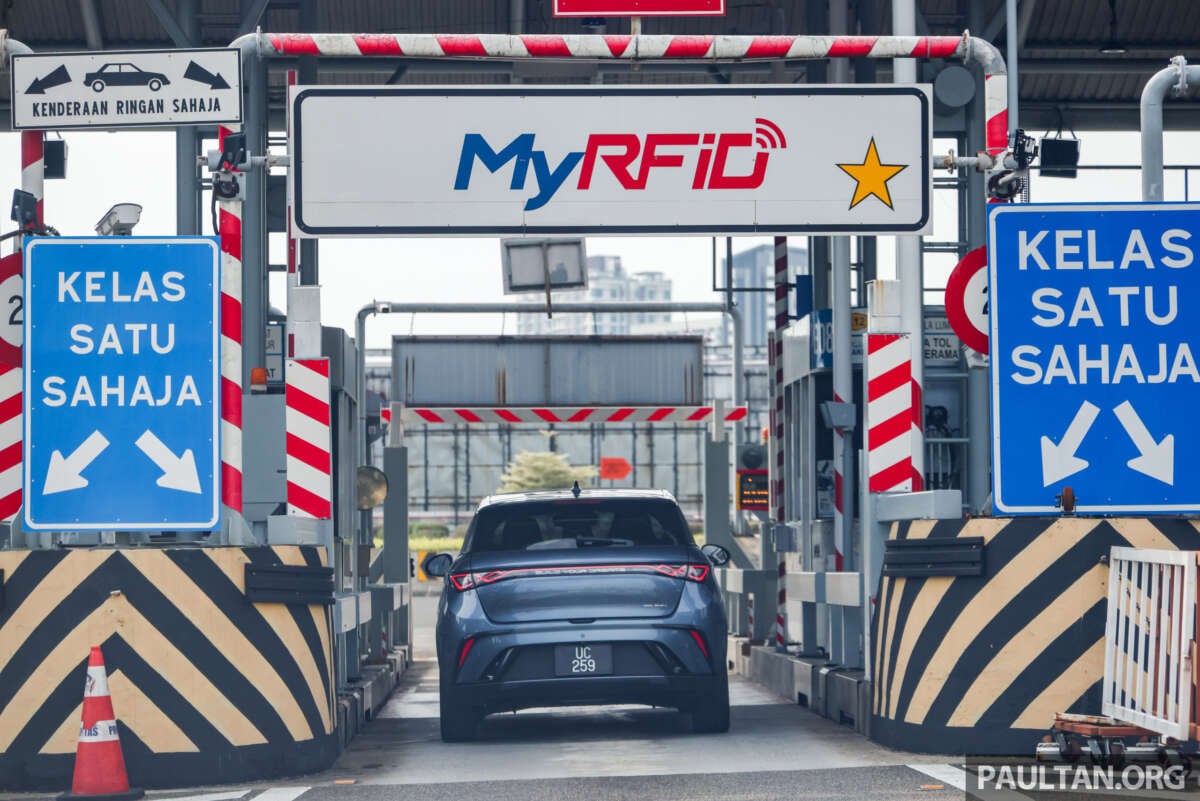
On repeated passes during our trial session at the Dato Keramat toll plaza at AKLEH (Ampang-bound, not into KL), the difference was very apparent, and Hafriz Shah said he felt confident that it would work every time, no longer questioning if it would open. Similar to Japan, the system still has boom gates, but the barriers opened earlier as soon as he entered the toll plaza, and showed that the system addressed the main drawback of the current RFID setup, which is inconsistency and slow response.
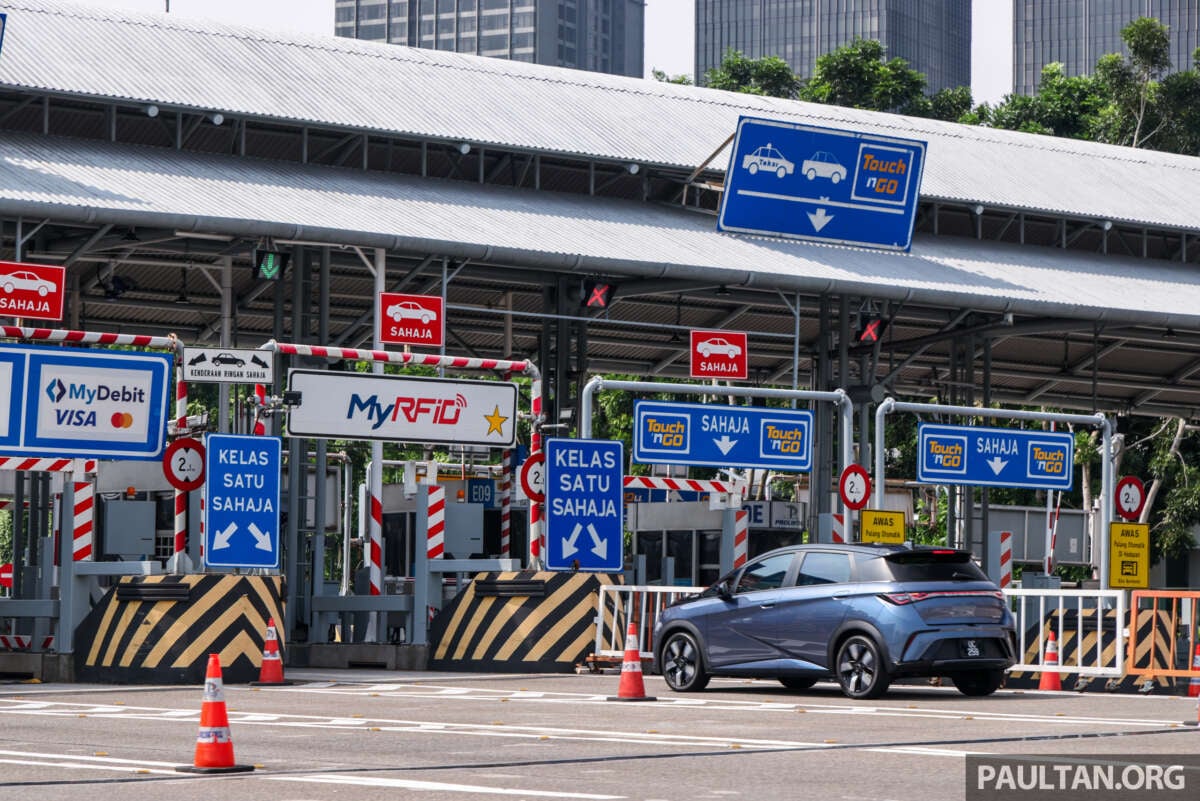
The AKLEH gantry is the first of the new Enhanced RFID Lanes, but it will soon be joined by others – by the end of 2026, there will be 10 such lanes across various highways, allowing more users to try out the new system. If you’re keen to try out the one on AKLEH, look for the MyRFID lane signage with the gold star symbol – it’s the only way to identify Enhanced RFID Lane at present.
What’s in a name


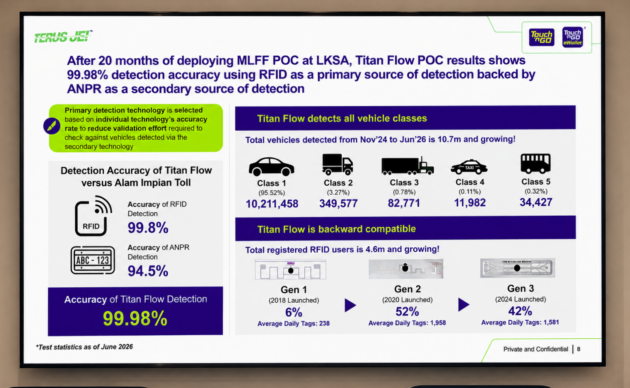
Behind the Enhanced RFID Lane are most of the elements from the Titan Flow system, which was showcased by TnG at the MyASEAN Roads and Traffic Expo (MyARTTE) in Kuala Lumpur last November. Unlike the setups in operation on current RFID lanes, the package for this one is far more comprehensive in terms of technical elements and, more important, performance ability.
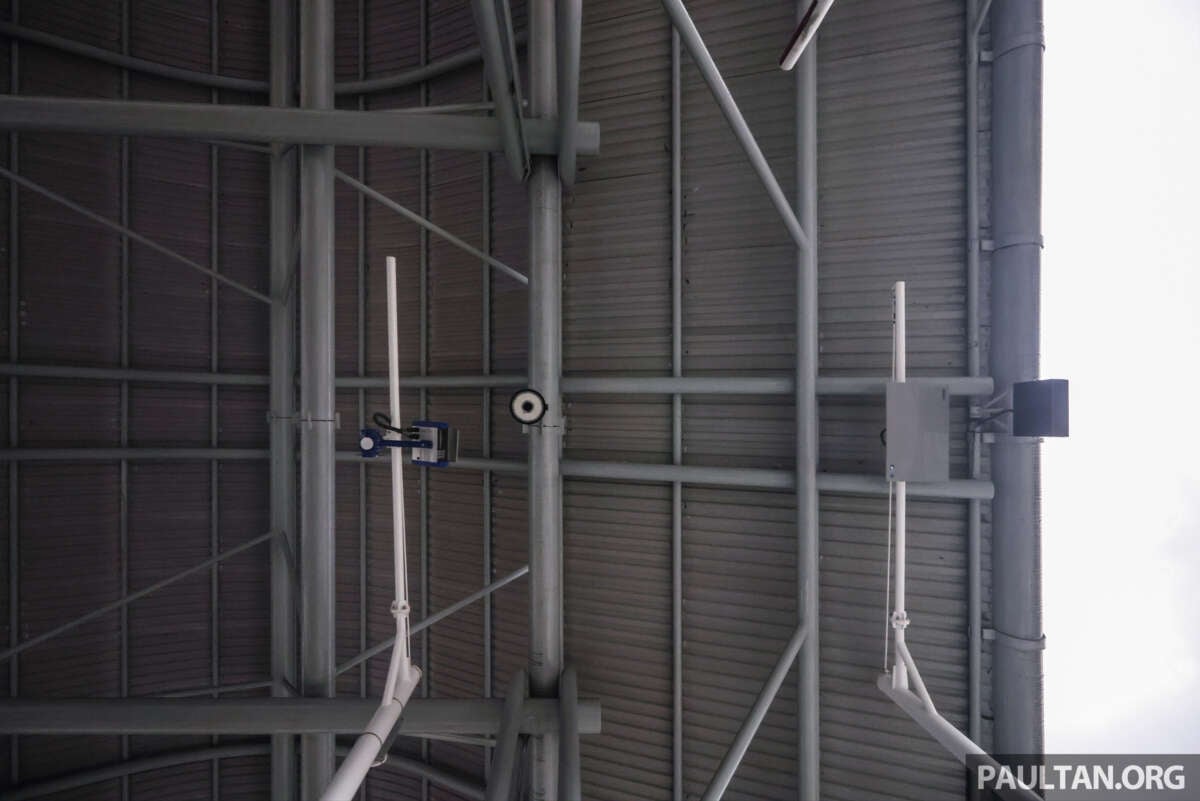
As shown at the expo, and also on the LKSA POC, Titan Flow features a set-up consisting of two patented design RFID antennas, an RFID reader, and two automatic number plate recognition (ANPR) cameras per lane with 3D LiDAR.
According to TnG, the RFID reader is more optimised for high-speed road tolling than the equipment currently in use at fully operational toll plazas and has been tested at speeds beyond the national limit, while the ANPR camera is capable of plate detection beyond 200 km/h. The system also eliminates the issue of tailgating or a car behind being too close, where the existing system can’t read fast enough – the new double antenna fixes that.
The AKLEH pilot utilises the same components, including artificial intelligence technologies, in its package, save for one change and one omission – the system uses only one ANPR camera (MLFF uses two), and there is no LiDAR here. While LiDAR helps identify the types of vehicles passing through the gantry according to their vehicle classes (private vehicles, buses, lorries) to determine the toll fare to be imposed, the system doesn’t need that as it only allows usage for Class 1 (private vehicles), saving entry costs.
It takes two to tango
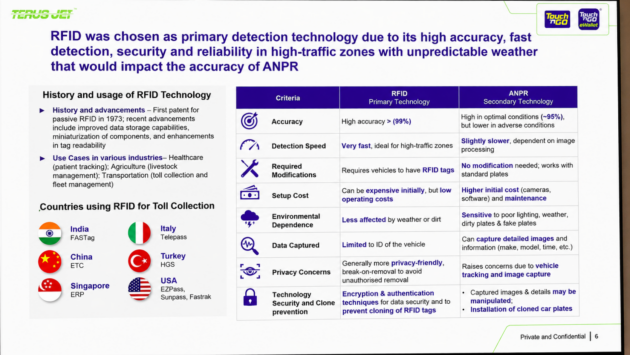
According to TnG, running on ANPR by itself isn’t enough, as there is lower accuracy rate with just using cameras alone. For one, RFID is still more reliable than ANPR, which has up to 95% accuracy at best. There are also situations that presents problems for it, from intense sunlight and heavy rain to the widespread use of fancy number plates, all of which interfere with visual pick up.
Additionally, the company says that both RFID and ANPR complement each other, with the ability to check if the RFID tag matches the car number plate, providing another level of verification and helping to detect any cars that manage to slip through the cracks. In use, the pilot system at LKSA achieved 100% vehicle detection and has read over 99.98% of existing TnG RFID tags.
With then deputy works minister Datuk Seri Abdul Rahman Mohamad having said back in 2023 that MLFF would need to combine both RFID and ANPR, not just either one alone, TnG believes that the Titan Flow system provides the ideal solution.
The company says the target for the Enhanced RFID Lane is to work towards the adoption of more RFID lanes, heading towards MLFF. Once that eventually becomes the standard, toll plazas can remove boom gates and leave the barrier open, so traffic flow becomes truly fast flow, eventually to the point that collection can do away with toll plazas completely in an open gantry system, essentially eliminating the need to widen roads for toll plazas and the subsequent merging choke point.
No need to reinvent the wheel


The biggest advantage of TnG’s system is that it integrates a payment method that already exists – the RFID and eWallet combination that is used for the vast majority of highways here. Customers will not need to get new tags or install a new application, sidestepping the hassle of adopting a completely new system.
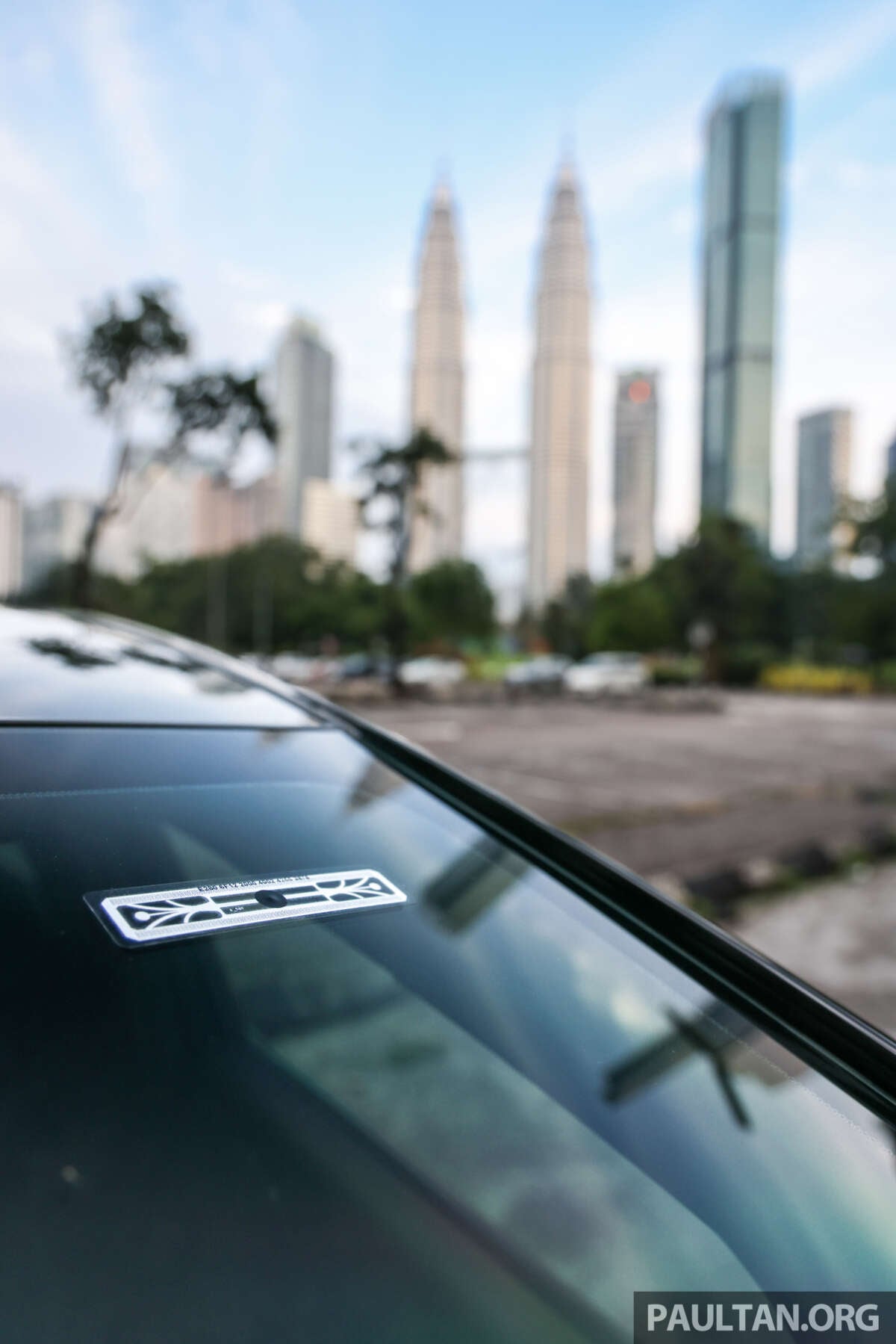
The company says that the Enhanced RFID Lane allows continued use of the existing RFID sticker, which is durable enough – many stickers from the initial pilot project in 2018 still work, after nearly eight years. Granted, there’s a cost, but at RM35 (with one time free replacement), TnG says this is a more affordable option than going with an all-new system.
From a performance perspective, a dedicated short-range communications (DSRC) system such as that used in Australia or Singapore (for its ERP) may be superior because they are active rather than passive, but those need an on-board unit (OBU), which is pricey – for example, the latter’s OBU unit costs around RM500, and given how Malaysians are, that kind of pricing simply won’t work.
With 4.7 million RFID users and over 27 million TnG eWallet consumers, the company says there’s a wide and ready audience, and it’s just a matter of installing RFID and linking that to the existing app. More importantly, it allows for one app for tolls, instead of many, avoiding the need for different programmes and payment methods for different highways.
So, existing RFID users, do you think Enhanced RFID Lane will provide a more seamless, fuss-free and faster toll collection? If you’re not using RFID yet, would this convince you to give it a try? If so, you can purchase a RFID tag via TnG eWallet, the Touch ‘n Go online shop or at selected Shell stations.









Looking to sell your car? Sell it with Carro.
