
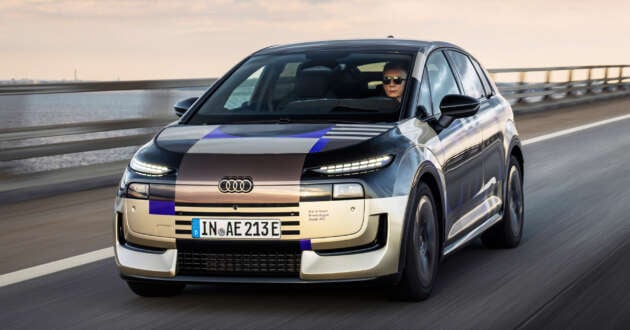
Ahead of the Audi A2 e-tron’s debut later this year, the German automaker has provided preliminary details about the powertrain featured in the compact electric vehicle (EV).
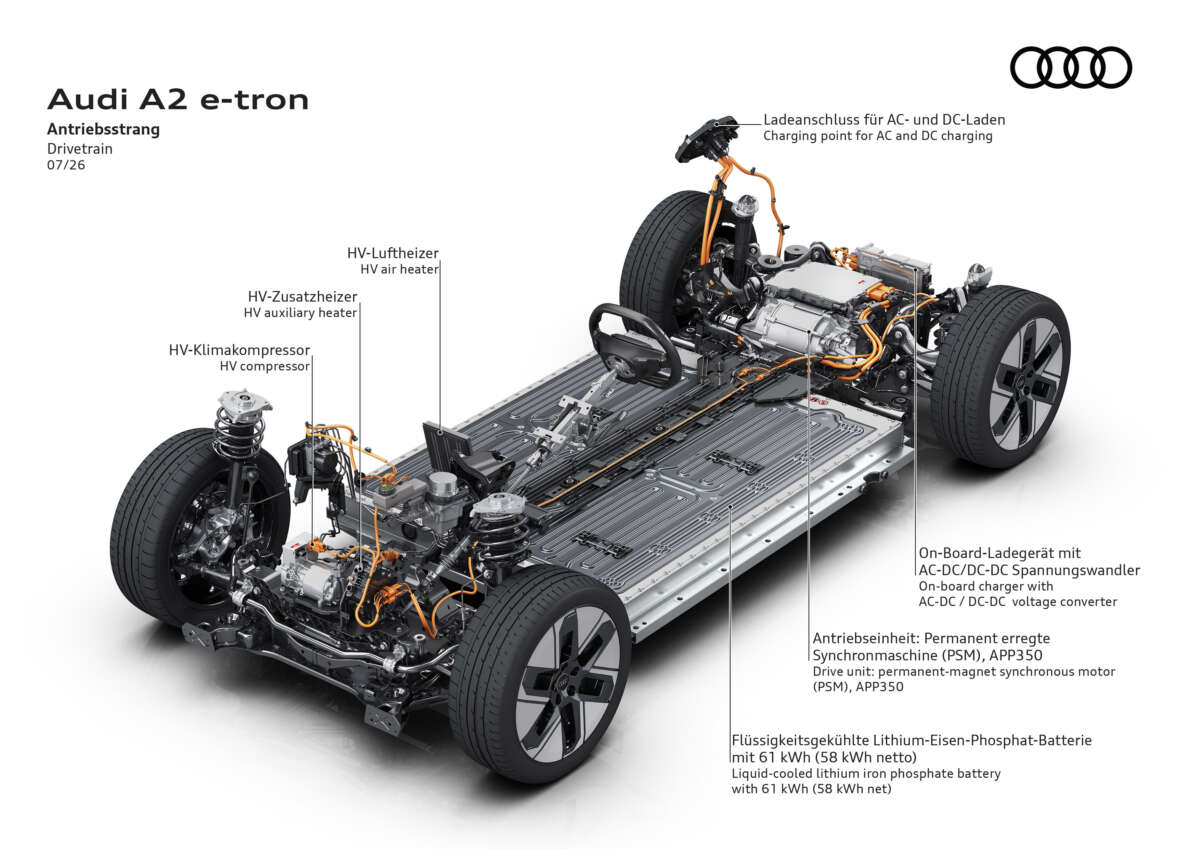
The A2 e-tron is built on the Volkswagen Group’s MEB+ platform with a 400-volt electric architecture and will feature lithium iron phosphate (LFP) battery cells in a cell-to-pack design, which sees the cells being bonded directly into the housing for increased packing density.
Audi is quoting a gross energy capacity of 61 kWh (58 kWh net) and an 89.6% charging efficiency at the wallbox with an adapted liquid cooling strategy, which is claimed improvement of 1.3%. The company also stated that getting from a 10-80% state of charge at a DC charger capable of 105 kW will take about 26 minutes.
“The battery can be charged to 100% time and again in everyday use, whereas manufacturers recommend limiting charging to 80% for other battery technologies to preserve the battery. In this regard, the LFP battery is particularly robust and regularly enables a full range,” said Benedikt Hackl, project manager for energy systems for the MEB product line.
The A2 e-tron is being touted as the most efficient Audi of all time, with preliminary energy consumption based on WLTP measurements being 12.8 kWh per 100 km. This is for the variant fitted with the optional efficiency package and an electric motor with a nominal output of 190 PS (188 hp or 140 kW).
Given the battery’s net energy capacity, we should be seeing a range of around 450 km on a single charge. Audi also states the A2 e-tron will come with a vehicle-to-home (V2H) system that delivers up to 11 kW to a DC wallbox to power homes in case of emergencies.
Alternatively, there’s also a vehicle-to-load (V2L) system with two outlets: one delivering 3.6 kW with an adapter plugged into the charging port, with the other being a regular power outlet capable of 2.3 kW. An onboard DC-DC voltage converter steps down the car’s voltage from 400 volts to 230 volts for these systems.
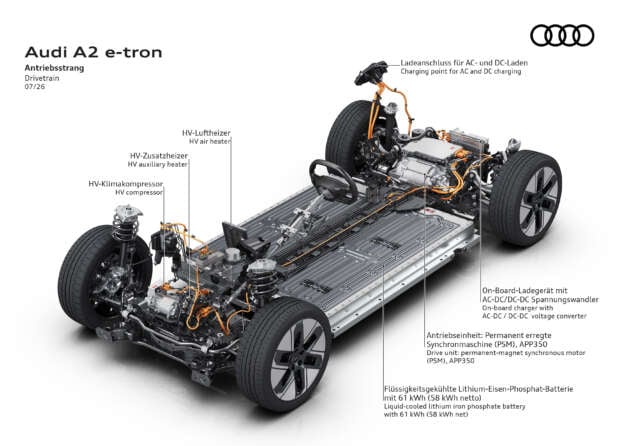
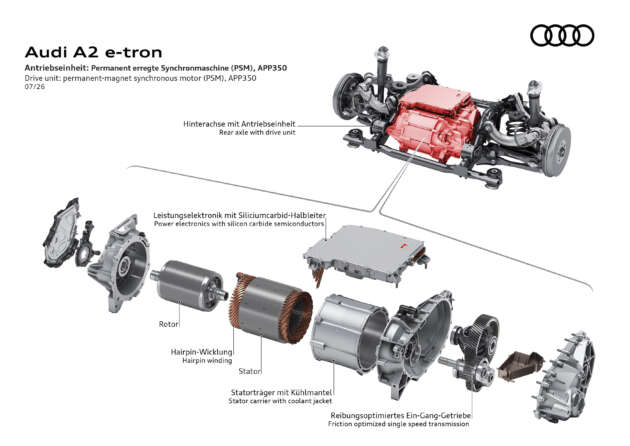
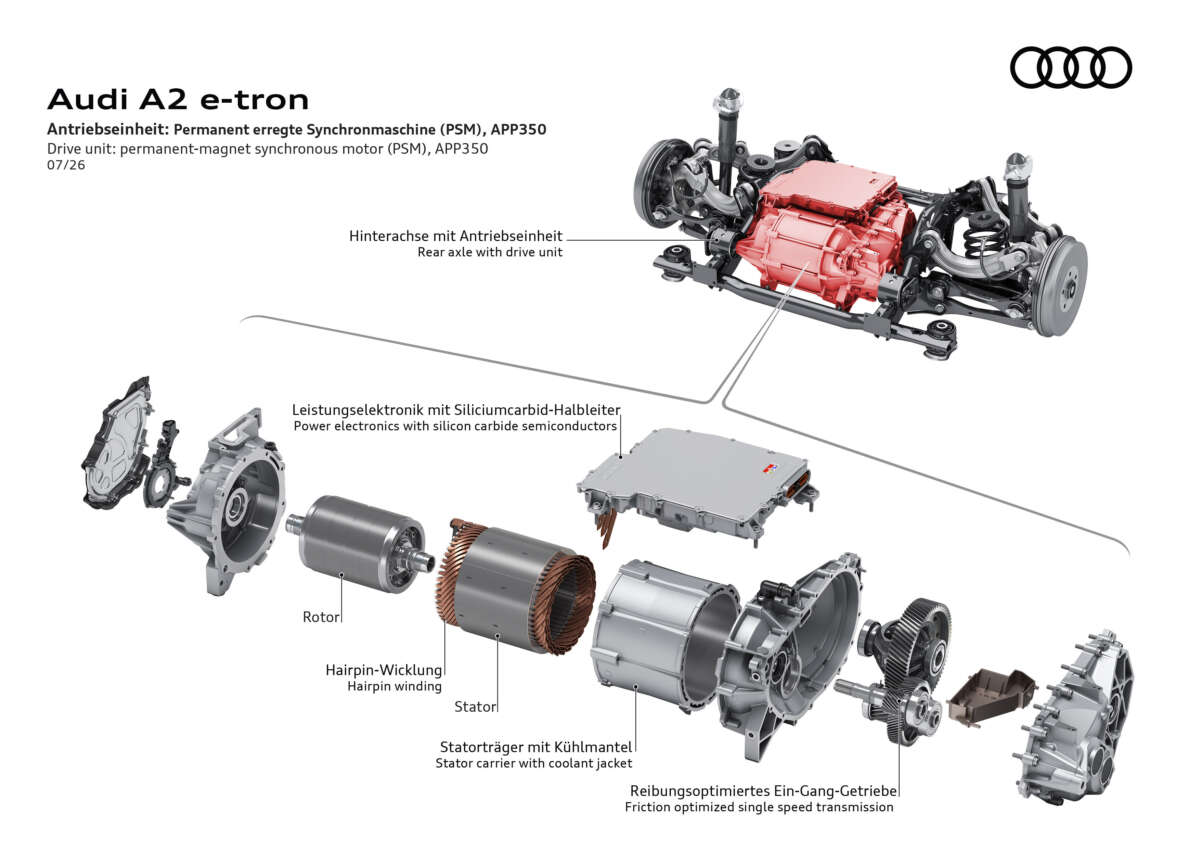
The electric motor drives the rear wheels and has the power electronics positioned above it. This drive system is said to be 10% more efficient thanks to the use of silicon carbide semiconductors that reduce switching losses, especially under partial load. Variable switching frequency alone cuts losses by up to 20 watts, while alternative modulation techniques reduce switching losses by up to 33% compared with conventional methods.
Meanwhile, the electric motor has thinner laminations (0.2 instead of 0.3 mm) to reduce what are known as iron losses, while the stator winding switches from a star to a delta configuration to shift operation into more efficient motor speed ranges. The accompanying transmission also uses a low-friction oil to cut losses, with a tall 10.2:1 gear ratio lowering the motor’s speed at higher road speeds to reduce energy consumption.
Two electric motors will be offered for the A2 e-tron, with the first being the newly-developed APP350 with a peak rating of 231 PS (228 hp or 170 kW) and 350 Nm of torque. It will be joined by the APP550 with up to 326 PS (322 hp or 240 kW) and 545 Nm.
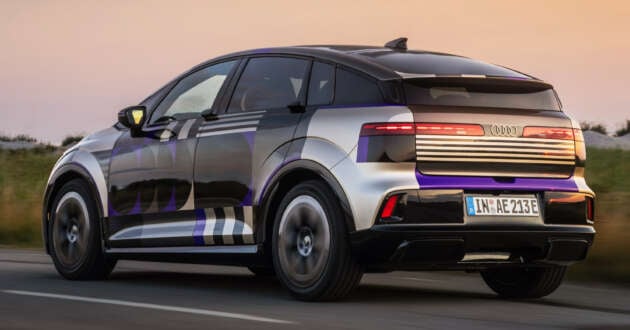
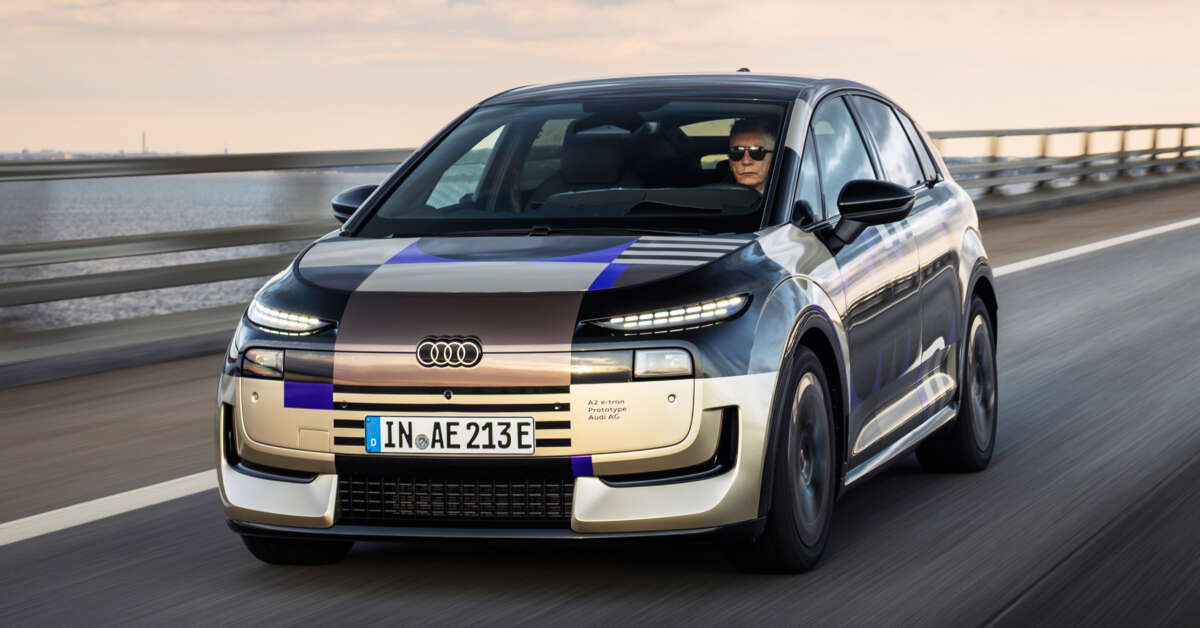
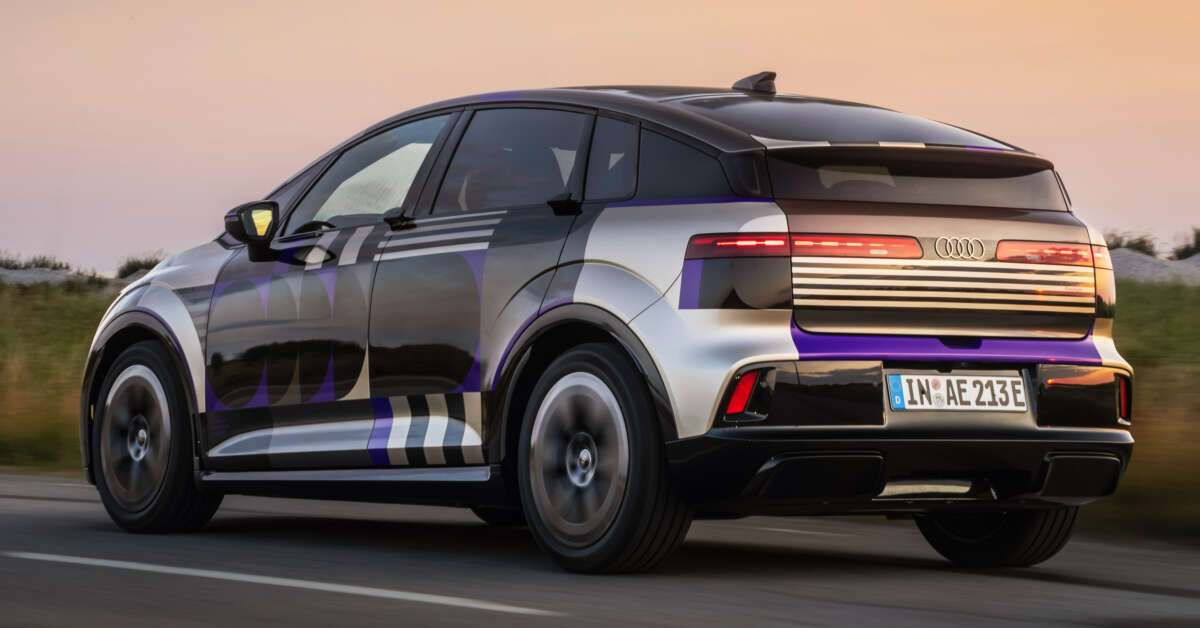
Further contributing to efficiency is the A2 e-tron’s design which is reminiscent of the original A2, albeit less bulbous and with greater emphasis on aerodynamics, as the steeper A-pillars and more rakish roofline indicate.
The rounded face features a grille that is largely closed off, save for the rows of slits seen above the large bottom intake, which comes with an active shutter. Corner air curtains at the corners of the bumper optimise air flow around the front wheels, while a discreet front spoiler sends air to the covered underbody that is joined by front wheel deflectors and a lower rear end spoiler.
Audi claims the shape it came up with has a drag coefficient of 0.24, which helps reduce WLTP energy consumption by as much as 0.9 kWh per 100 km to hit the preliminary 12.8 kWh per 100 km overall. The new A2 e-tron will be unveiled in fall 2026, which is sometime between September and November.







 Audi Q5
from RM352,900
Audi Q5
from RM352,900  Audi Q5 Sportback
from RM421,990
Audi Q5 Sportback
from RM421,990  Audi Q7
from RM462,272
Audi Q7
from RM462,272  Audi Q8 e-tron
from RM465,990
Audi Q8 e-tron
from RM465,990  Audi Q8 e-tron Sportback
from RM474,990
Audi Q8 e-tron Sportback
from RM474,990  Audi A3 Sedan
from RM338,990
Audi A3 Sedan
from RM338,990  Audi A5 Sportback
from RM440,990
Audi A5 Sportback
from RM440,990 