
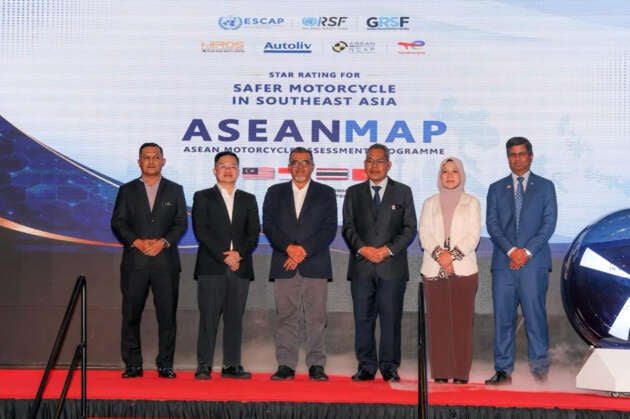
The ministry of transport (MoT), through the Malaysian Institute of Road Safety Research (MIROS), has launched the ASEAN Motorcycle Assessment Programme (ASEAN MAP), which aims to establish a harmonised regional framework for evaluating motorcycle safety.
This builds on Malaysia’s expertise with the Malaysia Motorcycle Assessment Programme (MyMAP) and will be rolled out in phases. During its initial phase from 2027 to 2028, the programme will focus on the assessment of technical and regulatory documentation, safety features, manufacturing and conformity-of-production processes, as well as support programmes provided by motorcycle manufacturers.
In the next phase from 2029 to 2034, ASEAN MAP will progressively expand to include technical performance assessments, which include braking performance and motorcycle visibility tests to further strengthen the region’s approach to motorcycle safety evaluation.
“ASEAN MAP reflects our collective responsibility to make motorcycles safer, empower consumers with better information and encourage manufacturers to continuously enhance the safety of their products. Its success will depend on strong regional cooperation and the active contribution of all participating countries,” said deputy transport minister Datuk Hasbi Habibollah.


Malaysia is joined by Indonesia, Thailand and Vietnam, who have expressed their commitment to participate in and contribute to ASEAN MAP. Motorcycles play a significant role in daily mobility in these countries, with motorcyclists accounting for a substantial proportion of road fatalities. Looking forward, the programme is expected to expand to other ASEAN member countries.
“As motorcycle technology continues to advance, ASEAN MAP must evolve alongside it. The programme must remain responsive to developments in braking systems, rider assistance technologies and connected safety systems, while continuing to reflect the motorcycles, riders and traffic environments of Southeast Asia,” commented MIROS deputy director-general Prof Dr Siti Zaharah Ishak.
The programme is supported by the United Nations Road Safety Fund (UNRSF), with the United Nations Economic and Social Commission for Asia and the Pacific (UNESCAP) serving as a key project partner. It also benefits from collaboration with the Global Roa Safety Facility of the World Bank, Autoliv as well as TotalEnergies.
