
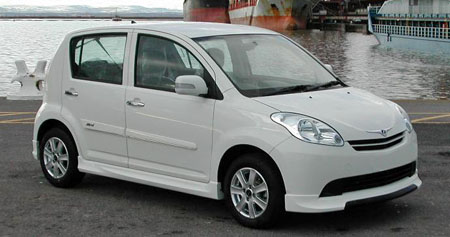
Perodua has introduced two new variants to its UK Myvi line up: the Myvi SE and the Myvi Sport. The Malaysian car maker also announced that the Myvi range, which also includes the manual SXi and automatic EZi, is now Euro 5 compliant.
The Myvi Sport gets a body kit consisting of front, side and rear skirts including “imitation quad exhausts” (yes, that’s the exact phrase used in the press release). Colour coded side mouldings with chrome ‘Myvi’ motifs, chrome door handles and different alloys are the other changes. No rear spoiler, though. Inside, mock carbon fibre inserts are fitted to the instrument panel and door panel switch. Only available with a manual gearbox, the Sport is priced at £7,799 (price includes £1,000 swappage allowance offer).
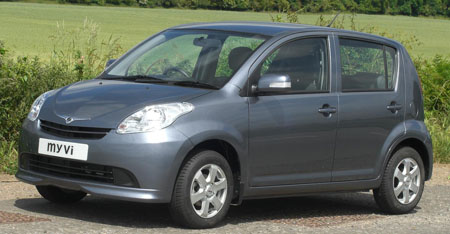
The Myvi SE is the “luxury model” fitted with dark grey leather. The centre panels of the seats are made from perforated leather, with matching door inserts. Available in manual or auto form, the Myvi SE is priced from £8,399 including the £1,000 trade in deal, which lasts till 31st October. The Myvi is a fair bit cheaper than mainstream superminis in the UK – B-segment car for A-segment money, although the brand counts against it.
The UK spec Myvi is also powered by the K3-VE 1.3-litre engine with 86 hp and 116 Nm of torque. There’s no mention of different figures for the Euro 5 versions. I didn’t know that Perodua is still exporting pre-facelift Myvis until now.
Looking to sell your car? Sell it with Carro.
 Perodua Myvi
from RM 46,500
Perodua Myvi
from RM 46,500  Perodua Traz
from RM 76,100
Perodua Traz
from RM 76,100  Perodua QV-E
from RM 80,000
Perodua QV-E
from RM 80,000  Perodua Axia
from RM 38,600
Perodua Axia
from RM 38,600  Perodua Alza
from RM 62,500
Perodua Alza
from RM 62,500  Perodua Ativa
from RM 62,500
Perodua Ativa
from RM 62,500  Perodua Bezza
from RM 34,580
Perodua Bezza
from RM 34,580  Perodua Aruz
from RM 72,900
Perodua Aruz
from RM 72,900 
 mohsin
on
mohsin
on 

 subhero
on
subhero
on  anonymous
on
anonymous
on  wolfsburg
on
wolfsburg
on  wolfsburp
on
wolfsburp
on  ray
on
ray
on  handsome*dude
on
handsome*dude
on  blackjkx
on
blackjkx
on  Pug
on
Pug
on  Facebook_User
on
Facebook_User
on  _xXx_
on
_xXx_
on  duda dude
on
duda dude
on  jolly_idiot
on
jolly_idiot
on  king
on
king
on  mu77
on
mu77
on  untitled
on
untitled
on  Tox
on
Tox
on  4x4Fan
on
4x4Fan
on  alldisc
on
alldisc
on  Tiadaid
on
Tiadaid
on  curious
on
curious
on  KZM
on
KZM
on  hetfield
on
hetfield
on  mim
on
mim
on  boyxinan
on
boyxinan
on  SukaTgkOrg
on
SukaTgkOrg
on  zimba
on
zimba
on  Ryan
on
Ryan
on  squawk
on
squawk
on  Shaekey
on
Shaekey
on  autojohndoe
on
autojohndoe
on  haidri
on
haidri
on  Armeng
on
Armeng
on  c
on
c
on  mujahid
on
mujahid
on  Isaac
on
Isaac
on  WinterAngeLs
on
WinterAngeLs
on  DICKYBIRD
on
DICKYBIRD
on  dude
on
dude
on  mini cooper freak
on
mini cooper freak
on  lazyf
on
lazyf
on  tikus
on
tikus
on  mr. wiseGuy
on
mr. wiseGuy
on  Lancermania
on
Lancermania
on  theanswer
on
theanswer
on  learner
on
learner
on  Malaysia Memang Boleh
on
Malaysia Memang Boleh
on  USDfan
on
USDfan
on  Ford_GT
on
Ford_GT
on  littlefire
on
littlefire
on  RT
on
RT
on  E Bear
on
E Bear
on  Power8003
on
Power8003
on  orang kecil
on
orang kecil
on  nolan
on
nolan
on  oomph
on
oomph
on  S.Roma
on
S.Roma
on  PakAbu
on
PakAbu
on  Right Royale
on
Right Royale
on  anti-first
on
anti-first
on  Zen
on
Zen
on  TP
on
TP
on  gilabasi
on
gilabasi
on  Cars 100
on
Cars 100
on  SR
on
SR
on  phas3r
on
phas3r
on  orgbiasa
on
orgbiasa
on  Someone
on
Someone
on  ah yat
on
ah yat
on  elite
on
elite
on  nabill
on
nabill
on  haprakah
on
haprakah
on  korokoro
on
korokoro
on  Buy MyVi
on
Buy MyVi
on  peYno
on
peYno
on  armandd
on
armandd
on  nazri
on
nazri
on  Adi
on
Adi
on  DSZ
on
DSZ
on  riph78
on
riph78
on  Basher
on
Basher
on  yamseng
on
yamseng
on  ikat perut
on
ikat perut
on  Jerami Cilakason
on
Jerami Cilakason
on  trollbait
on
trollbait
on  Puki
on
Puki
on  P2 - Blood Suck
on
P2 - Blood Suck
on  fly
on
fly
on  david betkam
on
david betkam
on  Peter
on
Peter
on  pultat
on
pultat
on  googlings
on
googlings
on  Simon
on
Simon
on  creator mind
on
creator mind
on  org melayu kat Manchester, UK.
on
org melayu kat Manchester, UK.
on 


AI-generated Summary ✨
Comments discuss various comparisons between UK and Malaysian car prices, highlighting the higher taxes and import duties in Malaysia that make local cars more expensive despite cheaper overseas models. Some mention UK-specific features like the Euro 5 compliance of the Myvi, while others criticize government policies and high fuel prices in Malaysia. Many express frustration over high taxes, import duties, and the perceived lack of support for local industries, showing both skepticism and pride in Malaysian cars and policies.