
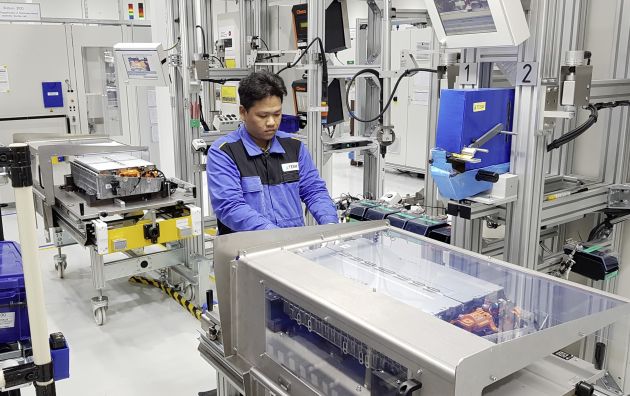
Mercedes-Benz has begun local production of plug-in hybrid-batteries in Thailand with the opening of its new battery plant, which is located at the company’s vehicle manufacturing plant in Samut Prakan.
The new facility, which sits on a 50,000 square metre site and has a 100-strong workforce, was announced last year when the automaker – together with local partners Thonburi Automotive Assembly Plant (TAAP) and Thonburi Energy Storage Systems (TESM) – said it was investing over 100 million euros (RM483 million) in expanding production operations in the country.
Output will serve localised needs in the production of the automaker’s plug-in hybrids, of which the C- and E-Class versions are in particular demand, but the plant will be able to make batteries for full electric vehicles in the future, according to a previous report. While no mention of production capacity was made, a figure of 5,000 units was indicated previously, and this can easily be doubled according to demand.
The new facility is the latest addition to the company’s global battery production network, which already has plants running in Kamenz, Germany, with Beijing also going online this year. With new plants in the United States, Poland and Germany set to begin operations at the beginning of the next decade, the network will eventually consist of nine factories at seven locations on three continents.
Looking to sell your car? Sell it with Carro.
 Mercedes-Benz AMG CLE
from RM722,888
Mercedes-Benz AMG CLE
from RM722,888  Mercedes-Benz EQV
from RM450,350
Mercedes-Benz EQV
from RM450,350  Mercedes-Benz G-Class
from RM958,888
Mercedes-Benz G-Class
from RM958,888  Mercedes-Benz AMG GT
from RM1,882,888
Mercedes-Benz AMG GT
from RM1,882,888  Mercedes-Benz Maybach EQS SUV
from RM1,088,888
Mercedes-Benz Maybach EQS SUV
from RM1,088,888  Mercedes-Benz AMG G-Class
from RM1,948,888
Mercedes-Benz AMG G-Class
from RM1,948,888  Mercedes-Benz AMG GLC Coupe
from RM498,888
Mercedes-Benz AMG GLC Coupe
from RM498,888  Mercedes-Benz AMG GLE
from RM1,191,888
Mercedes-Benz AMG GLE
from RM1,191,888  Mercedes-Benz E-Class
from RM355,888
Mercedes-Benz E-Class
from RM355,888 
 Benzs
on
Benzs
on 

 Mohd Shah Ibrahim
on
Mohd Shah Ibrahim
on  Ismail Bahrain
on
Ismail Bahrain
on  vape
on
vape
on  Rahman Zaidi
on
Rahman Zaidi
on  Ahmadjr
on
Ahmadjr
on  Cynic
on
Cynic
on  Troll Hunter
on
Troll Hunter
on  Darren Kong
on
Darren Kong
on  Avenger
on
Avenger
on  Steven Matthias
on
Steven Matthias
on  Segaran Marimuthu
on
Segaran Marimuthu
on  Raja
on
Raja
on  Lao Yee
on
Lao Yee
on  Andrew Ng
on
Andrew Ng
on  4bini
on
4bini
on  Stanley Sinnapa
on
Stanley Sinnapa
on  Civic Turbo 2018
on
Civic Turbo 2018
on  Wiki
on
Wiki
on  Gary
on
Gary
on  Ghani
on
Ghani
on  C.P. MOHAN
on
C.P. MOHAN
on  Celup King
on
Celup King
on  Mari
on
Mari
on  Adamos
on
Adamos
on  gt4
on
gt4
on  M.K
on
M.K
on  Rosman
on
Rosman
on  Alan
on
Alan
on  Somada
on
Somada
on  lkh
on
lkh
on  Logical Deduction
on
Logical Deduction
on  Calvin
on
Calvin
on  Frozen
on
Frozen
on  vivizurianti
on
vivizurianti
on  Abang
on
Abang
on  Samad Abd Rahman
on
Samad Abd Rahman
on  Sanjay
on
Sanjay
on  Steven Matthias
on
Steven Matthias
on  P.Alyanna
on
P.Alyanna
on  Buloh
on
Buloh
on
AI-generated Summary ✨
Comments generally reflect frustration with Malaysia’s investment climate, citing red tape, corruption, and unqualified leadership as barriers. Many praise Thailand for its hardworking labor force, stable policies, and lower costs, resulting in more foreign investment and battery production like Mercedes-Benz's new facility. There is concern that Malaysia’s policies and governance hinder competitiveness, leading companies to prefer Thailand or Vietnam. Overall, sentiments favor adhering to better policies, reducing corruption, and improving workforce quality to attract investments.