
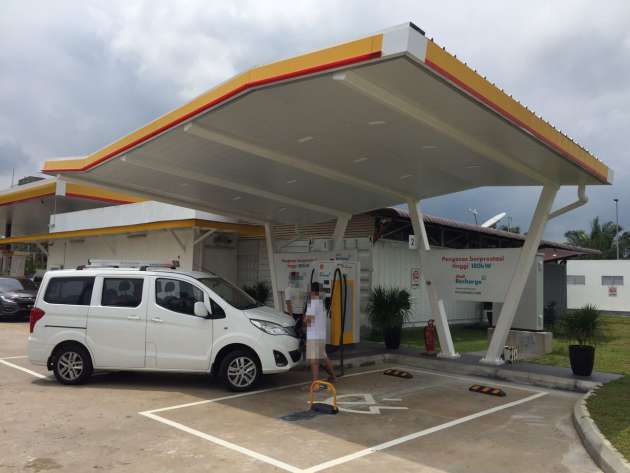
After all the drama with Singapore plate cars pumping heavily subsidised RON95 fuel in Malaysia when they are not supposed to, now we have Singapore plate EVs stealing electricity at our electric car chargers.
Seen here is a Singaporean-registered BYD M3 electric van using the 180 kW Shell Recharge DC fast charger at Tangkak. The BYD van’s driver just decided to park around the raised barrier to recharge his van.
Shell Recharge is a paid service – you are supposed to use the ParkEasy app to pay for the barriers on the parking lot to be lowered so you can park at the charger to use it. The DC charger itself does not need any authentication, this is how the BYD van was able to use the charger without paying for it.
For pay-per-use, payment for charging consists of a RM4 confirmation fee and RM20 for every five mins of charging for the first 25 minutes, and RM20 for every five minute block thereafter. This works out to RM240 an hour (or RM244 with confirmation fee included). The fees are based on how long you reserve the parking lot, and doesn’t take into account how many kWh you pull from the charger.
Please do not do this, as bad behaviour from EV owners (regardless which country they come from) would deter private companies from investing in our EV charging infrastructure which we need to increase EV adoption in Malaysia.
Use our referral code R88W3N2T when you download the ParkEasy app and you’ll get some free credits to try it out.
Looking to sell your car? Sell it with Carro.


 Tesla Owner
on
Tesla Owner
on 

 Dredd
on
Dredd
on  Hantu Raya
on
Hantu Raya
on  Gary
on
Gary
on  Andrew go
on
Andrew go
on  PlainBS
on
PlainBS
on  Wonga
on
Wonga
on  Targets bullshitters
on
Targets bullshitters
on  Hantu Raya 2.0
on
Hantu Raya 2.0
on  Nino
on
Nino
on  I love P2
on
I love P2
on  Adrian Tan
on
Adrian Tan
on  TSI
on
TSI
on  NK
on
NK
on  Malaysia-hater
on
Malaysia-hater
on  Thed
on
Thed
on  Alan
on
Alan
on  Spin Too Much
on
Spin Too Much
on  Anonym
on
Anonym
on  singa
on
singa
on  Annoynimouse
on
Annoynimouse
on  Dot
on
Dot
on  (Dude)
on
(Dude)
on  Blur Blur
on
Blur Blur
on  Ca’om
on
Ca’om
on  Ali H Salehuddin
on
Ali H Salehuddin
on  Black RX
on
Black RX
on  newme
on
newme
on  White RX
on
White RX
on  Why So Serious
on
Why So Serious
on  EV
on
EV
on  New citizen of SG
on
New citizen of SG
on  Avenger
on
Avenger
on  Rakyat Malaysia
on
Rakyat Malaysia
on  Jeremy
on
Jeremy
on  jeremoron
on
jeremoron
on  Logical Deduction
on
Logical Deduction
on  Amran
on
Amran
on  cedd
on
cedd
on  JustSaying
on
JustSaying
on  Michael
on
Michael
on  moron singaporean loves P2
on
moron singaporean loves P2
on  Copy Paste
on
Copy Paste
on  Lanhb
on
Lanhb
on  Ktk
on
Ktk
on  knk
on
knk
on  Jacob
on
Jacob
on  pengguna ploton kecewa
on
pengguna ploton kecewa
on  Once A Thief always A Thief
on
Once A Thief always A Thief
on  AL
on
AL
on  Jddkb
on
Jddkb
on  Mike Tanner
on
Mike Tanner
on  Paul Tan
on
Paul Tan
on  tike manner
on
tike manner
on  CKLin
on
CKLin
on  Al
on
Al
on  Syedimran
on
Syedimran
on  KC
on
KC
on  God zeus
on
God zeus
on  Daniel
on
Daniel
on  Mystic
on
Mystic
on  EV
on
EV
on  Damn hate this type of kiasu sporen
on
Damn hate this type of kiasu sporen
on 


AI-generated Summary ✨
Comments largely criticize the alleged EV thefts, with some claiming it's a matter of system loopholes or poor implementation. Many perceive the act as illegal and shameful, especially for Malaysians or Singaporeans, often linking behavior to cultural traits. Several comments also discuss law enforcement and the need for better infrastructure, while others mention mutual respect and the importance of following legal procedures. Overall, there's a negative sentiment toward the individuals involved and skepticism about the system's security.