
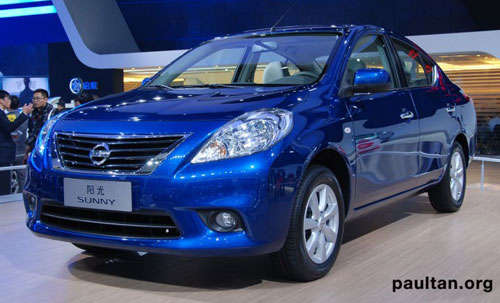
Nissan has announced a new six-year business development plan for the ASEAN region, with the objective of more than tripling sales to 500,000 units with a 15% market share by the end of 2016 from the 150,000 units and 6% market share it had in 2010.
The new mid-term plan, unveiled by Nissan Motor Asia Pacific (NMAP), identifies a number of areas to achieve its goals. The first is preparing for Indonesia’s low cost green car programme, which is initiated by the Indonesian government. The second is to double the regional production capacity from 350,000 to 700,000 units per year.
The plan also calls for an acceleration of localisation of R&D as well as powertrain production in the region – the Nissan Technical Center South East Asia will be expanded in Thailand and Indonesia with a tripling of total engineering staff by 2016.
In addition, Nissan’s affiliate company JATCO will invest 20 billion yen (US$250 million) to establish a new manufacturing plant to produce continuously-variable transmission (CVT) units in Thailand. It will be the first company to locally produce CVTs in Thailand.
The automaker also plans to invest 25 billion Japanese yen (US$312.5 million) in Indonesia for further growth, primarily on plant expansion – to increase production capacity to 180,000 units by 2013 – and a new engine assembly plant.
The establishment of NMAP, which is a new, strategic regional headquarters located in Thailand, will be in charge of developing the progress of this expansion.
Alongside all this will be the introduction of a “Power Up 2016” program by the company in Thailand, and this one looks to deploy more than 10 new models during the period. The first of these is will be the company’s second eco-car in the country, the Nissan March sedan. Production of the Honda City / Toyota Vios competiitor – very possibly the Sunny, as it’s badged in China – scheduled to begin in September.
Looking to sell your car? Sell it with Carro.
 Nissan Serena e-Power
from RM154,800
Nissan Serena e-Power
from RM154,800  Nissan Kicks e-Power
from RM113,800
Nissan Kicks e-Power
from RM113,800  Nissan Navara
from RM98,600
Nissan Navara
from RM98,600  Nissan Almera
from RM83,888
Nissan Almera
from RM83,888  Nissan Leaf
from RM168,888
Nissan Leaf
from RM168,888  Nissan NV200
from RM79,800
Nissan NV200
from RM79,800 
 jflee169
on
jflee169
on 

 Potato
on
Potato
on  KZM
on
KZM
on  Sad
on
Sad
on  kingjoke
on
kingjoke
on  Jaa
on
Jaa
on  yuhuu
on
yuhuu
on  MR
on
MR
on  Expatriate VN
on
Expatriate VN
on  Unforgiven
on
Unforgiven
on  carlocaraddict
on
carlocaraddict
on  GreenEco
on
GreenEco
on  david
on
david
on  amz
on
amz
on  lonelyobserve
on
lonelyobserve
on  udasalleh
on
udasalleh
on  Cowabunga!
on
Cowabunga!
on  Ash Menon
on
Ash Menon
on  MoFaz
on
MoFaz
on  isuzuki
on
isuzuki
on  tikus
on
tikus
on  zainal abidin
on
zainal abidin
on  chempedak
on
chempedak
on  sukasuki
on
sukasuki
on  Cheng
on
Cheng
on  kamaji
on
kamaji
on  q1
on
q1
on  Mask Ryder
on
Mask Ryder
on  kelso
on
kelso
on  Patriot
on
Patriot
on  Barkcrack
on
Barkcrack
on  BadBET
on
BadBET
on  ungrateful indons
on
ungrateful indons
on  surewi
on
surewi
on  Jakartan
on
Jakartan
on  b.boom
on
b.boom
on  jamal
on
jamal
on 


AI-generated Summary ✨
Comments express frustration over Malaysia's automotive policies, protectionism, and reliance on cronies, which hinder industry growth. Many highlight Thailand and Indonesia's competitive advantages due to low labor costs and open policies, urging Malaysia to embrace foreign direct investment and improve local industry development. Some praise Nissan's expansion in ASEAN, but others worry Malaysia's lack of inclusion in Nissan's plans signals missed opportunities. Overall, sentiments favor more openness, better policies, and development of a competitive regional automotive industry.