
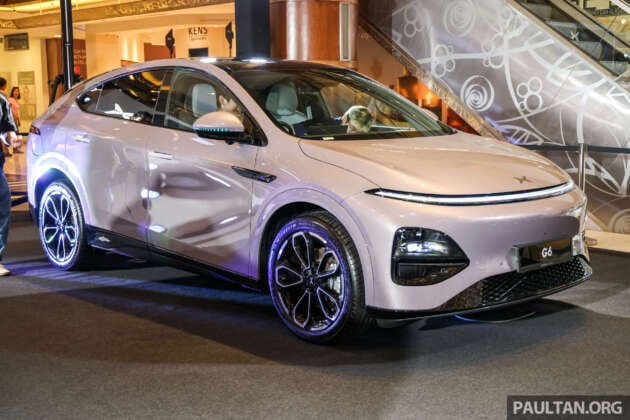
Aside from the proposed lemon law and the RM4,000 old car scrappage grant, the Malaysian Automotive Association (MAA) has also weighed in on one absence at Friday’s tabling of Budget 2026 – the lack of an extension for CBU fully-imported electric vehicle tax exemptions.
The organisation said that while it recognised “the government’s intention to prioritise CKD local assembly activities [and] investment”, and that it remained confident in Malaysia’s “long-term view in shaping…EV policy,” it urged the government to support both CBU and CKD EVs, “particularly during the early stages of Malaysia’s transition towards electrified mobility.”
It added that CBU incentives are critical in creating consumer awareness, market confidence and “demand readiness,” all of which it deemed necessary for the eventual success of CKD EVs. It also said it believes the government should continue evolving policies in line with “rapid technological advancements and global industry developments.”
Import and excise duty exemptions for CBU EVs were introduced during Budget 2022 to catalyse public adoption of these cars. Initially slated to expire by end-2023, these were extended twice – first during the first tabling of Budget 2023 to end-2024, then again to end-2025 during the second tabling when the current Madani government came to power. Despite MAA repeated calling for an extension, the tax breaks are set to end as scheduled, as confirmed by the ministry of finance (MOF).

No one knows for sure how much more expensive EVs will be come next year, but Francis Lee, group CEO of Bermaz Auto that distributes the Xpeng brand, has recently said he expects prices to go up by “at least 20 to 30% minimum.” Tesla has also advertised “a minimum of RM20,000 in savings” if buyers book now, meaning it anticipates prices rising by at least that amount in 2026.
Meanwhile, GWM Malaysia COO Roslan Abdullah told Berita Harian we could see as much as a 100% increase, given that customers are expected to bear the brunt of the reinstated import tax (10 to 30% of the car’s price) and excise duty (50 to 100%). Compounding matters is the fact that road tax will also be reapplied to EVs starting next year.
Tax incentives will remain for CKD locally-assembled EVs until the end of 2027, with most mainstream brands already committing to local production, including national carmakers Proton and Perodua. Some foreign makes like Volvo and Mercedes-Benz already make at least some of their EVs here, but a few others such as BYD and Xpeng expect to only start production in the second half of 2026, so expect some price increases at least for several months.
Looking to sell your car? Sell it with Carro.


EV will never be the future, my merc glc will be the choice
Not all EV brands are good, buy the ones that have more reliable ones
You didn’t know why EV have lots of advantages where petrol can’t, if you read website or go experience yourself
GLC at 400k is double the price of average EV
kesian T20 have to pay more for their expensive EV soon, or else pay RM3.1 per liter of Ron97 for their AMG45 or bmw m4 .
certified Stockholm syndrome pro max
Seriously don’t know what MAA has been smoking by saying “CBU EVs should continue to be tax free to increase consumer awareness”?
For Who’s awareness is it since it was introduced back in 2022 and CBU is to make others great again?
bro i just wanna get a Tesla man lemme be able to afford it
Hello MAA, you have to actively engage MOF and the relevant decision makers then only can make things happened. If comments come after budget has been tabled, then what’s the use?
Those brands now have ckd plants as deal done, should give grant exemption for cbu, as part of transition from cbu to ckd, though beyond end of exemption of 2025
it would only make sense if EVs were not rich people play things. in what universe can the average malaysian afford one, even at 100k. before people start bashing, the median income for the formal sector is only RM3k/month so that alone should tell you all you should know about how many people actually cannot afford EVs.
Many carmakers already have planned to setup assembly plants and will start assembly in 2026 for EV models. Gov can still considered to grant those EV still CBU in 2026 on those confirmed to start assembly at least middle of 2026. Those like Tesla should not be granted exemption as they no plan to setup factory. The issue of EV adoption slow is because EV cars mostly beyond 100k. When Proton and Perodua roll up around RM80k EV the adoption rate will increase.
Agree with MAA
Should give EV extension as part of environment friendly
For once MAA is making sense
1. Government should continue the incentives for CBU until CKD is ready.
2. We have limited CKD choices now. Malaysia volume is small. How to encourage others to invest here? By showing how conservative we are?
3. Government should further reduce tax to boost the EV volume so that the infrastructure will be well established. Consumer will be more willing to buy at high price.