
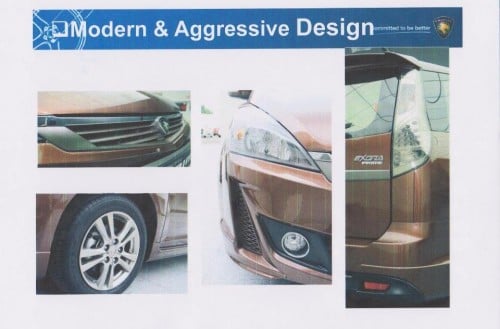
Click to enlarge.
It’s just around the corner now, the introduction of the turbocharged Proton Exora Bold, and stuff on the vehicle is coming out of the woodwork faster than that in a leaky boat, it seems. Photos of the supposed Prime variant surfaced a few days ago, and now, what are very much presentation sheets containing engine details have come about, source unknown.
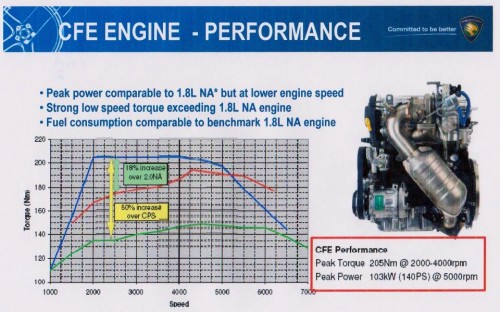
Click to enlarge.
As bandied about earlier, the performance specs for the CFE mill are 140 PS (or 138 hp) at 5,000 rpm and 205 Nm at 2,000 to 4,000 rpm, and there’s a graph that charts the torque curve of the mill, compared to the normally-aspirated CPS engine as well as a 2.0 litre NA engine. Another sheet offers a numerical output comparison against the CPS as well as two competitors, the Nissan Grand Livina 1.8 and Toyota Innova 2.0L.
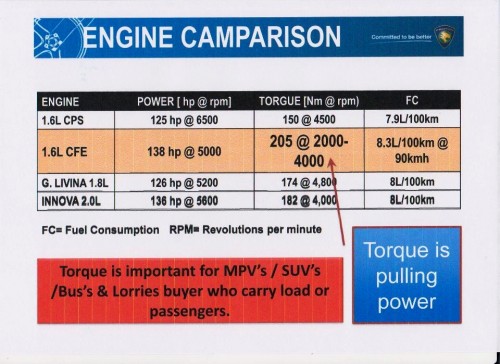
Click to enlarge.
We’ve also finally managed to confirm that the CFE term denotes Charge Fuel Efficiency, and not the Charged Fuel Enhancement and Campro Fuel Efficient touted earlier. All been very confusing, but hopefully that’s that. Oh, and looks like someone’s been looking at too much Campro, it seems – ignore the “engine camparison” typo, if you will!
AD: Drive the Proton model of your dreams. Submit your details and Proton PJ will get in touch with you.
Looking to sell your car? Sell it with Carro.
 Proton X90
from RM 106,800
Proton X90
from RM 106,800  Proton S70
from RM 73,800
Proton S70
from RM 73,800  Proton eMas 7 PHEV
from RM 109,800
Proton eMas 7 PHEV
from RM 109,800  Proton X70
from RM 106,800
Proton X70
from RM 106,800  Proton Saga
from RM 38,990
Proton Saga
from RM 38,990  Proton eMas 5
from RM 59,800
Proton eMas 5
from RM 59,800  Proton X50
from RM 89,800
Proton X50
from RM 89,800  Proton eMas 7
from RM 103,800
Proton eMas 7
from RM 103,800  Proton Persona
from RM 47,800
Proton Persona
from RM 47,800 
 drgn86
on
drgn86
on 

 PROdigy
on
PROdigy
on  adik pak mat
on
adik pak mat
on  As
on
As
on  Tan
on
Tan
on  dontreallycare
on
dontreallycare
on  1malaysia2020
on
1malaysia2020
on  pak syed
on
pak syed
on  hoi...
on
hoi...
on  hmm
on
hmm
on  sp3d2
on
sp3d2
on  Hameed Koyakuti
on
Hameed Koyakuti
on  alfie60
on
alfie60
on  Prismo
on
Prismo
on  Petrolhead
on
Petrolhead
on  Zen
on
Zen
on  adiia3
on
adiia3
on  blmers
on
blmers
on  Name
on
Name
on  MoFaz
on
MoFaz
on  Cron
on
Cron
on  clutch basah
on
clutch basah
on  niceone
on
niceone
on  carazy
on
carazy
on  Najib
on
Najib
on  dodgeviper88
on
dodgeviper88
on  DavidB
on
DavidB
on  lim
on
lim
on  cybernout10
on
cybernout10
on  littlefire
on
littlefire
on  Wheeler
on
Wheeler
on  Johnny
on
Johnny
on  cengeh
on
cengeh
on  asgard
on
asgard
on  payne
on
payne
on  ezracopters
on
ezracopters
on  ayamxxx
on
ayamxxx
on  Oldwira
on
Oldwira
on  fazlisan
on
fazlisan
on  blue-traveler
on
blue-traveler
on  normal_user
on
normal_user
on  Izzat
on
Izzat
on  foxis
on
foxis
on  GTR 2.0
on
GTR 2.0
on  Night Raven
on
Night Raven
on  SSS
on
SSS
on  Peyno
on
Peyno
on  sepucps
on
sepucps
on  keyboard.rosak
on
keyboard.rosak
on  123
on
123
on  Mohd
on
Mohd
on  Mr Wancer
on
Mr Wancer
on  shawal
on
shawal
on  JeremyNg
on
JeremyNg
on  4 cylinder
on
4 cylinder
on  farghmee
on
farghmee
on  mastermind
on
mastermind
on  KageSenshi
on
KageSenshi
on  ecah
on
ecah
on  bro
on
bro
on  arcana
on
arcana
on  bobdbilder
on
bobdbilder
on  Basikal_Buruk
on
Basikal_Buruk
on  Fukuoka
on
Fukuoka
on  armandd
on
armandd
on  proton?
on
proton?
on  lllll
on
lllll
on  matkota
on
matkota
on  anti-vios
on
anti-vios
on  ilhadi
on
ilhadi
on  mizzuddin945
on
mizzuddin945
on  aku
on
aku
on  cl_qwertyuiop
on
cl_qwertyuiop
on  gaman
on
gaman
on  Rhynnon
on
Rhynnon
on  ahem
on
ahem
on  bongek
on
bongek
on  kington
on
kington
on  oligopoli
on
oligopoli
on  wish
on
wish
on  kenji1903
on
kenji1903
on  EasyRider
on
EasyRider
on  Mire
on
Mire
on  DK
on
DK
on  Faizal
on
Faizal
on  eims @ gold
on
eims @ gold
on  Ajaw
on
Ajaw
on  chevy
on
chevy
on  Ajaw is bangang
on
Ajaw is bangang
on  jl@ipl
on
jl@ipl
on  b
on
b
on  Expatriate VN
on
Expatriate VN
on  Barai_98
on
Barai_98
on  akina
on
akina
on  anak malaysia
on
anak malaysia
on  Sarcastic Prick
on
Sarcastic Prick
on  tiadaid
on
tiadaid
on  rteh
on
rteh
on  amarz
on
amarz
on  squall_shinoda
on
squall_shinoda
on  dirtyoldmen
on
dirtyoldmen
on  ZX
on
ZX
on  sawi cool
on
sawi cool
on  fraz006
on
fraz006
on  casey-c
on
casey-c
on  callenish
on
callenish
on  Alter
on
Alter
on  Azlan
on
Azlan
on  Idaho
on
Idaho
on  DSZ
on
DSZ
on  A
on
A
on  Norman
on
Norman
on  ccm
on
ccm
on  PokokCerryMechanic
on
PokokCerryMechanic
on  maaajeeedaaa
on
maaajeeedaaa
on  TheInsider
on
TheInsider
on  Anon.
on
Anon.
on  mat koboi
on
mat koboi
on  ts
on
ts
on  zimmer 600
on
zimmer 600
on  cool!
on
cool!
on  momo
on
momo
on  Carl Wong
on
Carl Wong
on  eggman01
on
eggman01
on  i
on
i
on  mfoj8478
on
mfoj8478
on  makeitmine
on
makeitmine
on  ahmadi
on
ahmadi
on  SAGA BeLum Masak
on
SAGA BeLum Masak
on  kerelbort
on
kerelbort
on  Casq
on
Casq
on  Karl von Jitry
on
Karl von Jitry
on  Gebang
on
Gebang
on  AC
on
AC
on  FF
on
FF
on  Virosh
on
Virosh
on  csl
on
csl
on  bold
on
bold
on  voiddance
on
voiddance
on  mkt
on
mkt
on  Esbedon Esbebet
on
Esbedon Esbebet
on  SatriaNeo
on
SatriaNeo
on  taboogen
on
taboogen
on  3KS
on
3KS
on  kawan pak abu
on
kawan pak abu
on  Pak Abu
on
Pak Abu
on  as usual lah!
on
as usual lah!
on  Encikyokoyoko
on
Encikyokoyoko
on  jojo
on
jojo
on  BMW POWER FOREVER
on
BMW POWER FOREVER
on  LFA LOVER
on
LFA LOVER
on  abe
on
abe
on  Nizam80
on
Nizam80
on  BeemerFreak
on
BeemerFreak
on  mega9010
on
mega9010
on  vios
on
vios
on  lchan
on
lchan
on  wahedenator
on
wahedenator
on  whyalwaysme?
on
whyalwaysme?
on  Rambo Ramsey
on
Rambo Ramsey
on  hahaha
on
hahaha
on  mat
on
mat
on  akupunya
on
akupunya
on  gabla
on
gabla
on  DarkAvenger
on
DarkAvenger
on  DewaSemut
on
DewaSemut
on  xxx
on
xxx
on  Wisdom
on
Wisdom
on  Just
on
Just
on  pop
on
pop
on  art
on
art
on 


AI-generated Summary ✨
Comments expressed excitement and support for Proton's new turbocharged Exora CFE, highlighting improvements in torque, power, and potential fuel efficiency. Some pointed out typos and questioned the accuracy of claimed fuel consumption figures, suggesting they might be internal or provisional data. The overall sentiment is positive, with expectations that the vehicle will be competitive if properly priced and reliable, despite some skepticism about presentation errors and the need for further real-world testing.