
The Volkswagen Group is really going through a hard time. Reuters reports that amidst high costs, excess capacity at home, rising Chinese competition and US tariffs, the carmaker could cut its model line-up by up to half, decrease the number of options offered by up to 75% and reduce production capacity from 10 to nine million vehicles a year. And this could cost around 100,000 jobs.
“The global situation has continued to deteriorate over the past twelve months. That is why we are acting now,” said Volkswagen CEO Oliver Blume. Reuters‘ sources say the 58-year old is mulling closing four German plants (Hanover, Emden, Zwickau and Audi’s Neckarsulm site). Profit margins have halved between 2021 and 2025, while Volkswagen shares have lost over half of their value in the last three years.
Blume is under pressure not just from the labour reps but the Porsche and Piech owner families, whose core investments have lost tens of billions of euros in market value in recent years, Reuters reports.
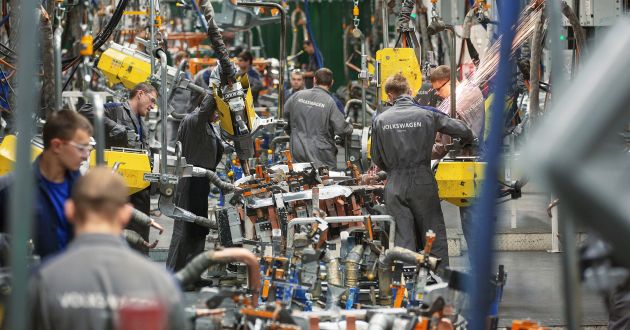
Volkswagen has not publicly said anything about potential job cuts nor factory closures, which triggered massive worker protests across company sites yesterday, according to the news agency. In Wolfsburg, around 400 workers blew whistles, waved red union flags and marched behind a banner reading ‘gemeinsam stark‘ (strong together).
Volkswagen works council head Daniela Cavallo said staff were not to blame for the sector’s crisis, and “great fear and deep uncertainty” were spreading across company factories and offices. The works council wants Blume to address speculation surrounding job cuts and plant closures by Friday, warning of more extraordinary staff meetings in the coming months otherwise.
The company faced mass strikes in December 2024, but there is currently an agreement for workers not to take industrial action while existing work contracts are in force.
Under Blume’s last restructuring deal, unions secured a commitment from management to avoid German plant closures, prompting Volkswagen to seek alternative uses for under-utilised sites, including looking for a defence-sector partner for Osnabrueck and considering producing models for China in Germany.
Mobility Global data estimates that the group’s German car plants will operate at 81% of standard capacity in 2026, and that this could drop to 73% by end-2030 even after the anticipated removal of Osnabrueck. Zwickau is forecast to have the highest utilisation rate out of the four sites threatened with closure at 88% in 2026, and this could fall to 42% by 2030.
Volkswagens Touareg, Touran and T-Roc Cabriolet, Audis A1, Q2, TT, R8 and Q8 e-tron, and Porsches 718 Boxster, Cayman and the original Macan are already gone or going – what’s next?
Looking to sell your car? Sell it with Carro.
 Volkswagen Tayron
from RM 190,660
Volkswagen Tayron
from RM 190,660  Volkswagen Golf R
from RM 338,812
Volkswagen Golf R
from RM 338,812  Volkswagen Golf
from RM 185,990
Volkswagen Golf
from RM 185,990  Volkswagen Golf GTI
from RM 244,012
Volkswagen Golf GTI
from RM 244,012  Volkswagen Touareg
from RM 384,972
Volkswagen Touareg
from RM 384,972  Volkswagen Arteon
from RM 291,012
Volkswagen Arteon
from RM 291,012 


With AI, Robotics, Automation reduced manpower vastly
slave labourer dislikes your comment
Very Worrying (VW)
1/poor reliability
2/dishonesty attitude
3/problematic post-warranty
Used to love VW. owned a few, last one being Passat 380tsi. Great cars to drive but what let’s if down is the cost cutting. horrible plastic components in the engine which can’t stand out heat. service charge equivalent to BMW and Mercedes. Spending 5k+ on service is not on. After warranty maintenance is crazy. The latest VW and Audi products are getting worse. They cheap out on even the interior plastics, buttons, sound proofing etc. We started looking at the rest and found that BMW and Mercedes also started cutting corners. Lexus still good. We ended up Chinese after shopping around . Just go and test out all the options in the market for the same price points and you will know VWs are now way overpriced for what they offer.
I’ve owned quite a few Volkswagens over the years (MK7 GTI, MK8 GTI, Arteon and Touareg) More recently, I’ve also spent plenty of time with several Chinese SUVs.
Chinese cars are great at making a strong first impression. You get leather everywhere, huge screens, ambient lighting and a long list of features. It feels luxurious at first.
But once you’ve lived with them for a while, you start to notice the difference. Volkswagen’s interiors aren’t designed to impress you for five minutes in a showroom. They’re designed to be used every day. The ergonomics, switch placement, seating position and overall usability show just how much thought the engineers put into them.
The biggest difference, though, is how they drive. Steering feel, chassis balance, body control, refinement and high-speed stability are still on another level. I haven’t driven a Chinese car yet that genuinely matches a well-engineered Volkswagen in those areas.
People often say German cars are overpriced. I don’t think that’s true, especially with today’s discounts. You’re simply paying for engineering, tuning and decades of development, not just bigger screens and softer leather.
stuck in traffic jam 90% of the time. most people neither need nor want those instangible traits that you described.
The days of Volkswagen are numbered
German makes should concentrate on the basics: affordable, reliable and simple to repair. Nowadays German makes are regressing backwards. Not meant to be repaired at all. Some cannot open bonnet. OTA update which can brick a car. Subscription this and that. Screens everywhere. Touch sensitive buttons instead of actual physical buttons.
Some like beemers are crazier. Example are like many plastic components like oil pan, radiator hose connectors. Some BMW don’t even come with a dipstick.
The only Lux car worth buying nowadays are Lexus, at least you have the renown toyota reliability behind it.