• Lexus RX facelift arrives – four in all, RM356k to RM525k

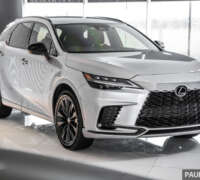
    Lexus Malaysia officially introduced the the facelifted RX last night – the reworked third-generation SUV makes its local debut just two months after its introduction in Geneva.

    A complete line-up makes its way in, four models in all, these being the entry-level RX 270, followed by the RX 350, RX 350 F SPORT and the range-topping RX 450h hybrid.

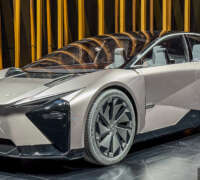
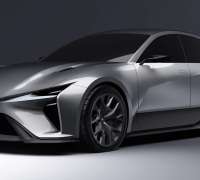
    Changes include a new front end, complete with the new spindle shaped grilled first seen on the LF-LC Concept, and most recently on the GS, launched here two months ago. The spindle grille will soon be adopted throughout the range to strengthen the Lexus family identity between model ranges, the company says.

    Aside from the new spindle grille, exterior revisions include a new front bumper as well as headlamps equipped with new LED daytime running lights, and the rear light cluster has also been redesigned. Also on is a new 19-inch wheel design, found on the RX 350 and RX 450h, wrapped with 235/55 series tyres (the RX 270 has 18-inch wheels, with 235/60 rubbers).

    Naturally, the interior gets reworked too, and features a new steering wheel with high quality wood and leather. For the first time, all RX variants are equipped with a second-generation Remote Touch Controller, which is linked to an 8.0-inch Electro Multi Vision screen and is equipped with navigation.

    Meanwhile, the RX 350 F SPORT adds performance dampers and an F SPORT suspension into the equation. There’s also F SPORT specific exterior trim, which is made up of a mesh grille, dark grey 10-spoke 19-inch alloy wheels and F SPORT badges on the front fenders.

    The interior on this one also gets kitted up to reflect a sportier tone, with aluminium panels in place of the more elegant wood inserts leading the changes. The seats get special F SPORT perforated leather and the six-speed automatic gearbox gains paddle shifters.

    No changes mechanically, with the same engine line-up as before. The front wheel-drive RX270′s 2.7 litre 1AR-FE four-cylinder mill offers 185 hp 5,800 rpm and 252 Nm of torque at 4,200 rpm, while the RX 350 and RX 350 F SPORT wear the 2GR-FE 3.5 litre V6 engine, with 274 hp at 6,200 rpm and 346 Nm at 4,700 rpm.

    The top-of-the-line RX 450h’s Atkinson Cycle 2GR-FXE 3.5 litre V6 engine continues with 245 hp at 6,000 rpm and 317 Nm at 4,800 rpm for output numbers as before, and in combination with a 123 kW electric front drive motor and a 50 kW rear motor, offers 295 hp in combined hybrid system output.

    As before, a three-block, 10-module-each 288V Ni-MH battery – located below the rear seats – continues to provide the necessary juice, and the powertrain is mated to an E-Four electronically-controlled continuously variable transmission.

    Standard kit on all four variants include a Lexus Premium Audio 12-speaker system and 10 airbags.

    Price-wise, the RX 270 goes for RM359,800, while the RX 350 is RM399,800. Opting for the F SPORT route takes the price to RM409,800, and the hybrid RX 450h features a marginal increase from before, at RM525,000.

     
  • 2013 Lexus ES sheds dowdy image, follows the GS’ lead

    When the Toyota Camry got renewed, it was just a matter of time before the Lexus that’s based on it was replaced as well, so the 2013 Lexus ES that debut at New York wasn’t unexpected. Compared to the smooth wallflower of old, the new ES gets a sharp new suit, wearing the spindle grille face and cues seen on the new GS, recently launched in Malaysia.

    For the first time, the Lexus ES will be available as a hybrid. Featuring a 2.5L four-cylinder Atkinson cycle engine, the Lexus ES 300h is expected to earn an EPA fuel economy rating of 40 mpg combined.

    This new, low friction DOHC engine features a sophisticated power management system, 12.5 compression ratio and VVT-i. The beltless motor is designed to improve fuel economy and durability, and a near zero evaporative fuel system helps reduce emissions.

    The Lexus ES 300h hybrid offers the driver four modes: Normal, Sport, Eco and EV. The latter allows short distance drives using only the power from the hybrid battery pack, something Prius owners can also do. Eco mode favors fuel economy while Sport mode increases powertrain responsiveness.

    The ES 350, on the other hand, is powered by a 3.5L V6 engine with Dual VVT-i, paired to a six-speed automatic gearbox. Suspension and steering changes and a stiffer body deliver more precise handling, while opposite-wound coil springs on the front suspension enhance straight-line stability, says Lexus.

    In the pursuit of better dynamics, Lexus also threw in revised rear suspension geometry and improved shock absorber damping characteristics.

    A reduction in the steering gear ratio delivers a more responsive and direct steering feel. Increased body rigidity is achieved through lightweight, high tensile strength steel, added bracing and additional spot welds. Despite being slightly larger and roomier, weight is reduced by almost 40 kg.

    The ES will roll on standard 215/55 low rolling resistance tyres on 17-inch alloys. For the first time, the entry luxury Lexus is also available with 18-inch high-gloss alloys.

    Like the exterior, the cabin is also much changed for the better. A newly sculptured seat design enhances comfort, while the steering wheel angle has been reduced from 24 to 22 degrees for a more “natural control position”. Fluid-filled engine mounts, new sound absorbing materials and a tuned engine intake minimise the intrusion of outside noise.

    Space wise, rear seat legroom and knee room have been improved, by 104 mm and 71 mm respectively. There’s also additional foot room below the front seats. The new ES’ wheelbase is up by just 46 mm, so better packaging is responsible for this jump in space. The new ES will feature enhanced NuLuxe seating surfaces, developed to reduce environmental impact. Genuine leather is also available, as is semi-aniline hide for an even more luxurious feel.

    Available comfort features include manual door window shades, a power rear shade and a power trunk closer. Optional ambient lighting, discretely placed under the wood trim, softly illuminates the surfaces of the instrument panel and all four doors.

    The new ES is further proof that Lexus is serious in fulfilling its promise to add dynamism in both looks and drive. Of late, Toyota’s luxury brand has been losing ground to the Germans in the crucial North American market, and we’re seeing a range renewal to address the slide. Read the brand’s plans here.
    Read more ›

     
  • Lexus GS launched; five variants from RM366k to RM464k

    Lexus Malaysia has just launched the new Lexus GS, which I drove it – for a very short time – not too long ago.

    There were five variants launched at the event – the GS 250, GS 250 Luxury, GS 250 F-Sport, GS 350 Luxury and GS 350 F-Sport. So in all, there are three different trim levels and two engine options. The three trim levels, if you have not guessed already, are standard, Luxury and F-Sport, which I will explain later.

    We’ll start with the engines. The Lexus GS gets a choice of two powerplants; both are 24-valve V6 engines with Dual VVT-i. The 3.5 litre 2GR-FSE produces a maximum power of 312 hp at 6,400 rpm and 378 Nm of torque with a 0-100 km/h of 6.3 seconds and a top speed of 235 km/h. The 2.5 litre 4GR-FSE is good for 206 hp at 6,400 rpm and 253 Nm at 4,800 rpm with a 0-100 km/h of 8.8 seconds and a top speed of 230 km/h.

    The engines are installed with something called a Sound Generator that raises the sound pressure of specific frequencies at the intake area to create a pleasant engine sound. This is a first for Lexus.

    Both engines are paired with a 6-speed Super ECT with A.I. Shift automatic transmission that sends power to the rear wheels. The transmission features a manual interface, the ability to enable faster shift speeds, earlier torque convertor lock-up and downshift throttle blips – all of which can be altered via the Drive Mode selector.

    There are four modes to choose from – ECO, Normal, Sport and Sport +. In ECO, the GS’s throttle mapping is revised as well as the seat heating and climate control systems to give a better fuel economy. Transmission is also set for a more un-rushed drive and avoids unnecessary use of fuel. Also in ECO, the meter lighting changes to blue.

    In Sport, the throttle mapping and transmission shifting priorities are set to make the best out of the engine. Needless to say, the driver will experience a stronger acceleration and more responsiveness. The meter cluster in this mode changes to red.

    Sport +, which is only available in the Luxury and F-Sport variants, changes the characteristics of the engine, the transmission, suspension and steering. In this setting, the difference between the inner and outer shock absorber damping through corners is increased to cut body roll. The electric power steering (EPS) is also sharpened and optimised to give a better driving dynamics.

    The GS features Lexus’ latest Vehicle Dynamics Integrated Management (VDIM), which also integrates the newly developed Lexus Dynamic Handling (LDH) system that calculates the optimum steering angles for all four wheels and responds to the driver’s input.

    The GS 350 F-Sport’s LDH also includes a Dynamic Rear Steering (DRS). This system monitors the vehicle speed and yaw rate, steering angle and speed and lateral G and adjusts the rear wheel angle to 2.0 degrees.

    The GS also gets new suspension bits. The front has a double wishbone front and multilink rear suspension system.

    Back to the equipment levels. The standard GS 250 is only available with the 2.5 litre engine. The interior is finished in leather and the seats are wrapped in smooth leather. The front seat is power adjustable in 10 different ways and it’s the only seat that has a memory setting. The climate control is a dual-zone automatic system and it comes without sunshades. On the dashboard, the LCD screen size is 8 inches and the sounds come from a Lexus Premium Audio 12-channel speaker. Outside, the standard GS does not have adaptive front light, has 17 inch wheels and does not come with a Sport + mode.

    The GS 250 Luxury and GS 350 Luxury are available with both engines. This variant gives you adaptive front headlights, 18 inch wheels and Sports + mode. Additionally, the interior is finished in wood and leather, the seats are wrapped in Semi-Aniline leather and the front seats are 18-way adjustable. Both front seats also have memory setting. As for creature comforts, the air conditioning is a automatic 3-zone system and there are sunshades for the rear window and rear door windows. There is a 12.3″ screen up front and the sound is hooked up to a Mark Levinson 17 speaker system.

    As for the F-Sport equipped models, which you can have with either the 2.5 litre or 3.5 litre engine, you’ll get the 16-way adjustable seat for the driver and a 10-way adjustable seat for the passenger. The other interior equipment mirrors to the ones you can find in the Luxury variant. Extra for the F-Sport are exclusive front grille and bumper, rear bumper, lip spoiler, dark alloy wheels and upgraded front brakes. The change in front bumper means that the F-Sport also loses the fog lights. The front and rear suspension systems are also retuned in the F Sport to make better use of the adaptive variable suspension system, which makes the F Sport a more sport-focused machine.

    The GS offers 10 airbags, including a knee airbag for driver and front passenger; rear gets protection from seat-mounted side airbags. The brakes have been tweaked as well. The brake booster power has been increased for instant response and brake-cooling performance has improved airflow to minimize brake fade.

    The F-Sport gets bigger ventilated front discs. Notably, the hat section of the two-piece rotor has been fabricated in aluminium to reduce weight and suppress heat deformation – Lexus claims this is a world’s first.

    The Lexus GS is built in Toyota’s advanced Tahara plant in Japan. It comes with a 3-year or 100,000 km warranty.

    The price, on-the-road without insurance, for the GS 250 is RM366,200; GS 250 Luxury is RM398,660; GS 250 F-Sport is RM400,600; the GS 350 Luxury is RM456,800 and the GS 350 F-Sport is price at RM464,800.

    Lexus are taking orders now. In fact, they’ve already been doing so for the past two months. Last tidbit: I heard, as I was walking to my car, a sales lady telling a potential customer that if he books the GS now, he’ll probably get it in the middle of the year. That’s a quick delivery time, isn’t it?

     
  • DRIVEN: Lexus GS 250 Luxury & GS 350 Luxury previewed

    There exist only two kinds of cars in this world with this level of noise inside the cabin – a hybrid and an electric. Both of which is what the new Lexus GS is not. Yet, the deafening silence keeps deceiving my noggin into thinking otherwise.

    Right now, I’m in the Lexus GS 250 Luxury Trim. I’ve been told that in total, there will be three trim-levels and two engines choices for the GS. The three trim-levels are standard, Luxury and F-Sport. You can have your Luxury and F-Sport with either the 2.5 litre or 3.5 litre engine, or the GS 250 and GS 350 respectively.

    The Luxury Trim falls in the middle, between the standard and the F-Sport. However, having the Luxury tag means that it gets all the pomp and circumstance, making this the crunchy peanut butter in a PB sandwich.

    It has a huge 12.3 inch display in the centre console, plenty of leather, some nice tactile plastics, dark wood finishes and an analogue clock that is a must for all luxury cars.

    What else… the indices of the meter cluster has a subtle matte sheen effect, the steering wheel has a nice meaty feel and the driver seat can be electronically adjusted to make it feel as if you’re in a bucket seat or a La-Z-Boy chair. And that Mark Levinson 17-speaker sound system sounds delicious.

    One improvement that I can immediately tell is the Remote Touch Interface. It still retains the mousey configuration, but this time it is more of an Apple mouse rather than a PC mouse. You see, in its previous incarnation, you select your option by pressing a button on the side of the controller. This one, you press down on the controller to select your option, which makes it more intuitive.

    And, Lexus has put more feedback, in the sense that there is some resistance when moving from option to the next. Elsewhere, the parking brake is fully automatic – pop the gear lever into ‘P’ and the parking brake engages automatically. Pop it out of ‘P’, well, you get the drift.

    So, the car creeps out quietly out of the parking lot. The GS 250 is in ECO mode, which kills anything that remotely resembles power in the car. The accelerator pedal feels like a sponge and the engine response is almost two years too late. The upside is there are three more drive modes above ECO – Normal, Sport and Sport +.

    There isn’t much difference between ECO and Normal, both having similar throttle and engine response characteristics. The only major difference in how hard the air conditioning blows, which for ECO’s case, it blows softer.

    As for Sport mode, the GS 250 gets a sharper throttle and remaps the gear’s shift points. Sport + will give you everything from Sport, plus a firmer suspension and a tighter steering.

    Dial the knob to Sport and the car gets more fun to drive. A nudge in the throttle quickly puts some speed into the GS 250. The 2.5 litre 4GR-FSE has 206 hp and 253 Nm. No official 0-100 km/h or top speed figures but it feels like it’ll do the century sprint under eight seconds. The engine is mated to a 6 Super ECT close-ration 6-speed conventional automatic gearbox that sends power to the rear.

    Handling-wise, the GS 250 in Sport has a sizable body roll to deal with; the suspension is not altered in any way. Although the GS is rear-wheel driven, the nose tends to push itself away from the corner instead of sniffing the apex.

    In Sport + mode, the GS 250 feels much quicker. The shift points are stretched deeper into the revs and sensitive to the throttle. Which means, you can hold the rev steady in the sweet spot while going through a fast corner. Then put your foot down for a speedy exit. The Sport + does a very good job in restraining the body roll. Again, there is a hint of understeer that makes it constantly want you to feed it a bit more steering; just a bit more.

    I can’t say much for the steering wheel, except that it needs to be more chatty. It’s nearly uncommunicative, even in Sport mode. Sport + puts more feel into the wheel, but only just.

    Is it boring to drive? Not quite. Push the throttle pedal closer to the floor and you’ll hear some encouraging noises coming from the front. Lexus has given the engine more roar by way of a Sound Generator at the intake area. They’ve also tuned the muffler to give a more sporty sound when taking off from standstill. That said, it still sounds soft in the GS 250. To really hear the noise, you need to be inside the GS 350.

    Basically, the GS 350 has everything the GS 250 possesses, except that it has a bigger engine. The 3.5 litre 2GR-FSE engine generates 312 hp and 378 Nm of torque, and obviously feels quicker. Again, no official numbers on the century sprint, but it feels close to about 6.5 seconds. The transmission is the same one as found on the GS 250.

    As for handling, the GS 350 does feel hairier around the corner mainly because of the entry and exit speed. I’d still wish for more steering feel though.

    The drive for both cars ended far too soon. This was a preview drive after all, so there was only a short 15 minutes allocated to each driver for each car. As soon as we can secure an extended test drive, we’ll be bringing you a detailed review on these two. No word on the price yet, but the official launch will happen later in the day, so more to come soon.

     
  • Sexy Lexus LF-LC Concept has 50% chance at production

    Remember the sexy red Lexus LF-LC concept we were raving about earlier in the year? The Detroit showstar went on to bag this year’s EyesOn Design Award for best concept car at Detroit, and most commentators were also generous in their praise. The bosses at Toyota has heard the chorus of good reception, and the LF-LC now stands a chance at making production!

    “A decision has not been taken. But we’re now up to a 50% chance from a 0% one. Every top Toyota Motor Company manager is aware of the great reception it has received and now we’re talking about how we can do it and fit it into the product plan,” Lexus product planning chief Karl Schlicht told Autocar UK at Geneva.

    Schlicht, who will be product planning head at Toyota and Lexus Europe from next month, said that the idea for such a dramatic Lexus production car would have been binned by Toyota top brass if not for the concept car, which was designed by the Calty Design Centre in America. The folks at sunny California were “let loose” and only had one brief – it must be a 2+2 coupe.

    “The only parameter was size. We wanted the designers to create excitement. We’d never get it built from a product planning point of view on paper, but people have seen the concept and fallen in love with it. Dealers have gone crazy for it as well,” Schlicht added.

    Click here to view our previous post and full gallery of the LF-LC.

     
  • Lexus RX facelift – leaked images ahead of Geneva debut

    You’d figure that automakers might as well get it over and done with, release images the moment they’re ready to go, because with increasing alacrity does the inevitable happen more than not these days, in this case the leaky boat syndrome.

    The next paddle steamer to take water is Lexus’ refreshened RX, which is set to debut in Geneva next week. First, images of the reinterpreted third-gen SUV broke via a brochure a little while back, and if that ha-ha moment wasn’t enough, further images of the vehicle have now surfaced on the Web.

    The RX 450 h and the first F Sport interpretation of the full hybrid luxury SUV are the Swiss show premieres, and the vehicle wears a new front fascia, replete with a spindle-shaped grille, reminiscent of that seen on the striking LF-LC Concept. As for the entire lowdown on the new RX, Geneva will provide the necessary, unless another hole springs up before then, of course.

     
  • VIDEO: New Lexus GS and swimsuit model Tori Praver?

    Hot women and race tracks have one thing in common – CURVES! Lexus puts them both in one video by creating a small track based on a photo of Sports Illustrated Swimsuit Model Tori Praver and then taking the new Lexus GS around it. They even created a “Tori 500″ iPhone app for you to drive around it yourself.

    The new Lexus GS will be launched in Malaysia soon and bookings are open, as well as a price list, which ranges from RM370k to RM488k OTR excluding insurance. Both the regular GS and the GS F-Sport are available, and you can have either the GS 350 with the powerful 3.5 liter V6 engine, or the new baseline GS 250 with a roadtax-friendly 2.5 liter V6.
    Read more ›

     
  • New Lexus GS is coming soon – now open for booking

    Lexus Malaysia has opened order books for the all new Lexus GS, which means you can now put your name down to be one of the first owners of the GS when it arrives soon.

    First unveiled at last year’s Pebble Beach show in the US, Lexus’ challenger to the BMW 5-Series, Mercedes E-Class and Audi A6 is a huge departure from the car it replaces, looking more dynamic and sporty than its German classmates, something it has never been before this generation.


    Click to enlarge

    There are quite a few variants to choose from. Lexus Malaysia will import in the GS 250, GS 250 Luxury and GS 350 Luxury. By the way, this is the first time Lexus is putting an engine below 3.0L in the GS, allowing it to better match German rivals, who all have lower entry points. F-Sport variants for both engines will also be available.

    The GS 250 is powered by a 2.5-litre V6 with D-4S direct port injection and Dual VVT-i. Maximum output is 206 hp at 6,400rpm and peak torque of 253 Nm is delivered at 4,800 rpm. 0-100 km/h is done in 8.6 seconds on to a top speed of 228 km/h. The V6 is matched to a Super ECT-i close-ratio intelligent six-speed automatic transmission, with sequential manual shift function. It’s likely that most GS buyers will opt for this engine.


    Click to enlarge

    There’s also a good selection of colours available, both for the exterior and cabin. Prices range from RM370k to RM488k OTR excluding insurance. We’ve seen it in the metal and sat in it before, at motor shows, and can say that the GS has never been more desirable.

    Click here for full details and a hi res gallery.

     
  • Lexus LF-LC Concept is the fairest of them all in Detroit

    Think the Lexus LF-LC Hybrid Sport Coupe Concept is a stunner? Well, you’re not the only one then; those in the industry seem to think so as well – a group of leading automotive designers and design academics have named the car the top design concept at the NAIAS.

    The Detroit debutant bagged this year’s EyesOn Design Award for best concept car. Created by Lexus’s Calty studio in Newport Beach, California, the design of the 2+2 coupe explores how a future redefinition of Lexus design might take be like, with a more emotive and avantgarde approach.

    The EyesOn Design Awards are given in recognition of skills and creativity in different areas of design for both concept and production vehicles, including Aesthetics and Innovation, Concept Implementation, Functionailty and the Spirit of Industrial Design.

     
  • Lexus LF-LC Concept fully revealed, and it’s spectacular!

    The Lexus LF-LC Concept has been officially revealed, and it’s one heck of a concept car. If I were at Detroit’s Cobo Hall, I can imagine spending good time just standing and staring at this sculpture. Awe inspiring, and check out that cabin!

    Challenged by the Lexus Center in Japan to come up with a design for a future hybrid sport coupe concept, the company’s Calty design studio in Newport Beach, California, sought to “advance the redefinition of Lexus” with emotive, avant-garde beauty and advanced technology, yet remain within reach for premium buyers.

    The movement is not new. “The concept we’re showing here in Detroit continues the Lexus design revolution started with the CT and GS. The concept hybrid 2+2 liberates the idea of a sport coupe and pushes the boundaries of performance, style and technology,” said Mark Templin, Lexus Group VP and GM.

    The LF-LC displays the new Lexus design language in its bold interpretation of the signature Lexus spindle grille and rear architecture. Silky curves blend smoothly into dynamic angles, creating a nice blend of lines, shadows and corners.

    Framed by a deep aluminum surround, the mesh pattern of the spindle grille takes 3D sculpture form, and the air intakes are functional. Daytime running lights are shaped like an “L” while the vertical fog lamps use a fading dot matrix pattern to suggest a sense of movement.

    The concept car’s glass roof features a lightweight, cantilevered pillar with a glass-to-glass juncture inspired by modern architecture. A rising, kick-up window graphic and polished aluminum trim are unexpected elements. Overall, the greenhouse design enhances driver visibility while adding to the sleek lines of the car.

    Lexus integrated the spindle grille theme to the rear as well. The tail lamps, inspired by the look of a jet afterburner at take-off, use inner lighting to create a sense of depth. The rear is also fitted with fog lamps, repeating the fading dot matrix pattern of the front. Visually, the integrated tail and fog lamps repeat the “L” shape and lead eyes down to the quad exhausts.

    The cockpit is spectacular. The driver is enveloped by deeply scooped side panels and a high, curved console. The effect is to focus the driver zone on the controls and on the road. LF-LC incorporates a remote touch-screen device that allows operation without shifting altering line-of-sight. Twin 12.3-inch LCD screens provide information and navigation display. A pop-up touch-screen keyboard is used to control the ICE, climate and navigation.

    Never mind all that, just look at the organic shapes and nice blend of metal trim and wood accents. The beautiful stitch details emphasise the attention to detail here.

    This is a design concept, so all we know mechanically is that the LF-LC is a front-engine, rear-wheel drive car featuring Advanced Lexus Hybrid Drive.


Archives