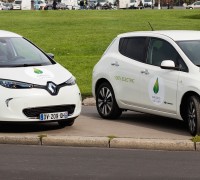
• ETCM forms First Energy Networks – subsidiary to build and operate charging infrastructure and system for EVs

    Nissan looks like its ready to up its EV game here, what with Edaran Tan Chong Motor’s recent announcement of the incorporation of a wholly-owned subsidiary called First Energy Networks. The start-up’s principal activity, according to the statement made in its filing to the Bursa, will be to build and operate the charging infrastructure and system for electric vehicles and any related facilities.

    The company already has the Nissan Leaf about, though the EV isn’t running commercially, but as part of a pilot programme to create public awareness of the car and the tech. Still, the move beyond just that now looks certain, and with the formation of the new subsidiary, ETCM looks like it’s planning early for the future.

    Perhaps it’s all spurred by the suggestion that the Government may pile on more incentives for hybrid and EVs. Reports indicate that the Government is looking at various avenues to help spur the uptake of such vehicles, and the incentives will supposedly be revealed when the second revision of National Automotive Policy is announced sometime this year.

     
  • Nissan achieves record sales, first quarter profit doubles

    Nissan is doing well compared to its Japanese peers. It was announced that profits made a sharp jump in the first quarter of 2012 on the back of an aggressive push in fast-growing markets. The Yokohama-based company reported a net profit of 75.3 billion yen (US$943 million), up from 30.8 billion yen from 2011.

    Global sales hit 4.8 million units in its 2011 financial year, a company record. For the full FY ending in March 2012, Nissan reported net income of 341.4 billion yen, a 7% rise on the previous year. Japan’s second-biggest carmaker outperformed rivals Honda and Toyota, both of which reported lower profits.

    The past 12 months have been a tough one for Japanese carmakers. The tsunami and earthquake disaster in Japan disrupted production lines and caused power shortages. And just when they were back on steam, the massive floods that covered Thailand – a regional base for most Japanese brands – bogged them down again. Nissan bounced back faster from these setbacks to create today’s headline.

    In addition to the natural disasters, a strong currency has hurt Japanese exporters as it makes their goods more expensive overseas and eats into the profits they bring back. “It is an even more encouraging performance given the headwinds created by natural disasters, an over-valued yen and uncertain global economic conditions,” underlined Nissan’s CEO Carlos Ghosn.

    No resting on laurels – Nissan is predicting an even better showing for the current financial year. Global sales is forecasted at 5.35 million units, an increase of more than 10%, while net profits are predicted to hit 400 billion yen.

     
  • Nissan Juke-R goes into production, very limited run

    Good news. The Nissan Juke-R will go into production. The bad news: Juke-R will be made in limited numbers on built-to-order basis. The price remains undisclosed but as my ex-Creative Director once told me, “If you need to ask for the price, you cannot afford it.”

    There are three reasons why the Juke-R will be made; two of the reasons are high-profile and well-respected members of Dubai society. No hint on who the third person is. You see, the Juke-R made its debut in Dubai in January and have without a doubt caught the eye of some the nation’s elites.

    Gareth Dunsmore, Marketing Product Manager for the Juke, said: “With such a strong reaction, and with three genuine offers on the table, we decided we had to make the car a reality. We can’t let down enthusiasts who are this keen to add to their collection of cars. The Juke-R has become something of a phenomenon and I’m enormously proud of the impact it has had. There will be more news to come on Juke later in the year.”

    While the original Juke-R was based on the MY10 GT-R running gear, the production Juke-R will get the drivetrain and chassis of the MY12 GT-R. As a recap, the Juke-R has a 3.8 litre engine that produces 545 bhp and can reach a top speed of 160 mph, or about 257.5 km/h.

    Nissan will be taking orders in the coming four weeks before officially starting production. The first three owners will get their cars in late summer. If you want to get one, here’s the email address Juke-R@Nissan.co.uk.

    The video below shows what the Juke-R was up to in Dubai. Watch out for the über-cool helmet with teeth.

     
  • Renault-Nissan buys majority stake in Russia’s AvtoVAZ

    The Renault-Nissan Alliance and state corporation Russian Technologies have agreed to create a joint venture that will takeover AvtoVAZ, Russia’s largest carmaker. The deal, which will see Renault-Nissan invest about US$750 million, gives the Alliance an indirect majority stake in AvtoVAZ, maker of Lada cars.

    The US$750 million investment will give the French-Japanese car group 67.13% of the joint venture. The JV will then hold 74.5% of AvtoVAZ. The transaction is expected to be complete by 2014.

    Renault has a relationship with AvtoVAZ prior to this. In 2008, it purchased 25% of AvtoVAZ and helped steer the Russian company in an aggressive turnaround. It will invest about US$300 million in the JV. Japanese partner Nissan, which does not have any stake in AvtoVAZ, will part with US$450 million.

    This comes a month after Russian Prime Minister Vladimir Putin inaugurated a US$525 million assembly complex in AvtoVAZ’s Togliatti factory, adding capacity of up to 350,000 cars per year. Now, the factory has a capacity of almost one million cars per year.

    Renault, Nissan and Lada are launching a product offensive that will update all core Lada models and launch new cars across three brands, including five models from the newly inaugurated facility. In addition to Togliatti, the three brands operate plants in Moscow, St. Petersburg and Izhevsk.

    With everyone’s full focus on China, Renault-Nissan is making a good move in deepening its roots in Russia. The former USSR is the fastest growing economy in Europe and has a growing population of upper- and middle-class consumers. More than 10 million Russian households already earn more than US$50,000 per year.

    Total industry volume in Russia last year was 2.65 million vehicles, including light commercial vehicles. Of this, the Alliance sold 878,990 cars, including 578,387 Ladas. With a market share of nearly 33%, Russia is the Alliance’s third largest market after China and the United States.

    I wonder if there are any Lada Nivas still running around in Malaysia.

     
  • New Nissan Cima – the long wheelbase Infiniti M35h

    The Cima luxury nameplate is back, after Nissan announced in 2010 that had stopped producing the Japan market Cima and President. No V8 engine this time around, and if the curvy looks are familiar, yes, it’s a long wheelbase version of the Infiniti M, or Nissan Fuga in Japan.

    To go on sale in Japan later this month, the new fifth-generation Cima is based on the current Y51 Fuga/Infiniti M. The 5-Series rival’s 2,900 mm wheelbase has been extended by 150 mm to make the Cima, which is traditionally chauffeur driven.

    The Cima’s “first-class hospitality” features soft, premium semi-aniline leather and wood grain panels coated with genuine silver powder, which gives them a mirror finish.

    There’s also the “Forest AC” air con system, ventilated/heated seats and a powered ottoman-style legrest. A Bose 5.1 Surround Sound System for the rear seats with 16 strategically placed speakers does ICE duties. Seven-inch VGA displays are installed in the front seat headrests.

    More comfort comes in the form of overhead reading lights for the two rear seats, rear illuminated vanity mirror, electrically operated rear sunshades, and switches in the rear center armrest for audio/air con/seats.

    Rear door “auto closer” shuts the doors tight with minimum effort from the user, also applicable to the boot. Sound-absorbing tyres (first time for a Nissan) and Active Noise Control tuned for the rear cabin ensure silent progress.

    Under the hood, the Cima uses the Infiniti M35h‘s “Intelligent Dual Clutch Control” (one-motor two-clutch) parallel hybrid system. It combines a VQ35HR V6 with 306 PS and 350 Nm with an electric motor with 68 PS/270 Nm. Connected to these are a lithium-ion battery and a seven-speed automatic gearbox.

    The Cima achieves both a 20% improvement in fuel economy over 2015 standards and SU-LEV certification, emitting 75% less exhaust emissions than 2005 standards. This means that under the Japanese system, the Cima is fully exempt from automobile acquisition tax and automobile weight tax.

    We will never get the Cima here, but the RM500k Infiniti M35h is pretty much the same car without the extra long wheelbase.

     
  • Nissan Leaf driven around the block – you can try it too!

    We just got back from Edaran Tan Chong Motor’s Petaling Jaya showroom, where the Nissan Leaf pilot program was launched yesterday by Datuk Seri Mustapa Mohamed, Minister of International Trade and Industry. The Leaf show is ongoing, and will be open to the public for test drives around the block this weekend

    I stepped in and was immediately impressed with the Leaf’s cabin. It feels light and airy inside and the seats are comfortable, something one can also observe in the Sylphy and Latio. It feels special enough, too, so there’s no mistaking the Leaf for a normal car from behind the wheel.

    There’s a Civic-style upper tier speedo, and the main binnacle is a multi-coloured blend of various displays. There’s a power bar made of dots, almost like an F1 style rev meter, flanked by battery charge level and battery temp. Planted between the seats is the special looking gear knob. Push up to reverse, down to drive, press to park – simple.

    The piano black centre stack looks like a tablet stuck on the dash, and the central colour LCD shows a wealth of information such as real-time power consumption, with a break down to see how much juice the climate control and accessories are actually sucking. You can also check consumption history here.

    Off we went from Jalan Kemajuan heading towards the Sprint Highway. I’ve driven a few EVs now, so the Leaf doesn’t shock, but I’m impressed with the lack of rolling noise/tyre roar compared to some other EVs. If you haven’t driven one before, the lack of noise and vibration will be the most jarring difference from a regular vehicle. It’s very serene and peaceful in the Leaf.

    The Leaf’s controls are lightweight and effortless to operate, as one would have guessed. I wasn’t expecting so, but ride comfort is rather good – the suspension damped away the harsh effects of rumble strips and manholes served up by Jalan Dato Abu Bakar.

    We got to stretch the EV a bit once on the Sprint, and acceleration is very strong off the mark thanks to 280 Nm of torque from standstill. The pick-up rate slows down once up to highway speeds, but I can already see the surprised faces of unsuspecting hot hatch drivers!

    The wave of acceleration is accompanied by a faint “woooooo” sound – no drama involved. There’s also a distinct “lack of resistance” from the drivetrain, which contributes to the feeling of effortlessness. Top speed is “over 140 km/h” but we didn’t have the chance to try.

    Back at base, I hopped into the rear quarters to find my 175 cm frame fit nicely, which means that taller folks are likely to face headroom issues. No such issue up front, since the rear seats are slightly elevated “stadium style”.

    I also noticed that while there’s good knee room, there’s no gap for my feet to slip under the front seats. By the way, the 24 kWh laminated lithium-ion battery pack, consisting of 192 cells, is spread out beneath the cabin. In the US LA4 mode, which Nissan says is realistic, a full charge of eight hours delivers a 160 km range. A full charge will add about RM7.90 to your TNB bill, so it’s cheap to run.

    No commercial sales yet though, and public awareness is the main goal for ETCM now. Full EVs are a different kettle of fish from hybrids, which requires no compromise on the buyer’s part. But I’m sure you and me can buy a Leaf some day – you don’t register 10 costly EVs and start a pilot program without the intention to sell, right?

    Speaking of which, ETCM is on the lookout for ambassadors to drive the Leaf for up to six weeks – no celebs, real people, real routines. This will go on for the rest of this year. Register your interest at this weekend’s event or online.

    I’m sure the chosen ones will have real fun experiencing zero emissions motoring. For them, motoring life might never be the same again!

     
  • Nissan Leaf EV pilot program launching this weekend


    UPDATE: The Leaf pilot program was officially launched today by Datuk Seri Mustapa Mohamed, Minister of International Trade and Industry at ETCM’s PJ showroom

    We know that the Nissan Leaf electric car is in town, ready to star in a pilot program by Edaran Tan Chong Motor. Looks like the public launch will happen this weekend in PJ, as seen on an invite posted on Nissan Malaysia’s Facebook page.

    Since its a pilot program and not commercial sales, we figure that the battery powered Leaf will be loaned out to individuals for tests. On sale commercially elsewhere, the Leaf is the reigning Japanese Car of the Year for 2011-2012, the first EV to win the award. The Leaf is also the 2011 European Car of the Year and the 2011 World Car of the Year winner.

    Stay tuned for updates!

     
  • Nissan GT-R Track Pack – a leaner and meaner GT-R

    Here is the Nissan GT-R Track Pack, the latest version of the Japanese supercar for those who think that the current Godzilla is not Godzilla enough. Nissan says that the Track Pack is more focused to set lap times on the racetrack while still remaining completely road legal. And unlike other aftermarket modifications, Mr. GT-R himself, Kazutoshi Mizuno has given his full blessing to this car.

    The philosophy behind the Track Pack is not to tinker with the powertrain to increase its power. So the figures of 550 PS and a century sprint of 2.6 seconds remain. Instead, the Track Pack adds more lightness to the car as well as handling-focused parts.

    The Track Pack features special lightweight six-spoke RAYS alloy that shaves 10 kg off the standard car. The front brakes now have additional cooling ducts built into the carbon front splitter that reduces operating temperature by 100 degrees during track use. As for the back, similar ducts channels cool air over the rear discs.

    Suspension has also been turned up to 11. It consists of a harder set-up and uprated body rigidity that have had input from GT-R development driver Toshio Suzuki during testing at the Nurburgring. The Track Pack also comes with special dampers that, with a flick of a switch, will make the ride bearable for road-use.

    The rear bench has been deleted and track-ready sport seats wrapped in what Mr. GT-R calls ‘magic cloth’ replace the front seats. It is made from a blend of fabric and leather, and is said to have a vice grip on the occupants during hard cornering and braking.

    There’s also a Track Pack emblem on the dashboard to help set itself apart from the rest of the pack. This GT-R also comes with comfortable seat belts, enhanced Bose sound system and rear-view camera as fitted on the MY2012 GT-R.

    This new GT-R comes at a price of £84,450, which is £10,000 more than what Nissan is asking for the standard car. This car is only officially available in UK and Japan.

     
  • Nissan invites all of you to test drive this silhouette

    Remember that teaser graphic that went up on Nissan’s website a while back? It is now changed and with it comes an invitation.

    From May 5 to May 6, you can test drive the car which the silhouette belongs to. The test drive, open to public, will be held in ETCM’s showroom in Jalan Kemajuan, Petaling Jaya between 9.30 am to 6.00 pm.

    The car that you will drive is an all-electric vehicle. Judging from the silhouette, we’ll take a guess that it is the Nissan Leaf – it has all the telltale signs.

    If you want to know (read: teased) more, then click on www.nissan.com.my/EV/media.

     
  • Nissan Sylphy gets new engine and updated CVT

    Nissan has released the new iteration of its Sylphy, the compact sedan which pitches against the Toyota Corolla and Honda Civic, and you saw it here first at Auto China 2012.

    Apart from the addition of daytime-running LEDs, new headlamps and a new grille, it isn’t exactly worlds apart from the previous-gen model when you look at it from the outside. Interior amenities include dual-zone air con and keyless ignition.

    However, the real changes are underneath. A new 1.8 litre MR engine is offered with Nissan’s Twin C-VTC technology. Like Toyota’s Dual VVT-i, the system continually alters the opening of both inlet and exhaust valves to suit driving conditions. The result is better fuel efficiency and more power.

    The valve lifters are also now coated with a hydrogen-free, diamond-like carbon (DLC) to reduce friction. There is a change to the transmission too – the Xtronic CVT’s gear ratios are now wider, and the gearbox is lighter and smaller.

    Built under license in Guangzhou by Dongfeng Nissan, the Sylphy will hit Chinese showrooms later in the year, and will be available in 120 countries around the world by 2014. It’s safe to say Malaysia will be among them.

    UPDATE: More live gallery photos added, after the jump.
    Read more ›


Archives