
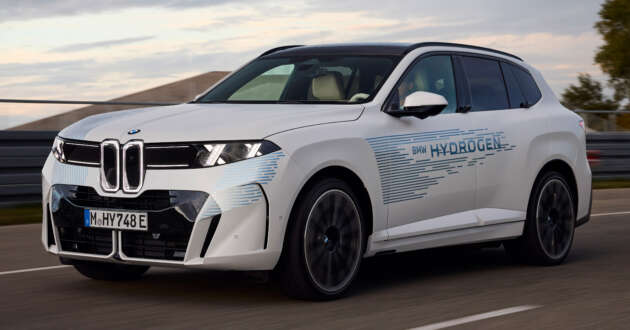
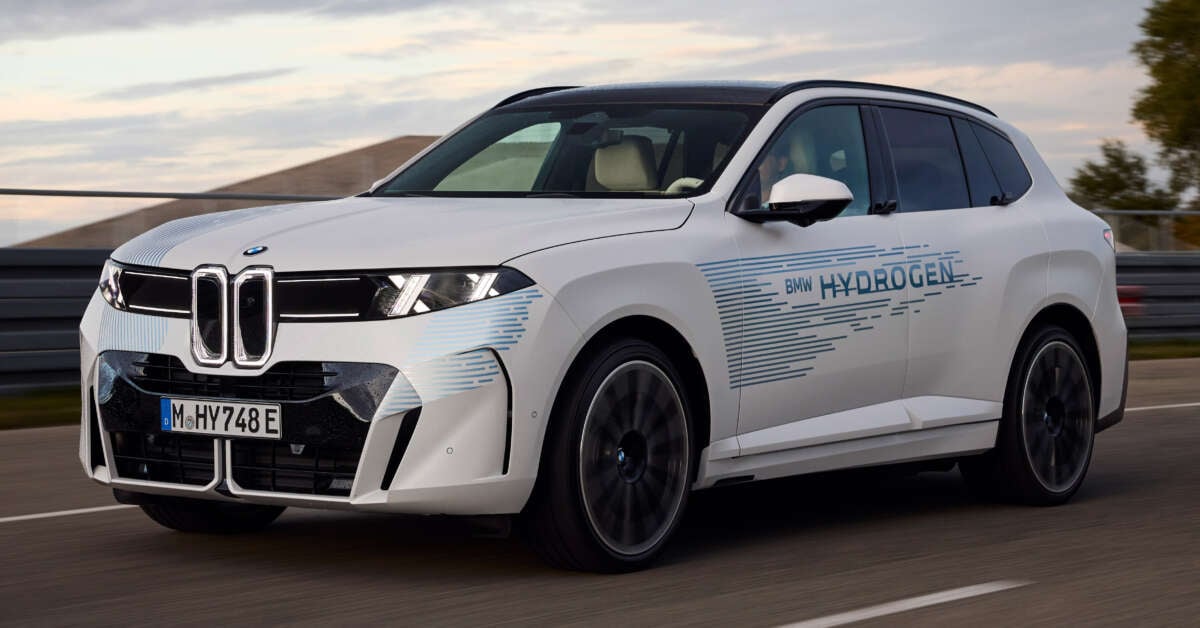
The upcoming BMW iX5 Hydrogen has reached the next development phase as it edges closer to series production and joining the G65 line-up in 2028. According to the company, the focus now is on further validation of its third-generation fuel cell system, which will be produced at the company’s engine facility in Steyr, Austria and was co-developed with Toyota.
Prototypes of the iX5 Hydrogen are currently subject to tests under demanding environmental and operating conditions. This is to ensure full performance capabilities of the drivetrain at all times, including systems such as the fuel cell, electric motor and high-voltage battery.
The BMW Hydrogen Flat Storage system is also part of the validation process and features seven high-pressure (700 bar) tanks made of carbon-fibre reinforced composite that are connected with one another in parallel in a metal frame.


A central main valve controls several connected chambers to form an enclosed unit, which optimises storage that affects range. BMW says the system can store at least seven kg of hydrogen and be refilled in five minutes, providing up to 750 km of range.
There’s also the Energy Master, a central control unit for the high-voltage system that sits above hydrogen storage system. Development and production of the Energy Master are being carried out fully in-house for the first time, the latter being at BMW Group Plant Landshut in Germany. BMW says it is targeting a 0-100 km/h time of five seconds for the iX5 Hydrogen.
In conjunction with validation testing, the fuel cell system also enters the next prototype assembly phase where the company establishes the necessary conditions for robust and efficient manufacturing processes. As this isn’t a lab experiment but a mass-production model, ensuring robust and efficient manufacturing processes is important to getting the zero-emissions vehicle to market.






 BMW iX3
from RM378,800
BMW iX3
from RM378,800  BMW M3 Touring
from RM898,800
BMW M3 Touring
from RM898,800  BMW iX1 L
from RM252,800
BMW iX1 L
from RM252,800  BMW iX
from RM425,800
BMW iX
from RM425,800  BMW X3
from RM325,800
BMW X3
from RM325,800  BMW M5
from RM1,200,800
BMW M5
from RM1,200,800  BMW M4 Coupe
from RM878,800
BMW M4 Coupe
from RM878,800  BMW 2 Series Gran Coupe
from RM173,800
BMW 2 Series Gran Coupe
from RM173,800  BMW 3 Series
from RM267,800
BMW 3 Series
from RM267,800 
It is an idea first propagated by Toyota so naturally they are involved in this.
But (1) does Malaysia have the infrastructure to inject hydrogen gas into cars (2) we are still quite a bit behind on the EV side of things so to add this item into the infrastructure may strain it too much – especially since it is such a niche technology (3) I would trust this much more if Toyota comes up with a similar car because it will be much cheaper than the Beemer.
So it is a nice idea – but you know a lot of great ideas die at execution when they realize the market is not yet ready for it.
ROFLMAO “Hydrogen”, a failed concept with horrendous energy efficiency. People don’t even have a clue how much energy is spent to make said compressed Hydrogen in the first place, not to mention the losses at every step of its transportation and storage at eventual Hydrogen topup station. Elon wasn’t exaggerating, Hydrogen powered vehicles are beyond dumb, how dumb? so dumb that only colossal ignoramuses can assume it is a good idea. There are alot of concepts that should never be attempted because how economically dumb those are, this is one. For those who cant be bothered to research this, energy efficiency of ICE is at ~30% (40% in some modern but complicated engines) Hydrogen is 20-25% and that just efficiency, we are not even looking at costs here.
BEVs? well over 93%, yep that’s right, EV haters read that weep your tears are delish.
hydrogen makes sense in niche use case for example borneo where they have a lot of hydro power. hydro by its very nature is inconsistent so during the peak output season how to store and buffer that excess ? one way obviously is battery storage and another way is hydrogen.
You are clueless moron as usual. Using Hyrdoelectric generation to split hydrogen and then have it transported to the end station for the customer IS the problem. You want know how dumb it is? Even if it you used a certain amount of energy to make said compressed hydrogen the resultant power gained by the vehicle is not more than 20%-25% of what was used to make that much hydrogen! LMAO Of course you hydrogen fanboys are school physics and basic economic fails so you aren’t really expected to understand any of this.
beemer also come out with their own version of hydrogen bomb to compete against toyota.