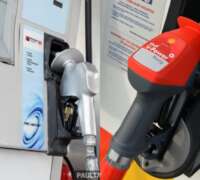

• Budget 2012: Petroleum product subsidies continue as is

    Among the items mentioned in Budget 2012 is the continuance of subsidies for petroleum products.

    For every litre of RON 95, the actual price is RM2.75, and the price of RM1.90 at the pump translates to a subsidy of 85 sen, or 31% of the actual price.

    Diesel has an actual price of RM2.66, and the RM1.80 retail price works out to a subsidy of 86 sen, which works out to 32%.

    As for cooking gas, every 14 kg tank is actually priced at RM48.02, and the retail price of RM26.60 means that the Government subsidy works out to RM21.43 or 45% of the actual price. We’ll have more updates on related items as we go along.

     
  • B5 biodiesel debuts in Kuala Lumpur, at 247 stations

    The roll-out of palm oil-based B5 biodiesel for the central region continued today, with the introduction of the fuel for the Federal Territory. The event to mark the introduction was held at a BHPetrol station in Jalan Kuching this morning, and present at proceedings was Plantation Industries and Commodities Minister Tan Sri Bernard Dompok, who officially launched the fuel at the retail level in June, as scheduled.

    Kuala Lumpur is the fourth location in the central region to introduce B5; Putrajaya kicked the programme off on June 1, followed by Malacca and Negeri Sembilan. The KL roll-out is just over a month later than planned – B5 was slated to be introduced here on September 1. Selangor is the next on the list, on October 1, according to the schedule.

    The B5 programme for KL will see B5 being supplied by 247 stations, and through this, 890 tonnes or 1.03 million litres of palm-oil biodiesel will be used per month, which will contribute to saving the connsumption of nearly 12.4 million litres of fossil-based diesel a year in KL.

    Priced at the equivalent of petroleum diesel, at RM1.80 per litre, Dompok said that the government would continue to keep the price of B5 as such, and absorb the differences. He also said that full B5 supply nationwide would be implemented in 2013 at the earliest.

    Meanwhile, BHPetrol said that B5 is available in its 35 stations in KL, and currently has around 60 stations offering the fuel in the central region.

     
  • RON97 price dropped by 10 sen to RM2.80 per liter

    For the first time since RON97 was put on a ‘controlled market float’ in July last year, the price of the higher octane fuel has been reduced by 10 sen from RM2.90 per litre to RM2.80 per litre. The last change was on the 5th of May, where it was hiked 20 sen. The ‘mainstream’ RON95 fuel remains at RM1.90 per litre, while both petroleum diesel and B5 biodiesel (currently only available in Putrajaya) are sold at RM1.80 per litre.

     
  • B5 biodiesel: pure palm biodiesel (B100) sulphur content less than 10ppm

    Seems that the datasheet listing the properties of petroleum diesel and B5 biodiesel from last week’s launch of the B5 biodiesel programme in Putrajaya wasn’t quite up to date. With regards to certain aspects, specifically that of the sulphur content, Paul noticed the numbers didn’t quite add up, so having asked around, we’ve managed some answers.

    Apparently, the column listing the properties of the total sulphur content for both in a photo recapture I took was from a booklet published by the Malaysian Palm Oil Board in August 2009 (third edition). The datasheet listed the sulphur content of B5 as 0.26% and Malaysian petroleum diesel as 0.28%, essentially 2,600 and 2,800 ppm, which met the MS123:1993 0.50% maximum sulphur content requirement which was still in effect at the time of printing.

    According to Puah Chiew Wei, research officer in the engineering & processing research division at the MPOB, the current sulphur content of 100% pure palm biodiesel is <10 ppm (<0.001%) which meets the stringent requirements of MS2008:2008 and EN14214:2008.

    Malaysian petroleum diesel currently has a sulphur content of 300 to 400 ppm (0.03 to 0.04%). Puah adds that the low sulphur palm biodiesel thus contributes to reduction of sulphur content in B5, and as such, B5 meets the requirement of maximum sulphur content of 0.05% as stipulated under MS123:2005.

    Apparently again, the booklet wasn’t officially distributed at the launch, but it was inserted into the press kit bag anyway by someone who saw fit to do so – time to print an updated booklet, perhaps?

     
  • B5 biodiesel programme begins – Putrajaya kicks things off

    The palm oil-based B5 biodiesel programme began as scheduled today – the fuel was officially launched by Plantation Industries and Commodities Minister Tan Sri Bernard Dompok at the Petronas station in Precinct 9D in Putrajaya earlier this evening.

    With the introduction, Malaysia becomes the second country to implement the use of B5 (Indonesia has been using it since 2006 in selected cities and provinces), which is of course higher than the mandatory B2 (2%) blend in Thailand started in April 2008 and the B1 mandated in the Philippines, which was introduced in May 2007.

    It’s actually been around for a while, B5 has – since February 2009, no less than 3,900 vehicles from various government agencies such as DBKL and the Armed Forces have been conducting test usage of the fuel, with no adverse effects reported to date.

    From today, however, it is available at point of retail: B5 biodiesel will be sold at the six petrol stations – five from Petronas and one from Shell – located in Putrajaya, the first location in the Central Region to deploy the fuel. It is priced at the equivalent of petroleum diesel, at RM1.80 per litre.

    As it goes along, the fuel will be made available in other locations in the Central Region. The next to launch B5 will be Malacca on July 1, followed by Negeri Sembilan on August 1. Stations in Kuala Lumpur will begin selling B5 on September 1, and then Selangor will follow suit on October 1. The implementation of B5 in other regions in the Peninsular as well as in Sabah and Sarawak as part of the planned nationwide coverage will be announced in due time.

    At this initial stage, the deployment of B5 will cover the land transport sector, which encompasses private cars, those in the civil service as well as commercial vehicles. From November 1, B5 will begin to cover the industrial and fisheries sectors as well.

    To ensure the success of the programme, the government, through the Malaysian Palm Oil Board, has allocated a sum of RM43.1 million to finance the development of in-line blending facilities at six petroleum depots in the Central Region.

    The facilities are owned by five oil companies, namely Petronas Dagangan, Shell Malaysia Trading, Esso Malaysia, Chevron Malaysia and Boustead Petroleum Marketing. Three of these depots are located in Selangor – two in Port Klang and the Klang Valley Distribution Terminal in Dengkil. Two other depots are located in Port Dickson, and the last is at Tangga Batu in Malacca.

    The notes provided at the launch had a comparative table of the fuel properties of the MS2008 compliant B5 palm biodiesel and petroleum diesel in the country, as represented in the photo recapture below.


    Click to enlarge

    As far as performance goes, engine performance aspects of the B5 palm biodiesel (methyl esters) blend compared to petroleum diesel are a decrease in ignition delay (due to a presence of oxygen), lower smoke emission and volatility levels for B5.

    It also has a slightly higher brake specific fuel consumption and NOx emission (which is still well below the regulated level) and exhibits a comparable thermal efficiency and the same combustion pressure patterns – with no adverse effect in terms of knocking – as petroleum diesel. It does however offer slightly lower brake power, due to a low calorific value.

     
  • Malaysian B5 biodiesel at pumps to comply with MS2008 based on EN14214 biodiesel standard

    A week ago we heard that the government was going to start their B5 biodiesel programme in Putrajaya from June 2011. There will be 6 stations involved – all 5 Petronas stations and one Shell station. Seeing as we’re only about two days away from June 1st 2011, we’re sure that there are many questions going through your minds if you drive a diesel vehicle in Malaysia.

    B5 is a blend of 95% regular petroleum-based diesel and 5% biodiesel. This source of biodiesel can be from various sources. Different countries with different climates typically choose a feedstock source that is most suitable with the environmental (mostly temperature) conditions in which the fuel has to work in.

    For us, the feedstock that makes the most sense is palm oil, given that we are one of the biggest producers of palm oil around, and the properties of palm oil-based biodiesel are suitable for our climate. For example, we do not have to worry about winter temperatures. Palm oil based biodiesel tends to have incrementally worse cold weather operability.

    Sime Darby Plantations have already started using its own blend of biodiesel called Bio-N in its upstream operation vehicles since March 2008. The Bio-N initiative started at the East and West Estates and Mills on Carey Island and later expanded to other estates and oil mills in Selangor and Negeri Sembilan. Bio-N started off as a B5 blend, but for some estates this mix have been upped to B10. Bio-N’s palm oil comes from Sime Darby’s biodiesel plant in Teluk Panglima Garang and Pulau Carey.


    Sime Darby demonstrated Bio-N in a BMW 730Ld company car

    We have no idea what specs Bio-N complies to, but we won’t be pumping Bio-N into our tanks next month. According to a Petronas source, what we will be using is a biodiesel blend that complies to the MS2008 standard, which is derived from the international EN14214 standard for biodiesel fuel.

    MS2008 (Automotive Fuels – Palm Methyl Esters for Diesel Engines – Requirements and Test Methods) is essentially a localized EN14214 standard, and as its name suggests it was established in 2008 by the Department of Standards Malaysia. It was developed with an Industry Standards Committee consisting of 17 organizations, and a Technical Committee consisting of 16 organizations, which include all the fuel retailers in Malaysia as well as SIRIM, AAM and JPJ.

    Instead of the European EN14214 typically using rapeseed as its source, Malaysian MS2008 is using palm oil. The table below shows some key differences between the properties of MS2008 biodiesel and EN14214 biodiesel:

    For the first 6 months upon introduction, the Ministry of Plantation Industries and Commodities require that the fuel retailers obtain their feedstock source from the Malaysia Biodiesel Association’s 21 members. There are already at least 10 active biodiesel plants in Malaysia – operated by subsidiaries and JV companies of groups like Sime Darby, IJM, and Boustead.

    According to Caltex Senior Product Engineering Specialist Greg Engeler, all diesel engines should theoretically be able to run B5 without issues. It’s only the higher biodiesel mixes which need re-engineering. For example, the fuel cap on the F10 BMW 520d says you can use a maximum of B7 biodiesel, which means it should run properly on B5 biodiesel.

    According to a source in BMW Malaysia, their cars should run fine on MS2008, since its properties pretty much correspond or in certain cases better EN14214. Sime Darby AutoConneXion also says their portfolio of diesel cars under the Ford and Land Rover brands including the Ford Focus TDCi should run fine on EN14214.

    You won’t be able to choose between regular diesel and B5 biodiesel at fuel stations that have started selling biodiesel. B5 biodiesel will replace regular diesel at existing stations. However, according to a Petronas source as of last week the Government has not given any firm sign to 100% replace standard diesel to biodiesel nationwide. It has been made clear so far that the implementation of B5 will only be in the Central Region, which for example includes areas such as Putrajaya, Selangor, Melaka and Negeri Sembilan.

    This doesn’t mean B5 will be contained to only the Central Region though, it just means there hasn’t been any official directive or gameplan for a nationwide roll-out yet. B5 will cut our dependence on fossil fuels, but you guessed it right – by about 5%. Plantation Industries and Commodities Minister Tan Sri Bernard Dompok says the B5 blend’s price mechanism will be regulated and determined by the Finance Ministry. It’s not very clear at the moment whether B5 will eventually be priced differently from normal diesel.

     
  • Ismail Sabri: No RON95, diesel and LPG price hike, for now

    Domestic Trade, Cooperatives and Consumerism Minister Datuk Seri Ismail Sabri Yaakob said today that the government will not increase the price of RON95 petrol, diesel and liquefied petroleum gas (LPG) for now. He however did not mention for how long the government would maintain current prices, when probed by reporters

    However, with the subsidy for petroleum products set to baloon to a massive RM18 billion this year, it’s just a matter of time before pump prices go up. The current price of RON95 petrol is RM1.90 per litre, as opposed to RON97′s RM2.90 per litre after the recent round of revision. The government has already announced that super subsidy diesel for commercial vehicles will end effective 1 June.

    “This decision was made because the government is concerned for the people’s welfare. But at the same time, the government will continue studying subsidy rationalisation as a whole following the increase of fuel and gas prices in the global market,” Ismail Sabri told reporters today.

     
  • B5 biodiesel programme to start with Putrajaya

    The implementation of the B5 biodiesel programme in the country is set to begin in June, with Putrajaya starting off things, according to Plantation Industries and Commodities Minister Tan Sri Bernard Dompok.

    It’s all going according to plan, as announced last year, for B5, which is a blend of 95% regular petroleum-based diesel and 5% palm oil-based biodiesel. The minister told reporters last Fri that the programme will be introduced in stages, starting from Putrajaya, before its full implementation at all petrol stations nationwide.

    He added that B5 blend’s price mechanism will be regulated and determined by the Finance Ministry. “The price will not burden the people and the Government will ensure that it will be affordable to everyone,” he was quoted as saying.

    The introduction, of course, follows on the recent announcement that the super subsidy on regular diesel is to be removed, meaning everyone – including those running commercial vehicles – will have to pay the same RM1.80 per litre for regular diesel.

     
  • Commercial vehicles will no longer enjoy cheap RM1.481 per liter diesel from June 2011

    Diesel drivers have been enjoying their RM1.80 per litre of subsidised diesel that can take them over 1,000km per full tank, but commercial vehicles have been enjoying their diesel even more – certain industries get super subsidies that result in a per litre price of RM1.481 for diesel.

    If your business falls under these 9 categories, you’ve probably been enjoying super cheap diesel thanks to your subsidy fleet card – prime movers, general cargo movers, Luton box vans, vans, rigid lorries for bottled beverages, rigid tanker lorries for flour transport, rigid lorries for refrigerated goods, water tankers and limousine taxis.

    I know for a fact that these subsidy cards can be abused and are being abused as I know someone who enjoys fueling his pickup truck with super-subsidised diesel thanks to a card that he got from a relative who runs a business that qualifies for the subsidies.

    But when even RON95 and RON97 price hikes can affect the prices of goods and services that the everyday rakyat consume, what more a hike in the price of diesel fuel that’s used by these lorries that run everyday and perform services that are essential to the economy?

    That’s exactly what the government is going to do – it announced earlier this week that it will be removing this super subsidy, which means everyone will have to pay the same RM1.80 per litre of diesel. That’s about a 20% hike in fuel costs, and the government will supposedly save RM659.3 million in 2011 alone from this action.

    I wonder what’s the real situation with the government coffers right now as I consider this to be sort of an extreme measure relative to any previous subsidy cutting. The government has in the short term only resorted to removing subsidies for RON97, a so-called “luxury” fuel, and have promised to only revise the “everyday man” RON95 fuel every six months. They rarely touch diesel as diesel practically runs the country’s logistics.

    Other than the fact that this might and most definitely will increases the prices of certain goods and services, there’s also the danger of lorries resorting to overloading to be so-called “more efficient” per trip. It’s not like they don’t already do that.

    Read more at TMI.

     
  • RON 95 petrol pricing to be reviewed soon

    The price of RON 95 petrol, along with the pricing of all other petroleum products, will be reviewed in June, according to Domestic Trade, Cooperative and Consumerism Minister Datuk Seri Ismail Sabri Yaakob. He told reporters yesterday that the finance ministry and Pemandu (Performance Management & Delivery Unit) would be among those which would determine if the prices should be maintained or increased.

    Ismail Sabri added that according to Pemandu’s subsidy rationalisation plan, there would be a revision every six months for subsidies on all products, saying that diesel, LPG and RON95 prices were revised last December and therefore a revision was now due.

    “This means that a mid-year revision will be carried out this month or early June. I can’t say what will happen, but the revision will take place and the government’s subsidy burden is high,” he told reporters, who posed the question about the status of RON 95 pricing following the increase of RON 97 recently to RM2.90.

    He said that although he had previously stated that petrol prices would not go up at the moment, that wasn’t a guarantee that petrol prices would stay the same forever, since the government was already burdened with subsidies for petroleum products.

    “Last year, the government’s subsidy for petroleum products was RM8bil when world fuel prices shot up, and we don’t see signs that it will drop. If this continues, the government will bear RM18bil in subsidies this year, an increase of RM10bil,” he stated, adding that if subsidies were reduced, the RM10bil could be used to build more schools, housing projects, educational aid and village roads.


Archives