
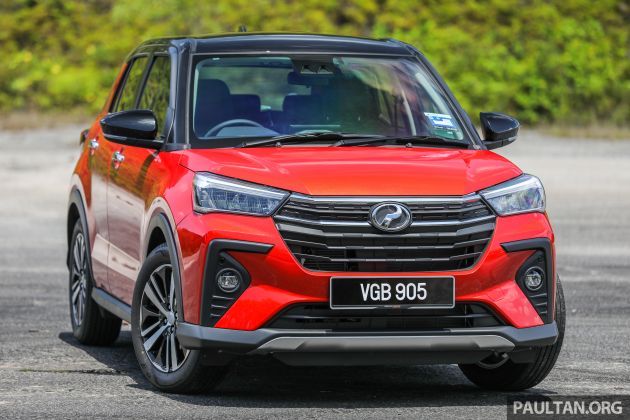
Last week, we took a look at the vehicle sales in Malaysia in 2023, broken down by brand. The vast majority of those were passenger cars, but there were commercial vehicles on the list as well. Now, we’re stripping away the pick-ups trucks, lorries and vans to give you an idea of which body styles were favoured by most car buyers last year.
The total passenger car sales figure of 719,160 units – versus 799,731 overall – included 440,205 sedans, hatchbacks and other body styles (wagons, coupés, convertibles, all that fun stuff). Nearly 30% of the market share was taken up by the phenomenon that is the SUV, with 213,128 sold last year. This appears to be at the expense of MPVs, the market share of which dwindled to under 10% with just 65,937 sold.
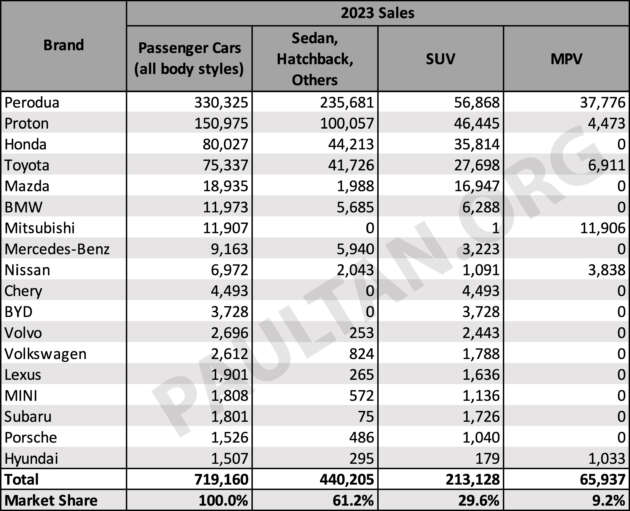
As companies that sell only passenger cars, Perodua and Proton’s sales remain unchanged at 330,325 and 150,975 units respectively. Perhaps surprisingly for Proton, both national carmakers still derive an overwhelming chunk of their figures from sedans and hatchbacks instead of their increasingly popular SUVs – fair enough, given the latter occupy the higher end of the price ladder.
One thing of note is that Proton no longer holds the lead for SUV sales – that title now belongs to its cross-town rival, which sold 56,868 units of the Ativa and Aruz compared to Proton’s 46,445 X50s, X70s and X90s. And while the Exora MPV was discontinued in 2023 with just 4,473 units sold, Perodua delivered 37,776 units of the Alza to customers, contributing significantly to the company’s record-breaking performance.


Shorn of sales of the Hilux and Hiace, Toyota (with 75,337 cars sold) fell to fourth place in the standings behind Honda (with 80,027 cars sold), the latter claiming the non-national passenger car crown for the tenth consecutive year. The H brand eclipsed its biggest competitor both in terms of sedans/hatchbacks (44,213 vs 41,726) and SUVs (35,814 vs 27,698), although Toyota did sell 6,911 MPVs versus none for Honda.
But even Toyota couldn’t hold a candle to new non-national MPV leader Mitsubishi, which derived almost all of its 11,907 passenger car sales from the Xpander (the company sold just one SUV last year, presumably the Outlander PHEV spotted last year, probably for internal use). Ahead of it was Mazda, which sold 18,935 passenger cars; Hiroshima is now predominantly an SUV brand, selling 16,947 of those things versus just 1,988 of everything else.


Elsewhere, Nissan sold more units of its Serena MPV (3,838) than it did the underrated Almera sedan and the electric Leaf hatch (2,043), as well as the X-Trail SUV (1,091). Bringing up the rear was Hyundai, which sold 1,033 Staria and Starex MPVs versus a pitiful amount of sedans (295) and SUVs (179).
In the premium stakes, sales were stacked even more heavily in favour SUVs, led by BMW with 6,288 SUVs and 5,685 sedans, hatchbacks, coupés and convertibles sold last year. By contrast, Mercedes-Benz’s traditionally more conservative buyers bought more cars (5,940) than SUVs (3,223), the former narrowly beating Munich.


It must be said that Stuttgart was the sole outlier in its segment; indeed, Volvo’s iconic sedans and wagons now make up less than 10% of its overall sales, while Lexus’ sedans and coupés accounted for 14% of its total. Even renown sports car maker Porsche sold more than twice as many Macan and Cayenne SUVs (1,040) as it did 718s, 911s, Panameras and Taycans (486).
At this juncture, we should point out that the Malaysian Automotive Association’s (MAA) breakdown of cars and SUVs seems a little suspect. For instance, BYD sales were listed as being completely made up of SUVs, even though the Dolphin is a hatchback – and its registration card correctly listing it as a “motokar” instead of “jip” (SUV).
Looking to sell your car? Sell it with Carro.



Proton sembang kencang punya sembang pasal SUV, padahal SUV sales dia kalah jugak kat P2, by 18% somemore.
Imagine if they really overtake P2 one day, they will have kenduri 3 bulan with bunga api every night.
So when will P2 take ownership on the latest string of safety scandals and fake emission testing from their father Toyota & mother Daihatsu plus compensations to all the millions of their current, former and deceased customers that passed most likely due to subpar safety equipment standards.
In Japan, their top execs will go on TV and bow for 1 hr to show regret and in some cases they committed harakiri when found out their relatives died because of them. So no less expected from CEO Zainal Abidin & his team of cheaters.
When is P2 going to do harakiri press conference?
The topic is about sales figure.
Are you sure Proton have zero casualty due to substandard cars?
Proton has car that survive 150kmph crash test. Can P2 say the same?
Good sales no point if all you do is murder more people.
1house got 4-5cars. Happy M’sians bersyukurr
these data not include recon sales ….
Perodua got 1 and only suv Ativa already become champion??
Perodua got Ativa and Aruz. Deciding factor is price.
I wonder what is 1 unit registered under Mitsubishi. New Outlander coming soon?
“Nearly 30% of the market share was taken up by the phenomenon that is the SUV, with 213,128 sold last year. This appears to be at the expense of MPVs, the market share of which dwindled to under 10% with just 65,937 sold.”
This is why in NA & Europe, minivans has becomes extinct …ppl prefer more rugged/stylo looking SUV instead of a box vans.