





















Follow us:
Advanced search
           
Browse all EVs
           
Browse all used cars
           
Sell your car, get paid fastFree inspection · fast payment Get an offer Add paultan.org as a preferred source on Google Add
 

Chery Tiggo Cross review - Turbo vs Hybrid

Sell your car to Carro, get paid in 24 hours

Latest Stories

  • Xpeng G9L full details – flagship EV SUV with 585 PS, 755 km CLTC, PowerX REEV available, 33 speakers!

    Xpeng G9L full details – flagship EV SUV with 585 PS, 755 km CLTC, PowerX REEV available, 33 speakers!

    Revealed only last week, the Xpeng G9L is now open for pre-orders in its home market in China, which means we now have full details on the five-seater luxury SUV. Sitting at the top of Xpeng’s lineup alongside the six-seater GX, this car is of relevance for Malaysia as one of the candidates for the “large SUV” earmarked for our market.

    As the name suggests, the G9L is a larger redevelopment of the G9, which debuted four short years ago in 2022 and continues to be on sale. It has grown significantly – measuring 5,120 mm long, 1,999 mm wide and 1,782 mm tall, it’s 229 mm longer, 62 mm wider and 112 mm taller, while its 3,100 mm wheelbase is 102 mm longer.

    The extra length is evident in the design, which is sleeker and more elegant, transposing the GX’s almost Range Rover-like minimalist styling onto a sportier and more dynamic body. The inspiration from its sibling is most obvious in the full-width front and rear light bars and the organic surfacing in the flanks, made more dramatic here.

    Xpeng G9L full details – flagship EV SUV with 585 PS, 755 km CLTC, PowerX REEV available, 33 speakers!

    The wraparound windscreen remains but is paired with a lower-slung roofline, body-coloured D-pillars and a faster rear windscreen rake, having been shorn of the need to provide headroom for a third row of passengers. Meanwhile, the main headlights are mounted very low on the bumper, flanking an active grille shutter that helps deliver a drag coefficient of just 0.238 – nearly identical to that of the supposedly aero-focused forthcoming Audi A2.

    Keeping the side profile unadorned until needed are the deployable side steps that work alongside the projected light curtain to welcome occupants into the vehicle. The G9L comes as standard with 20-inch aero alloy wheels and is available with 21- and 22-inch options, the latter with staggered sizing and tyres.

    The G9L maintains the impressive first impression on the inside, with a plush cabin said to be inspired by first class airline cabins. The layered dashboard features lashings of metal-look trim and an illuminated starry pattern, a motif repeated in the doors.

    Xpeng G9L full details – flagship EV SUV with 585 PS, 755 km CLTC, PowerX REEV available, 33 speakers!

    The upper decor strip incorporates a slimline 8.88-inch instrument display, which is coupled with a massive 17.3-inch infotainment touchscreen and an 88-inch augmented reality head-up display. The cantilevered centre console houses dual 50-watt Qi wireless chargers, while the threaded connectors on the dashboard for attaching accessories – pioneered by Xiaomi and all the rage in China these days – can send another 50 watts of power.

    As previously reported, the front seats – which by the way, come with 22-way power adjustment, heating, ventilation and 16-point massage – use AI to adjust its 27 airbags to achieve the ideal posture. The G9L’s sheer length also means the pews can be fully reclined without removing the headrests, instantly turning the cabin into a bed.

    The 10-point massaging rear seats, on the other hand, feature recline and even lumbar adjustment as standard, with either one or both of the outboard seats being available with a one-touch “zero gravity” recline function and a built-in ottoman. The centre seat can be optioned with an executive console – when folded, it can be opened up to reveal a flip-out table. A rear Qi wireless charger is also standard-fit.

    Other features include the obligatory rear fridge, powered sunshades for the rear panoramic glass roof and side windows, a 21.4-inch roof monitor, an eight-inch control touchscreen and a surround sound system with up to a whopping 33 speakers – including in each outboard headrest. The boot measures a healthy 1,152 litres, including 230 litres of storage under the reversible water-resistant boot floor; a 109 litre front boot is also included.

    The G9L is available in pure electric and PowerX range extender forms, with the former coming in single- and dual-motor forms. The rear-wheel-drive version makes 367 PS (270 kW) and 465 Nm of torque and accelerates from zero to 100 km/h in 6.8 seconds on its way to a top speed of 200 km/h. With a 91.9 kWh LFP battery, it delivers a range of up to 702 km on China’s lenient CLTC cycle; expect a WLTP figure of around 570 km.

    The all-wheel-drive models boost outputs to 585 PS (430 kW) and 695 Nm, slashing the century sprint to 4.6 seconds but dropping the range to 660 km (around 540 km WLTP). A 110 kWh NMC battery option brings this back up to 755 km (circa 620 km WLTP) and cuts the zero-to-100 km/h time to 4.45 seconds.

    Xpeng G9L full details – flagship EV SUV with 585 PS, 755 km CLTC, PowerX REEV available, 33 speakers!

    With an 800-volt electrical architecture, the G9L boasts “5C” DC fast charging (so, around 500 kW), topping up the 91.9 kWh battery from 10 to 80% in just 10.7 minutes and the 110 kWh pack in 11.7 minutes.

    The G9L AWD can also be had with a 1.5 litre turbo four-cylinder petrol engine under the bonnet. This is solely used as a generator for the electric motors, detuned to 503 PS (370 kW) but still able to bring the car to 100 km/h in 4.95 seconds.

    The 63.3 kWh battery provides a pure electric range of 435 km (around 350 km), and when combined with the 60 litre fuel tank, this PowerX variant is claimed to be able to travel a whopping 1,602 km. It too has an 800-volt electrical architecture, and with the same “5C” charging support (around 300 kW) it can be topped up in the same 10.7 minutes.

    Under the skin, the G9L rides on double-wishbone front and multilink rear suspension, with standard dual-chamber air suspension, adaptive dampers and hydraulic bushings. Also standard is 15 degrees of rear-wheel steering that shortens the turning radius to 5.4 metres.

    The G9L features three of Xpeng’s proprietary Turing AI processors to power its second-generation Visual-Language-Action (VLA 2.0) driving assistance model, now with a major update to version 6.3.0. This enables highly-autonomous highway and city driving functionality, and unlike other such systems in China, the company has already confirmed that VLA 2.0 will be introduced in Malaysia within the next two years.

    Prices have yet to be released, but it’s been confirmed the G9L will start at 259,800 yuan (RM157,500). Would you like to see this leviathan in Malaysia? Let us know in the comments.
     
  • Honda at GIIAS 2026 – Super-One EV kei car, Civic e:HEV RS with S+ Shift, HR-V with Mugen accessories package

    Honda at GIIAS 2026 – Super-One EV kei car, Civic e:HEV RS with S+ Shift, HR-V with Mugen accessories package

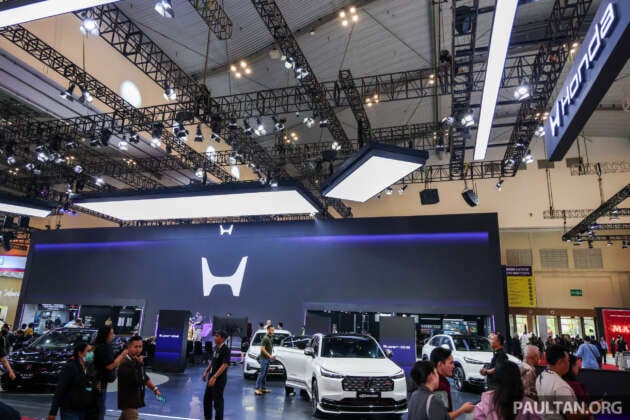
    Honda brought a selection of models to the 2026 Gaikindo Indonesia International Auto Show (GIIAS 2026), ranging from a showcase of the Super-One electric kei car to the HR-V Mugen and the Civic e:HEV RS with S+ Shift technology.

    The Super-One was at first almost certain to come to Malaysia, with a camouflaged example sighted road-testing in Malaysia. This gets a powertrain with 64 PS and 162 Nm, the former figure being the mandated limit for kei cars in Japan, though a Boost Mode can be activated to release the full 95 PS.

    A 29.6-kWh battery provides range of 205 km on the WLTP cycle, and supports up to 50 kW DC charging, as well as 6 kW AC charging. Its charging port is a CCS2 unit at the front of the vehicle.

    In Indonesia, the Super-One is priced at 438 million rupiah, or RM100,250, which places it in a price segment that falls short of the threshold of the Malaysian MITI’s new regulations for fully imported (CBU) electric vehicles.

    This effectively sets a RM300,000 minimum price for imported electric vehicles. As this is unlikely to be locally assembled in Malaysia, the Super-One is essentially ruled out.

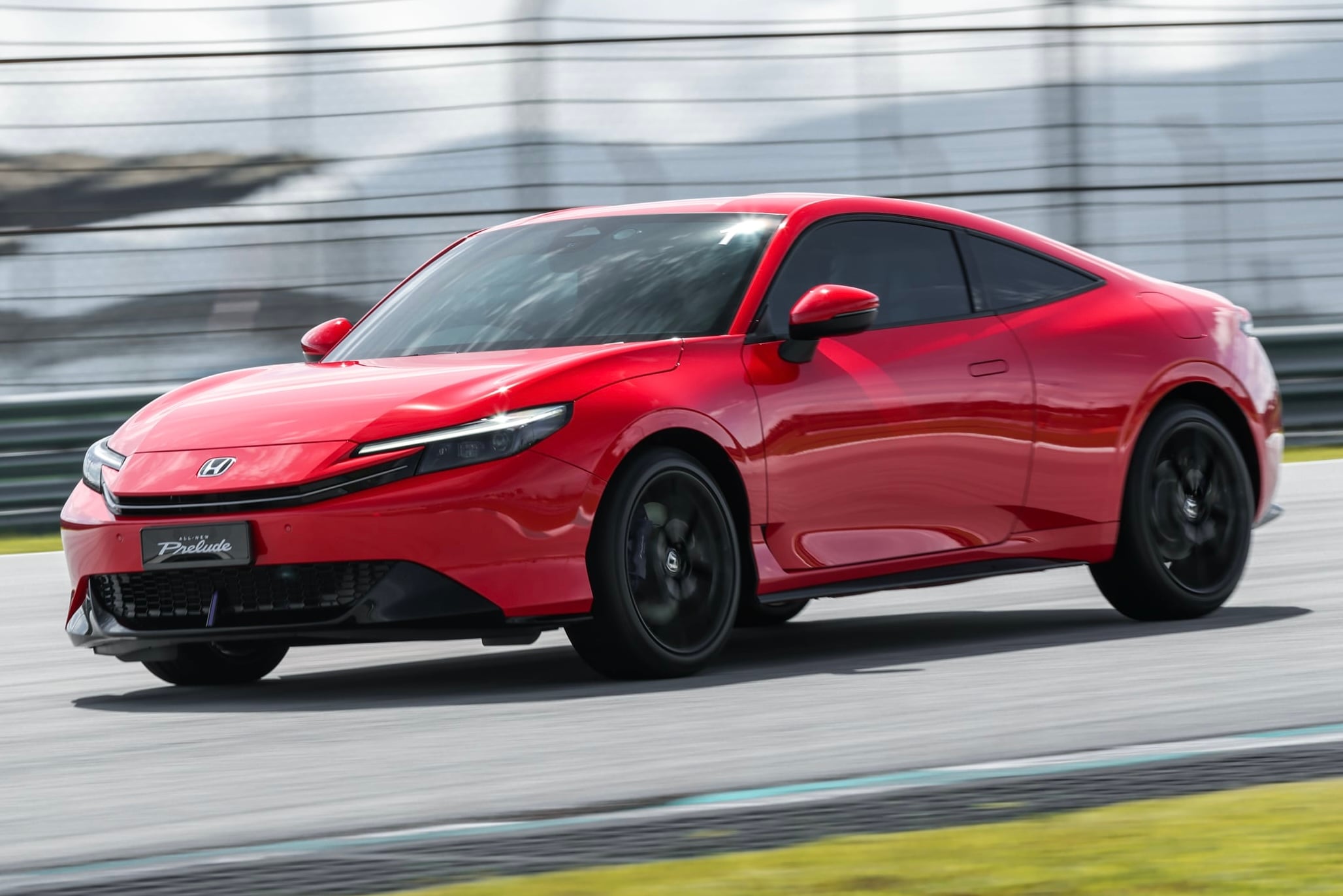
    Certainly more likely to arrive in Malaysia is the Civic e:HEV RS with Honda’s S+ Shift technology from the Prelude, which is a system that simulates the gearshifts of an eight-speed transmission.

    Mechanically, the hybrid variant continues to feature a 184 PS/315 Nm e-motor and single-speed transmission to drive the front wheels, with the 141 PS/182 Nm petrol engine only engaging the driveline directly at higher speeds where it is most efficient. Combined, this powertrain outputs 203 PS.

    Key specifications of the Civic e:HEV RS in Indonesia are black 17-inch wheels (as found in on the Malaysian-market V variant), black door handles and RS badges, the Honda Sensing suite of ADAS functions, and 10.2-inch digital instrument display.

    Equipment also includes a Bose 12-speaker sound system, eight-way power adjustable driver’s seat and four-way power adjustable front passenger seat, wireless device charger and more. The Civic e:HEV RS in Indonesia is priced at 699 million rupiah (RM158,200).

    Also shown at GIIAS 2026 is the Honda HR-V Mugen, a kitted-out version of the RS e:HEV variant that adds front and rear under spoilers, side skirts, a rear spoiler, carbon-fibre side mirror caps, Mugen side decals and tailgate emblem, and a Mugen RS Sport exhaust silencer.

    Also included are door visors and emblems, while inside there are Mugen floor mats, as well as Mugen scuff plates for the front and rear door sills.

    Its unchanged mechanical specification means the use of the 1.5 litre Atkinson-cycle naturally-aspirated inline-four petrol engine that outputs 106 PS and 127 Nm, serving as a generator for the battery that feeds a 131 PS/253 Nm electric motor.

    GALLERY: Honda Super-One at GIIAS 2026

    GALLERY: Honda HR-V Mugen at GIIAS 2026

    GALLERY: Honda Civic e:HEV RS with S+ Shift at GIIAS 2026

     
  • New Mercedes-Benz CLA teased – C174 EV with 792 km range, 320 kW charging launching soon in Malaysia

    Mercedes-Benz Malaysia (MBM) has teased a new model on social media. “A new star is set for a dazzling debut. Arriving soon in Malaysia,” the caption reads. The video shows a covered car under tightly-wrapped cloth, and when the room’s lights are turned off, the car’s front LED lighting is visible, leaving us in no doubt that it’s the new Mercedes-Benz CLA.

    The third-generation CLA was previewed in CLA 250+ EV form in January this year, but we haven’t heard anything about the C174 since. The estimated price given back then for this CBU Germany EV was RM295,888. Much has happened since then in terms of taxes/duties for imported EVs, but the minimum RM200k CIF requirement is more damaging to mid-range EVs than a ‘naturally expensive’ one like this. We’ll see.

    Yes, the CLA is now an EV. It debuted in March 2025 as was designed from the ground up to be an EV. Built on the new Mercedes-Benz Modular Architecture (MMA), it has an 800V electrical architecture that allows for DC fast charging at up to 320 kW.

    New Mercedes-Benz CLA teased – C174 EV with 792 km range, 320 kW charging launching soon in Malaysia

    The new CLA was announced with two fully electric variants – the CLA 250+ with a 272 PS/335 Nm single rear motor, and a CLA 350 that adds a 109 PS front motor for a combined output of 354 PS and 515 Nm. Last month, the AMG CLA 45 surfaced with three e-motors. Malaysia gets the CLA 250+, which is good for 0-100 km/h in 6.7 seconds and a top speed of 210 km/h.

    Powering the EV is an 85 kWh (nett) nickel manganese cobalt (NMC) battery, which provides WLTP range of 792 km for the CLA 250+. M-B says that the impressive range is boosted by the second-generation Electric Drive Unit (EDU 2.0) with a two-speed transmission.

    The two-speed ‘box offers a better balance of power and efficiency across a wide range of speeds, Stuttgart claims. The first gear is optimised for quick off-the-line acceleration and low-speed efficiency, while the second ratio is used for efficient highway cruising, allowing the motor to run at a lower rpm. Claimed efficiency is very good at 12.2 kWh per 100 km.

    New Mercedes-Benz CLA teased – C174 EV with 792 km range, 320 kW charging launching soon in Malaysia

    As mentioned, the max DC charging rate is an impressive 320 kW, which allows for 325 km of extra range to be added in just 10 minutes of charging – highway pit stops will be very quick. AC charging maxes out at just 11 kW, though. Note that while the CLA is only compatible with 800V DC chargers, MBM claims that it’s not really a big issue in Malaysia where most of our DC chargers are relatively new and compatible with 800V architecture.

    The new CLA’s drag is very low at 0.21 Cd, which is Hyundai Ioniq 6 levels without appearing that extreme, or odd like the EQE and EQS. At 4,723 mm long and 1,855 mm wide, the new CLA is 35 mm longer and 25 mm wider than its predecessor, while the 2,790 mm wheelbase is 61 mm longer than the second-gen C118’s. Compared to the original CLA that Malaysians are more familiar with, this is a much larger car.

    Boot volume is 405 litres, 55L less than before, but there’s a frunk and it’s a pretty sizeable one too at 101 litres. This cavity is filled by an engine in the hybrid version.

    New Mercedes-Benz CLA teased – C174 EV with 792 km range, 320 kW charging launching soon in Malaysia

    For context, the CLA is about the same length as a Tesla Model 3, but the latter’s wheelbase is 85 mm longer – you can see the difference in the Merc’s overhangs. The Tesla is also wider and has a 28 mm lower roofline, so it might appear sleeker in shape. Mercedes-Benz says that the CLA has evolved beyond the compact class, so here’s another reference point – the CLA is just 28 mm shorter than the W206 C-Class, and the EV is actually 35 mm wider. The C’s wheelbase is 75 mm longer.

    The CLA is way flashier than all of the above. You won’t miss the 142 individually-animated LED chrome-effect three-pointed stars in the grille, and you can also find the famous logo in the LED lights at both ends. Speaking of that, the CLA has full-width lights at the front and ‘powerful GT rear’, as you’d expect from an EV in 2026. Of course, flush pop-out door handles too.

    The interior highlight is the MBUX Superscreen with three displays that span the width of the dashboard – the wall of screens includes a 10.25-inch digital instrument display and two 14-inch touchscreens, including one just for the front passenger. All passengers get to enjoy the one-piece fixed glass roof, which has no central brace and extends seamlessly from the windscreen frame to the rear.

    The new MB.OS operating system is ‘enhanced by AI’ and connected to the Mercedes-Benz Intelligent Cloud. The MBUX Virtual Assistant uses ChatGPT and Microsoft Bing searches for general enquiries, switching to Google’s Gemini for navigation-related questions.

    Mercedes says that the system can retain context even when jumping between the two AI models, so conversations can continue uninterrupted, and during an active dialogue, it recognises emotions and can respond accordingly. The assistant is represented on screen by an avatar in the form of a three-pointed star, of course.

    The preview unit you see here is a Singapore-spec car wrapped in red – while this isn’t fully representative of what Malaysia will be getting (we’ll have Multibeam headlights with star DRLs and different wheels, for instance), it’s more or less similar. So, what do you think of the 2026 European Car of the Year?

    GALLERY: C174 Mercedes-Benz CLA 250+ Malaysia preview

    GALLERY: C174 Mercedes-Benz CLA 250+ Malaysia preview, official pics

    GALLERY: C174 Mercedes-Benz CLA official images

     
  • Next-gen Mazda CX-3 to debut in 2027 – Thailand to serve as production base for ASEAN, Japan, other markets

    Next-gen Mazda CX-3 to debut in 2027 – Thailand to serve as production base for ASEAN, Japan, other markets

    The Mazda CX-3 is currently one of the oldest models in the carmaker’s line-up, with the B-segment SUV first making its debut way back in November 2014 at the Los Angeles Auto Show. While it is still being sold in our part of the world, the CX-3 has been discontinued in several major markets, including the United States, Japan as well as Europe.

    If you’ve been hoping for Mazda to redesign the CX-3 for a new generation, good news. In its mid-year financial report, the company confirmed the second-generation CX-3 will be introduced in phases in ASEAN, Japan and other markets from 2027. The wait continues then, but at least there is a complete redesign to look forward to instead of another rolling update.

    In the report, the company also stated that AutoAlliance Thailand (AAT), a joint venture established between Ford and Mazda, will be the strategic production base for the next-generation CX-3. Located in the Rayong province, AAT currently makes the CX-3 for local consumption as well as exports, with Malaysia being a former recipient – the SUV has since been dropped from the Malaysian line-up.

    Next-gen Mazda CX-3 to debut in 2027 – Thailand to serve as production base for ASEAN, Japan, other markets

    Mazda previously announced an investment of five billion baht (about RM618 million) in AAT as part of plans to make it a compact SUV hub with an annual capacity of 100,000 units, and the next CX-3 is now confirmed to be part of the production schedule.

    As for our market, a market insight report posted by Maybank Investment Bank last year revealed Bermaz Auto is looking to launch a new B-segment SUV in financial year 2028 (FY2028) ending April 30, 2029. The unnamed model – presumably being the all-new CX-3 – is said to be locally assembled (CKD), which suggests we won’t be getting it from Thailand as with the outgoing model.

    This could be part of Mazda’s Lean Asset strategy, which was mentioned in the mid-year financial report and emphasises collaboration with local partners to improve efficiency. A representation of this strategy is the start of CKD assembly of the CX-30 in Indonesia, which joins Malaysia and Thailand that have been doing so for some time.

     
  • ASEAN MAP launched to establish harmonised regional framework for evaluating motorcycle safety from 2027

    ASEAN MAP launched to establish harmonised regional framework for evaluating motorcycle safety from 2027

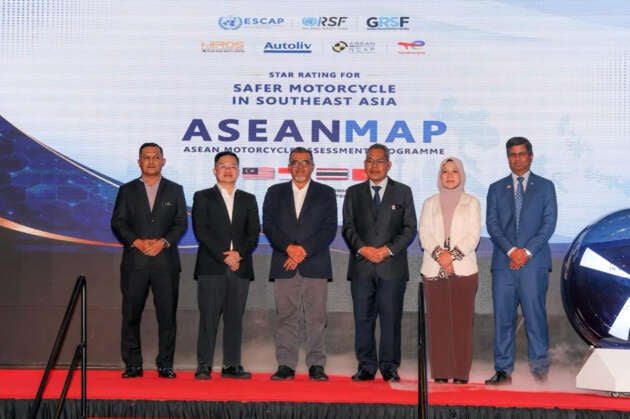
    The ministry of transport (MoT), through the Malaysian Institute of Road Safety Research (MIROS), has launched the ASEAN Motorcycle Assessment Programme (ASEAN MAP), which aims to establish a harmonised regional framework for evaluating motorcycle safety.

    This builds on Malaysia’s expertise with the Malaysia Motorcycle Assessment Programme (MyMAP) and will be rolled out in phases. During its initial phase from 2027 to 2028, the programme will focus on the assessment of technical and regulatory documentation, safety features, manufacturing and conformity-of-production processes, as well as support programmes provided by motorcycle manufacturers.

    In the next phase from 2029 to 2034, ASEAN MAP will progressively expand to include technical performance assessments, which include braking performance and motorcycle visibility tests to further strengthen the region’s approach to motorcycle safety evaluation.

    “ASEAN MAP reflects our collective responsibility to make motorcycles safer, empower consumers with better information and encourage manufacturers to continuously enhance the safety of their products. Its success will depend on strong regional cooperation and the active contribution of all participating countries,” said deputy transport minister Datuk Hasbi Habibollah.

    Malaysia is joined by Indonesia, Thailand and Vietnam, who have expressed their commitment to participate in and contribute to ASEAN MAP. Motorcycles play a significant role in daily mobility in these countries, with motorcyclists accounting for a substantial proportion of road fatalities. Looking forward, the programme is expected to expand to other ASEAN member countries.

    “As motorcycle technology continues to advance, ASEAN MAP must evolve alongside it. The programme must remain responsive to developments in braking systems, rider assistance technologies and connected safety systems, while continuing to reflect the motorcycles, riders and traffic environments of Southeast Asia,” commented MIROS deputy director-general Prof Dr Siti Zaharah Ishak.

    The programme is supported by the United Nations Road Safety Fund (UNRSF), with the United Nations Economic and Social Commission for Asia and the Pacific (UNESCAP) serving as a key project partner. It also benefits from collaboration with the Global Roa Safety Facility of the World Bank, Autoliv as well as TotalEnergies.

     
  • Pro-Net recognises first batch of certified EV technicians

    Pro-Net recognises first batch of certified EV technicians

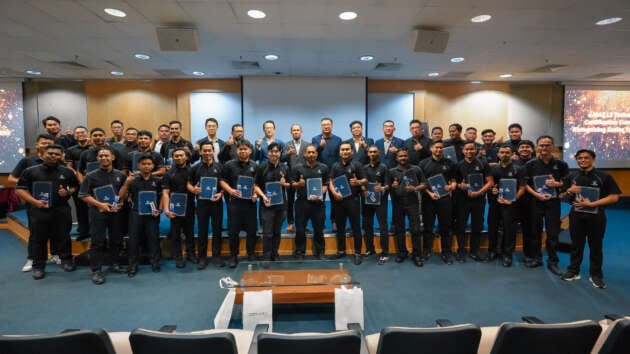
    Proton New Energy Technology (Pro-Net) yesterday recognised its first cohort of 37 Level 2-certified eMas technicians from 25 authorised dealerships nationwide in collaboration with TVETMARA.

    “Through the eMas Technician Certification Programme, we are investing in our people, elevating after-sales standards and developing a future-ready workforce that will play a key role in supporting Malaysia’s transition towards electrified mobility,” said Pro-Net CEO Zhang Qiang.

    To achieve Level 2 certification, participants completed seven training modules covering key EV competencies, including high-voltage system training, followed by technical assessments to validate their technical knowledge and practical capabilities. The certification programme was independently verified by TVETMARA Masjid Tanah.

    Pro-Net said in a release that its next step is to conduct certification programmes annually for Levels 2, 3 and 4 technicians. There are currently over 30,000 eMas vehicles, 58 dealerships, 45 service centres and 10 body and paint centres in Malaysia.

     
  • Jaguar Type 01 interior revealed before October 6 debut

    Jaguar Type 01 interior revealed before October 6 debut

    Jaguar’s reinvention starts with the Type 01, which we’ll get to see in all its glory in New York come October 6 this year. This is the production version of the Type 00, a concept that faced divisive opinions when the company revealed it in December 2024, just a month after it announced an equally controversial rebranding campaign.

    Before October 6 arrives, the Type 01 will appear as a prototype with a distinctive new wrap during Monterey Car Week, with the showcase culminating at Pebble Beach Concours this weekend on August 16.

    To keep the interest train chugging along, Jaguar has revealed the interior of the Type 01 for the first time, which it describes as “architectural drama.” According to the company, the design of the interior is influenced by the “enduring beauty of travertine stone and the rich textures of artisan textiles.”

    Jaguar Type 01 interior revealed before October 6 debut

    One of the highlights is a central spine that runs the full length of the cabin, which was also present in the Type 00 concept and serves to create four individual spaces for occupants. This spine sports a brass-inspired finish that is also repeated along the tops of the doors bearing the Jaguar leaper.

    An overhead view of the driver’s area shows a long top dash ahead of a large display, the latter appearing to integrate both vehicle instrumentation and infotainment. Meanwhile, a separate touchscreen on the central spine provides quick access to the climate and media systems.

    Other key points include a sculpted two-spoke steering wheel, smooth seat upholstery and a large panoramic glass roof. Concealed compartments, hidden‑until‑needed technologies and unexpected pops of colour are also touted by the British carmaker.

    If you notice, there isn’t a rear-view mirror in sight, likely because it is pointless given there is no rear window. Instead, Jaguar implements what it calls the ‘ClearSight Rear View Display’, which is a digital display positioned centrally at the base of the windscreen that shows a feed from a rear camera. The company says this is at the same height as the door mirrors and serves to help the driver focus.

    “Jaguar Type 01 is the first production car to follow our new creative philosophy. Unmistakable from every angle, the interior is no different. With Type 01, we wanted every journey to be an occasion, from how it drives to how it looks and how it makes you feel. With a confidence‑inspiring GT driving position, clean and sophisticated technology and dramatic styling, Type 01 has an interior like no other,” said Rawdon Glover, managing director of Jaguar.

    The Type 01 will be the first Jaguar to use the dedicated Jaguar Electric Architecture (JEA), with design, development and production of the electric vehicle (EV) taking place in the United Kingdom.

    GALLERY: Jaguar Type 01 prototype

     
  • Puspakom’s GiCheck Early Access Reservation (GEAR) next-day appointments rolled out to 26 outlets this month

    Puspakom’s GiCheck Early Access Reservation (GEAR) next-day appointments rolled out to 26 outlets this month

    Puspakom’s GiCheck Early Access Reservation (G.E.A.R) next-day appointments for private vehicles will be rolled out to 26 outlets nationwide this month. It will be done progressively by week.

    This week, G.E.A.R makes its debut at Puspakom branches in Padang Jawa, Cheras, Pandan Mewah, Banting, Bangi, Seremban, Alor Gajah, Muar, Kluang, Johor Bahru and Senai. These outlets join Wangsa Maju, Glenmarie and Batu Caves, which had the service since launch.

    The fourth week of August will see branches in the northern region, east coast and East Malaysia join the G.E.A.R fray. The outlets are Alor Setar, Sungai Petani, Teluk Kumbar, Ipoh, Mak Mandin, Gopeng, Taiping, Kota Bharu, Kuala Terengganu, Kuantan, Kota Kinabalu and Kota Samarahan.

    Puspakom’s GiCheck Early Access Reservation (GEAR) next-day appointments rolled out to 26 outlets this month

    Launched last month, G.E.A.R is a premium booking option offering next-day inspection appointments for private vehicles. The introductory fee is RM150 per vehicle, before inspection fees.

    Puspakom says that G.E.A.R is expected to benefit private vehicle owners, buyers and sellers completing ownership transfers, as well as customers with time-sensitive inspection requirements. The introduction of the new service is in response to growing demand for greater appointment flexibility, particularly during peak periods such as month-end, festive seasons and high transaction periods, when demand is typically higher.

    The company adds that G.E.A.R does not affect normal appointment slots, which will continue to be available to customers nationwide. Only a small allocation of each participating branch’s daily inspection capacity will be reserved for G.E.A.R customers, it says.

     
  • JPJ seizes five motorcycles from man who spent RM25,000 in illegal modifications

    JPJ seizes five motorcycles from man who spent RM25,000 in illegal modifications

    A Kuala Lumpur man in his 20s has lost five motorcycles after JPJ seized the heavily modified machines, following separate enforcement actions against him since last year. The rider reportedly spent up to RM25,000 modifying the motorcycles, including engine and braking system modifications as well as the use of components that failed to meet safety specifications.

    Investigations revealed four of the five motorcycles did not belong to him. According to Road Transport Department (JPJ) senior director of enforcement Datuk Muhammad Kifli Ma Hassan, the bikes belonged to the rider’s father, younger sibling, mother and uncle.

    The motorcycles were reported to have been borrowed from the relatives before carrying out the modifications. The fifth motorcycle, which belonged to the rider himself, was seized during a recent “Op Ekstrem” operation against modified motorcycle in the capital.

    JPJ seizes five motorcycles from man who spent RM25,000 in illegal modifications

    “All five motorcycles are currently in the process of forfeiture and will be auctioned off,” said Muhammad Kifli during a press conference. JPJ said the offences involved extreme modifications such as removing rear brakes, fitting ‘tayar sotong’ or narrow width tyres, changing the ECU and modifying engines.

    Muhammad Kifli urged so-called “hardcore” riders to stop carrying out such modifications, warning that they can seriously compromise motorcycle safety and increase the risk of fatal crashes. “I want to appeal to these ‘hardcore’ riders to stop taking these useless actions,” he said in a Bernama report.

    JPJ seizes five motorcycles from man who spent RM25,000 in illegal modifications

    During Op Ekstrem on August 8 and 9, JPJ inspected 443 motorcycles, taking enforcement action against 336 and seizing 140 motorcycles. From January 1 to August 10, JPJ has conducted 441 Op Ekstrem operations nationwide, inspecting 68,528 vehicles. Of those, 18,534 vehicles were subjected to enforcement action, while 1,942 vehicles were confiscated.

    JPJ also warned that it will not hesitate to take legal action under Section 59(2) of the Road Transport Act 1987 (Act 333) against parties who refuse to restore modified vehicles to their original specifications.

     
  • Electrified cars in Malaysia double in a year: one in six new vehicles registered is now a hybrid or EV

    Electrified cars in Malaysia double in a year: one in six new vehicles registered is now a hybrid or EV

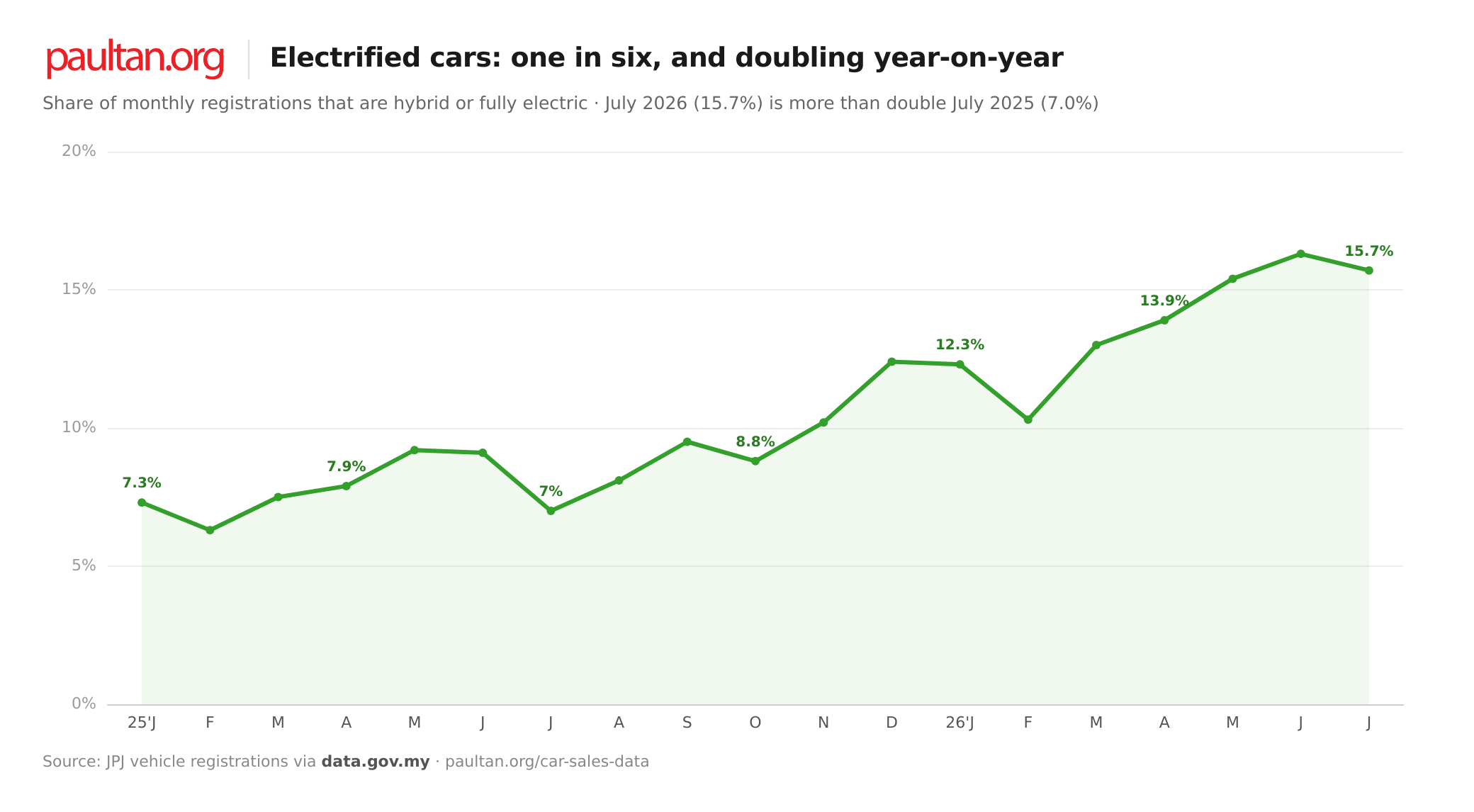
    While the headlines follow individual EV launches, the bigger shift in Malaysia’s car market is happening quietly across the whole fuel mix. In July 2026, 15.7% of all new vehicles registered were electrified, meaning either a hybrid or a fully electric vehicle.

    A year earlier, in July 2025, that figure was just 7.0%. In other words, the electrified share of the market has more than doubled in twelve months. Roughly one in every six new cars registered in July had a plug or a hybrid system, up from about one in fourteen a year ago.

    Electrified cars in Malaysia double in a year: one in six new vehicles registered is now a hybrid or EV

    Electrified share sat between 7% and 9% for most of 2025, ticked up to 12.4% in the December EV rush, and has trended higher through 2026 to peak at 16.3% in June before July’s 15.7%.

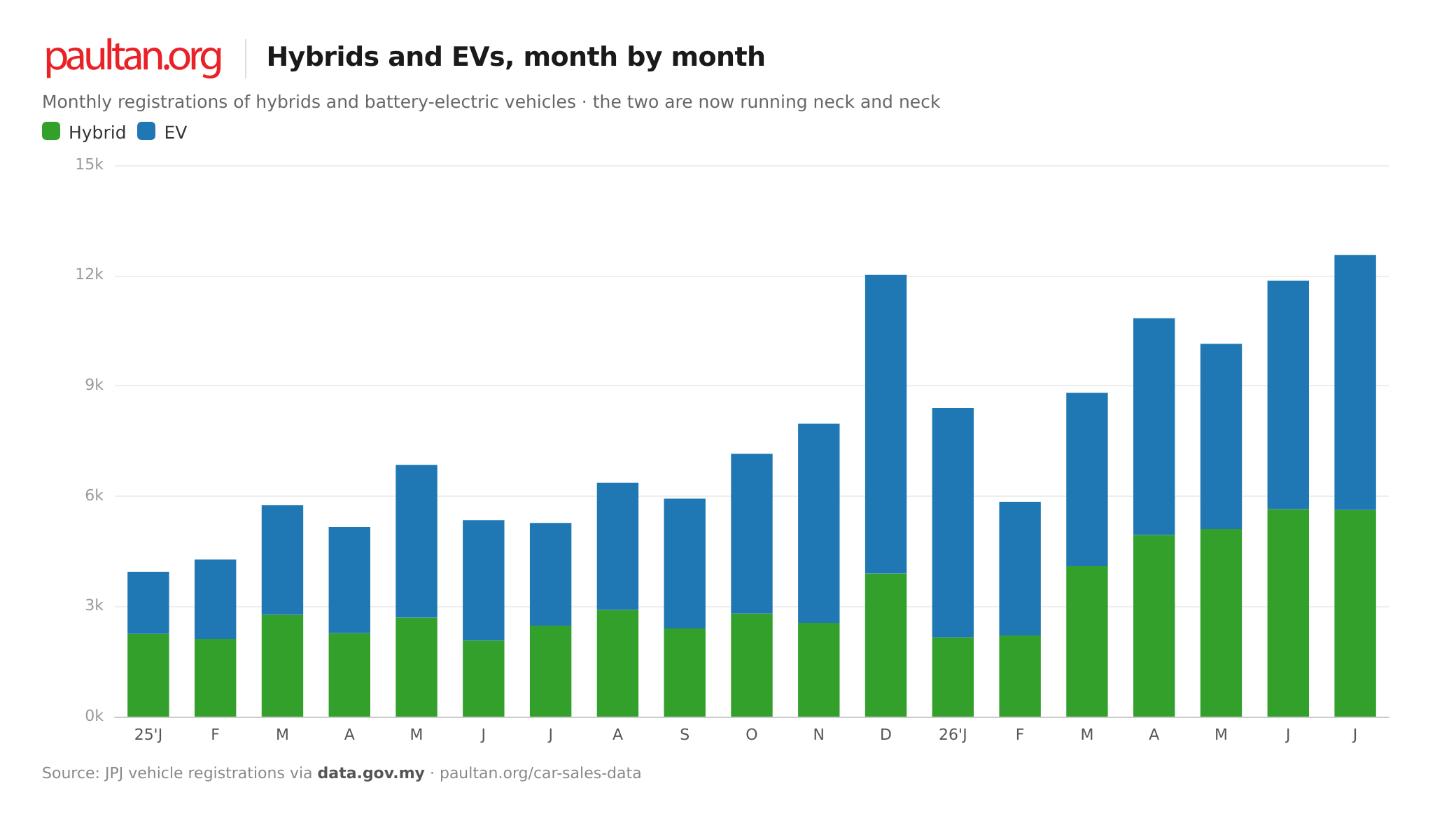
    For most of 2025, hybrids outsold EVs comfortably. Through 2026 the two have converged, and they are now running neck and neck: July saw 6,937 EVs and 5,622 hybrids registered. The plug-in and full-hybrid crowd, led by the Japanese marques and Proton’s e.MAS 7 PHEV, is growing alongside the pure-electric surge rather than being replaced by it.

    Electrified cars in Malaysia double in a year: one in six new vehicles registered is now a hybrid or EV

    Petrol still powers the vast majority of the market, of course, and will for years yet. But at the current rate of change, the day when one in five new cars in Malaysia is electrified is no longer far off. You can explore the full fuel-mix breakdowns, by month, brand and model, on our car sales data tool.

     
  • Perodua Traz becomes best-selling SUV in July 2026

    Perodua Traz becomes best-selling SUV in July 2026

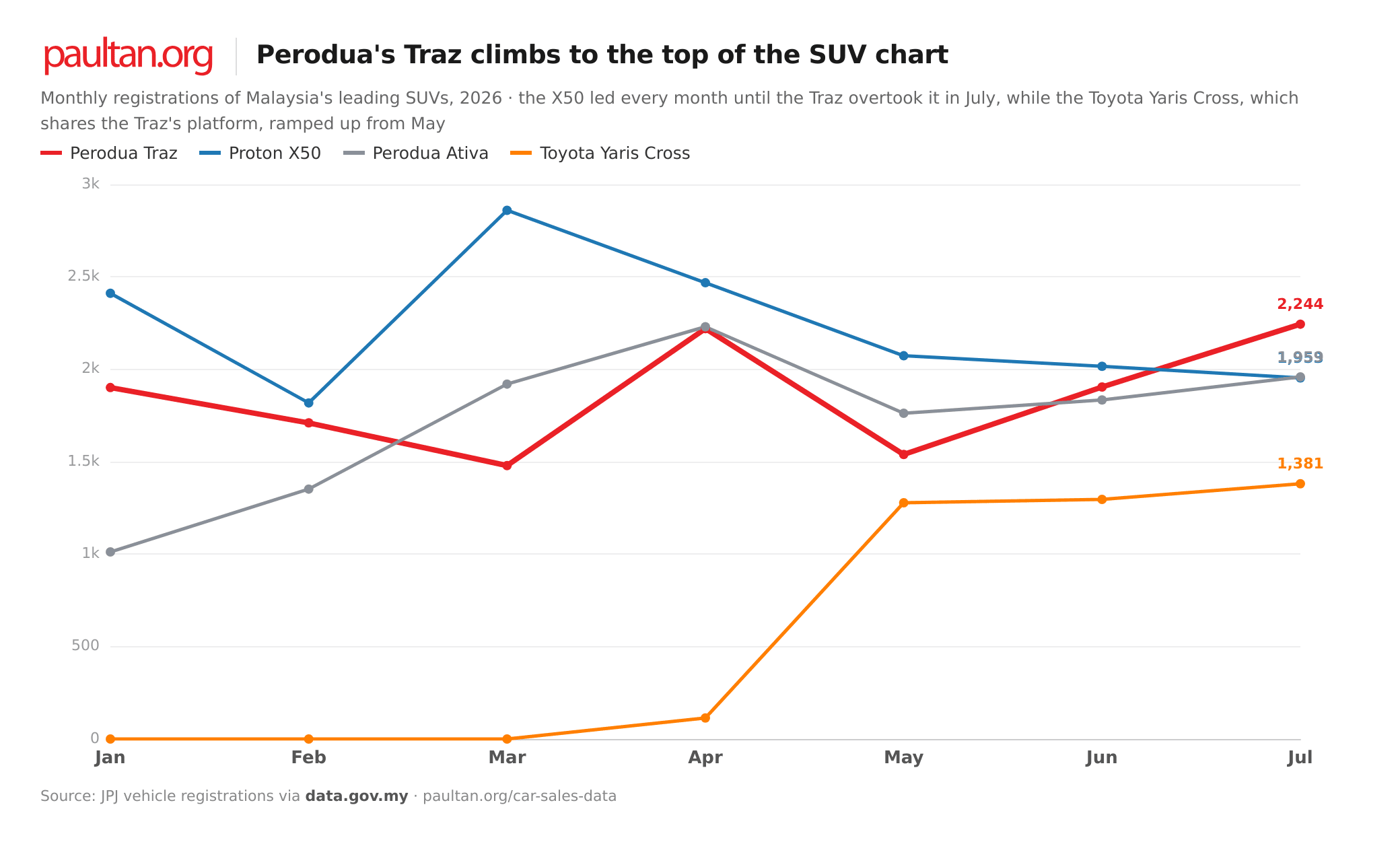
    Malaysia has a new best-selling SUV, at least for now. In July 2026 the Perodua Traz finished top of the SUV chart with 2,244 registrations, the first time the model has led the segment since it went on sale at the end of last year. It is a milestone worth putting in context, because the picture over the full year still looks rather different.

    Monthly registrations of the Perodua Traz, Proton X50, Perodua Ativa and Toyota Yaris Cross, 2026

    For the first half of 2026 the Proton X50 was the SUV to beat, leading every single month from January to June. The Traz, launched only in December 2025, spent that stretch settling in behind it, usually sitting second or third as production ramped up. July is where the lines cross: the Traz climbed to 2,244 units while the X50 eased back to 1,953, handing Perodua the top spot for the first time. Watch the orange line too, the Toyota Yaris Cross came on stream in volume from May and is now a fixture in the top four.

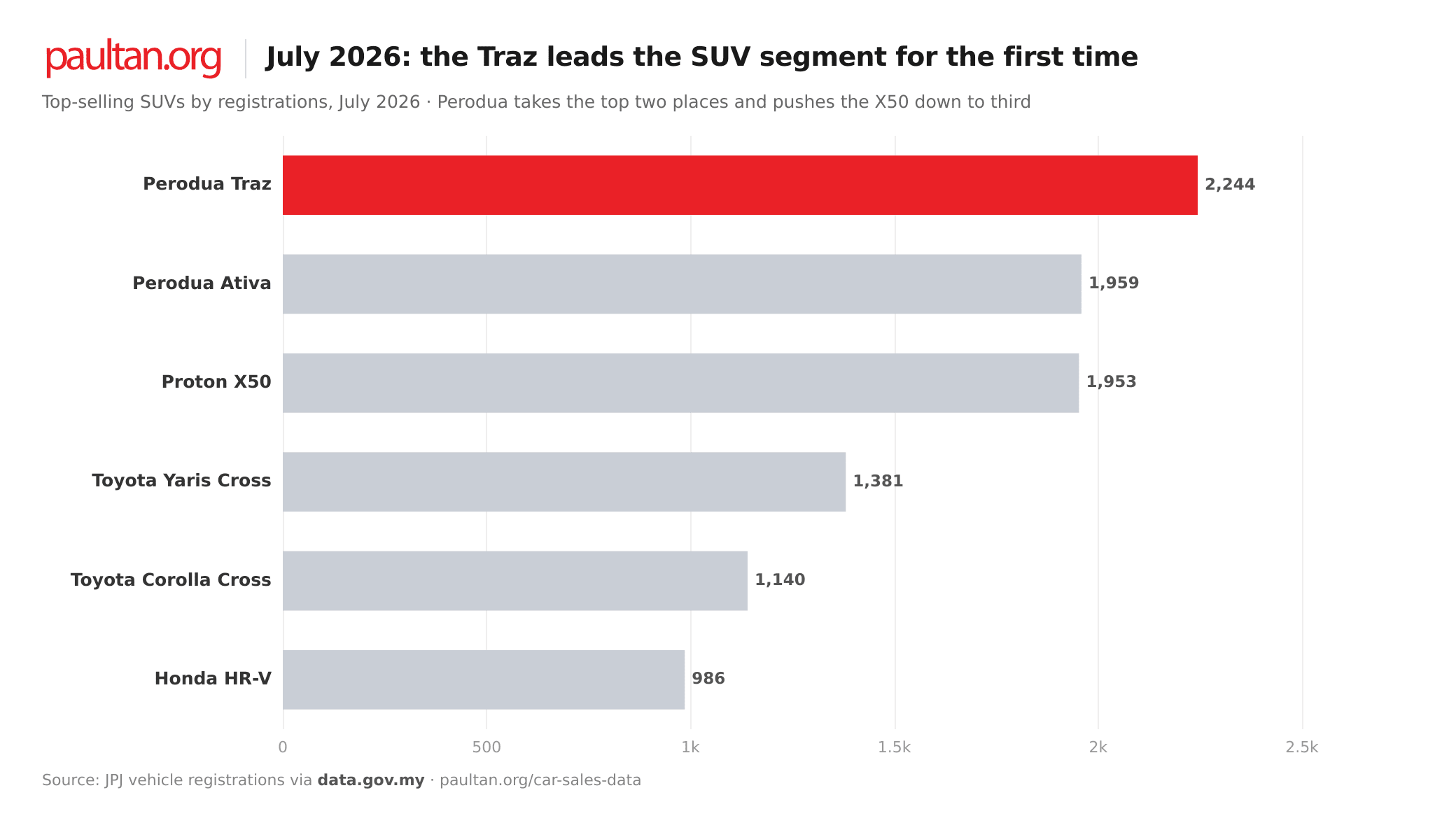
    Top-selling SUVs in Malaysia, July 2026

    The July podium underlines how tight it was. The Traz led on 2,244, its own stablemate the Ativa was right behind on 1,959, and the X50 a whisker further back on 1,953, so the gap covering the top three was under 300 units. The Traz’s T-badged twin the Toyota Yaris Cross followed in fourth on 1,381.

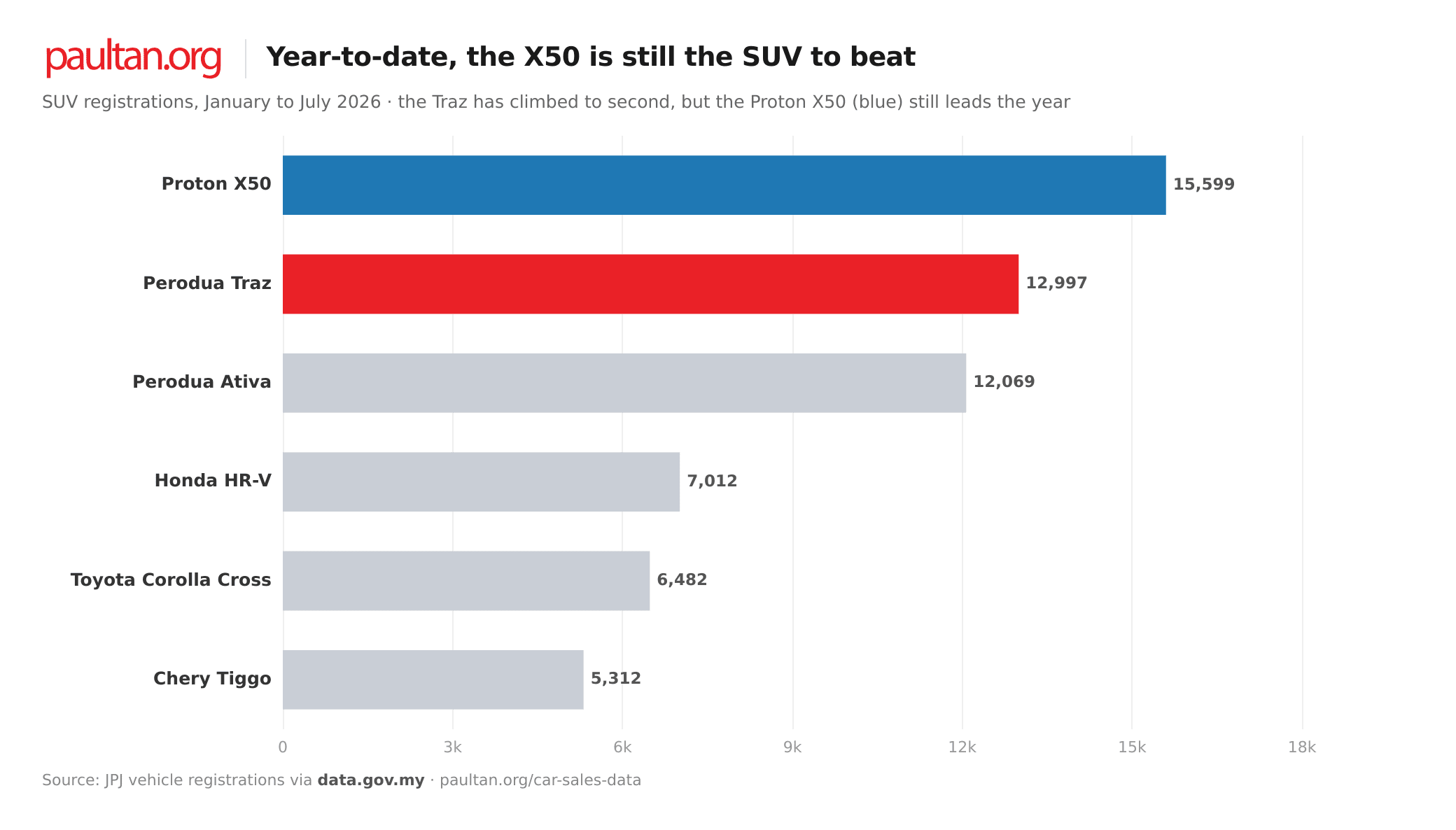
    Year-to-date SUV registrations in Malaysia, January to July 2026

    Over the whole year, the X50 is still on top. Across January to July the Proton has racked up 15,599 registrations against the Traz’s 12,997 and the Ativa’s 12,069, so one strong month does not yet make the Traz the year’s best-selling SUV.

    What it does show is momentum: the Traz is climbing while the X50 has drifted down from its early-year highs, and with the Yaris Cross still ramping the segment is getting more crowded at the top. If July was not a one-off, the second half of 2026 could turn into a genuine fight for the SUV crown.

     
  • Inokom adds new Paint Shop 3 facility to its Kulim plant – painting capacity upped by 50k vehicle bodies a year

    Inokom adds new Paint Shop 3 facility to its Kulim plant – painting capacity upped by 50k vehicle bodies a year

    Sime Motors has further expanded Inokom Corporation’s (Inokom) automotive manufacturing capabilities with the addition of a new painting facility, Paint Shop 3 (PS3), at Inokom’s 200-acre site in Kulim, Kedah. Constructed with an investment of RM300 million, the new paint shop was launched by the minister of investment, trade and industry, Datuk Seri Johari Abdul Ghani.

    The introduction of PS3 adds a substantial production capability to Inokom’s operations, including production requirements for the Mazda brand while providing capacity and flexibility for other CKD customers. The facility is able to accomodate diverse vehicle models and colour specifications, offering the flexibility to scale production volumes and accommodate future requirements.

    Based on a two-shift operation, the facility is designed to support up to 50,000 painted vehicle bodies per year, at a rate of 15 units per hour, coupled with the capability of plastic parts painting. The addition of PS3 increases the total combined paint shop capacity at Inokom to 100,000 painted vehicle bodies per annum.

    Most of the facility’s operations are automated, anchored by a fully automated pre-treatment and electrodeposition (PTED) line, advanced spray booths and an integrated conveyor system.

    The PTED line features a 1,053 metre fully automated conveyor network, comprising electric monorail systems, roller beds, lifters and turntables to support smooth and continuous movement throughout the painting process, enabling stable production and reliable throughput.

    Thirty two painting and sealant robots enable consistent, high precision paint application across exterior and interior surfaces as well as plastic components. Key automation features include a Cartridge Bell System (CBS) that enables rapid colour changes in under 10 seconds and supports up to 27 colour variants, reducing downtime and improving operational flexibility.
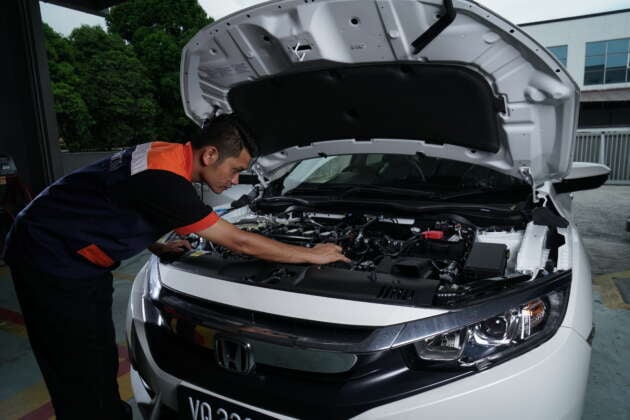
    The painting plant also incorporates an energy-efficient three-coat, one-bake painting process, which enables three coating layers to be applied with a single baking cycle. This reduces energy consumption, shortens processing time and supports more sustainable manufacturing operations.

    It also features a dry scrubber filtration system that eliminates water usage in spray booth operations, reducing environmental impact and maintenance requirements. In addition, PS3 has been designed with full waterborne paint readiness, enabling a seamless transition to more environmentally friendly coating technologies, in line with evolving industry requirements.

    The development of PS3 benefited from a close collaboration with Mazda’s technical support team, providing Inokom employees with valuable knowledge transfer, training and technical guidance throughout the installation and commissioning phases.

     
  • Bas Muafakat Johor now serves as feeder bus for KTM stations in Paloh, Kluang, Layang-Layang, Renggam

    Bas Muafakat Johor now serves as feeder bus for KTM stations in Paloh, Kluang, Layang-Layang, Renggam

    Good news for Johor commuters. Perbadanan Pengangkutan Awam Johor has announced that a few Bas Muafakat Johor (BMJ) routes will now function as feeder buses to KTM stations in Paloh, Kluang, Layang-Layang and Renggam. BMJ is free for Malaysian citizens.

    For Kluang, bus KL004 makes a loop between Kluang’s Terminal Pengankutan Awam and the Paloh bus station. KL001 is from Kluang to Bandar Kluang while KL002’s route is from Kluang to Hospital Enche’ Besar Hajjah Khalsom.

    As for Renggam, bus SR002 is a loop from Renggam to Layang-Layang while SR004 takes one from Renggam to Kluang. All the routes above now stop at the KTM stations of the towns they serve. Exact timing of the buses and the stops in between the start/end points are in the graphics below.

    These towns are not part of the KTM Shuttle Selatan that was launched in June (feeder buses for that, here), but they are connected to the main line served by the ETS, which stretches from Padang Besar in the north to JB Sentral in the south.

     
  • 2026 MINI Countryman S Desert Night – inspired by Bahrain GP in Malaysia, 48 units, standard ACC, RM255k

    2026 MINI Countryman S Desert Night – inspired by Bahrain GP in Malaysia, 48 units, standard ACC, RM255k

    MINI has introduced its second localised special edition of the third-generation U25 Countryman in Malaysia, the Desert Night. Said to be inspired by Formula 1’s unique, one-year-only Bahrain Grand Prix in Malaysia in October, the SUV has been dressed in black and gold highlights akin to the “striking beauty of the desert at night.”

    Following hot on the heels of the Chinese New Year-themed Fiery Stallion in January, the CKD Desert Night is priced at RM267,333 on-the-road without insurance with a two-year, unlimited-mileage warranty (RM277,733 with a five-year warranty and service package).

    That makes the car RM6,555 more expensive than the regular Countryman S All4 on which it’s based, although customers who place a booking before the aforementioned F1 race on October 4 will receive a RM12,000 cash rebate. This brings the price down to RM255,333, or RM262,733 with the warranty and service package.

    The S suffix indicates that this is a petrol model, powered by a 2.0 litre B48 turbo four-cylinder engine that produces 204 PS and 300 Nm of torque. Paired with an seven-speed wet dual-clutch transmission and All4 all-wheel drive, the car sprints from zero to 100 km/h in 7.4 seconds on its way to a top speed of 228 km/h.

    The exterior addenda includes a distinctive sand dune door stripe running down from the wing mirrors, along with a “Desert Night” black strip on the passenger-side front bumper that visually extends the grille “moustache”. The script also adorns the sail-like C-pillar insert, just above the “All4” badge.

    Meanwhile, the aero rear windscreen fairings, tailgate and even the valve stem caps on the 20-inch Windmill Spoke two-tone alloy wheels feature a starry badge. Speaking of which, the rollers’ centre caps have been switched to gold from the usual black. Inside, MINI is flexing its customisation capabilities with 3D-printed Desert Night badges on the steering wheel and key cap, plus the recurring star roundels on the floor mats.

    Beyond all those additions, the Desert Night is identical to the standard Countryman S, still coming in range-topping Favoured trim with features such as adaptive LED headlights, a 9.2-inch circular OLED touchscreen, a head-up display, dual-zone auto air-con, power-adjustable John Cooper Works sports seats, a Qi wireless charger, a 12-speaker Harman Kardon surround sound system, a 360-degree camera system and a hands-free powered tailgate.

    One change is the Driving Assistant Plus package, which includes Level 2 semi-autonomous driving functions such as adaptive cruise control and lane centring assist. This usually requires a subscription but is standard on the Desert Night, meaning that users won’t have to fork out the RM202 monthly fee or the RM4,481 one-time payment to unlock it.

    The Desert Night is available exclusively in Smokey Green or Slate Blue, limited to 30 units and 18 units respectively. Both are paired with Vintage Brown upholstery, which replaced Dark Petrol (read: teal) on the 2026 model year Countryman S.

     
  • BAW X03 on display at GIIAS 2026 – five-seat Denza B8-sized 4×4 SUV with 2.3L turbodiesel, RHD world debut?

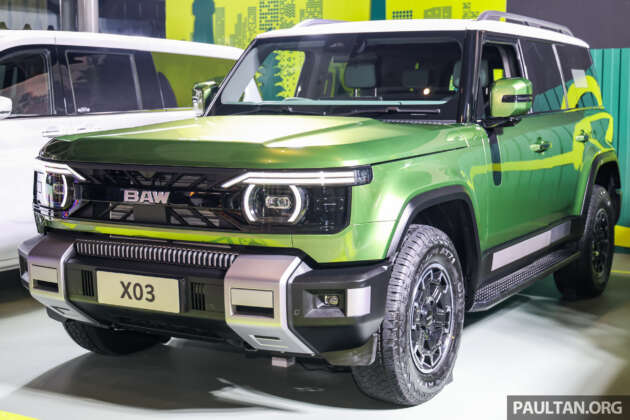
    BAW X03 on display at GIIAS 2026 – five-seat Denza B8-sized 4×4 SUV with 2.3L turbodiesel, RHD world debut?

    Looks quite a bit like a Denza B8, doesn’t it? Well, think of it as a more marhaen version. This is the X03, one of five models BAW brought to the just-concluded Gaikindo Indonesia International Auto Show (GIIAS) 2026. Yup, the seven-decade-old brand is now officially in Indonesia, with plans to CKD in West Java, no less.

    Length, width, height and wheelbase are respectively 5,095, 2,038, 1,945 and 2,950 mm – really not far off the Denza B8’s 5,195, 1,994, 1,905 and 2,920 mm. Like the Denza, the BAW’s a body-on-frame 4WD SUV, but it’s not a PHEV, has only five seats and certainly doesn’t have anywhere near 612 PS and 760 Nm of torque.

    Instead, it has a 185 PS/480 Nm 2.3 litre turbodiesel engine. There are double wishbones up front, multi links out back, ventilated disc brakes all around, a centre-locking diff, Comfort, Standard and Sport steering modes, a full-sized spare tyre on the back of the barn-door tailgate and a 170 km/h top speed.

    Other numbers include approach and departure angles of 33 and 30 degrees respectively, and a 2,570-kg kerb weight. Those 18-inch alloys are wrapped in 265/70 all-terrain tyres.

    Not much else is actually known (yet) about the BAW X03. This could be due to the fact that it’s extremely new – according to Autohome, the vehicle only surfaced a few days ago (yes!) and even so, through China’s industry and information technology ministry (MIIT) filings.

    This makes the existence of a right-hand drive (RHD) car even more inconceivable – even if BAW wanted the X03 to go international first, only a quarter of the world is RHD. Reminds us of how the Chery Maxime had its world debut in Malaysia in 2015 – the RHD version was developed first. Anyway, the X03 is part of BAW’s iconic 212 series, though it’s much less hardcore than this one.

     
  • Flood mitigation works at Jalan 223 food court in PJ will take six months to complete – part of RM40.5 mil plan

    Flood mitigation works at Jalan 223 food court in PJ will take six months to complete – part of RM40.5 mil plan

    According to a report by The Star, flood mitigation works at Medan Selera Jaya 223 in Petaling Jaya are expected to take six months to complete from the time the appointed contractor receives the go-ahead to start work.

    “We have submitted an application to appoint a contractor with experience in on-site detention ponds, and we are awaiting approval from the state to enable us to make the appointment and carry out the works,” said Petaling Jaya mayor Datuk Mohd Yazid Sairi.

    The food court is one of several hotspots identified as being at risk of flooding within the jurisdiction of the Petaling Jaya city council (MBPJ), which has identified possible solutions as well as contractors for flood mitigation projects in the city.

    “There are projects that we have categorised as short-term, which need to be completed immediately within six months to a year, while others are long-term solutions. For now, priority will be given to short-term projects in areas that we have identified as recurring flood hotspots,” said Yazid.

    Last month, it was reported that the Selangor state government would spend RM40.5 million on 39 projects as part of immediate and long-term mitigation plans to address flooding in Petaling Jaya. These include high-capacity drainage upgrades, automated flood gates, run-off pumping stations and an underground water detention pond to absorb downpours.

     
  • Are roof-mounted digital panels road-legal in Malaysia?

    Are roof-mounted digital panels road-legal in Malaysia?

    Cars are often used as advertising space for businesses, and digital display boards have also been used on vehicles for this purpose. Digital advertising boards have initially found to be mounted on the roofs of cars, where they were installed longitudinally for the ad content to be shown to the sides of the car.

    There have recently been instances of digital boards installed in a transverse manner, where the content is shown to the rear of the vehicle, presumably to capture the attention of the motorists behind the car, such as shown in this image posted to Threads.

    We reached out to our contact at the road transport department (JPJ) for clarity on the matter, specifically on the legality of the installation of advertising panels on a motor vehicle as depicted in the image above.

    View on Threads

    The road transport department has confirmed to paultan.org that such an installation is permitted under Rule 49 of the Road Traffic Rules 1959, Rule 79A of the Motor Vehicles (Construction and Use) Rules 1959, and Rule 94 of The Motor Vehicles (Construction and Use) Rules 1959.

    Responding to our further query on the brightness limit for digital advertisement boards, the department has shown paultan.org an internal circular which stated that LED advertisement boards:

    • are required to have a brightness of no more than 1,000 nits
    • are permitted to operate when the vehicle is in motion at speeds under 80 km/h
    • have transitions between each displayed image of no more than one second
    • must be deactivated or returned to its original state in the event of malfunction
     
  • BMW Malaysia and UM install solar-powered smartphone charging station using second-life BMW EV batteries

    BMW Malaysia and UM install solar-powered smartphone charging station using second-life BMW EV batteries

    BMW Group Malaysia and Universiti Malaya (UM) has installed a solar-powered smartphone charging station running on second-life BMW EV batteries at the university’s Central bus stop. The initiative, which serves a location with more than 3,000 daily users, brings over two years of laboratory research into direct, everyday use by the campus community.

    Engineered by associate professor Tan Chia Kwang and his team of researchers and PhD students at the UM power energy dedicated advanced centre (UMPEDAC), the project represents the first real-world application of the RE:GENERATE x Universiti Malaya research initiative following the start of the tie-up earlier this year.

    The charging station is one of two concurrent and distinct applications to emerge from the initiative. In the first, lower-capacity battery packs are used for lighter applications, such as the mobile device charging station deployed at the UM bus stop.

    Meanwhile, higher-capacity battery packs from the same programme are being allocated to a more demanding application, which is providing rural, off-grid electricity access to a Semai Orang Asli community in Pos Sinderut, Kuala Lipis, Pahang.

    Designed to power essential household appliances including lighting, fans, and refrigeration in off-grid villages, these energy storage units are expected to be deployed in the near future. Here, solar panels charge the batteries during the day, and the stored energy is then discharged to power household appliances after sunset, when energy demand is at its highest

    Looking further ahead, early-stage plans are being considered to explore how research can be scaled beyond rural electrification, including possible applications for an autonomous zero energy building in the UMSDC building within UM itself.

     
  • BAW D5 at GIIAS 2026 – RHD, little city EV takes on BYD Atto 1, Geely EX2 with 82 PS/125 Nm, 330 km CLTC range

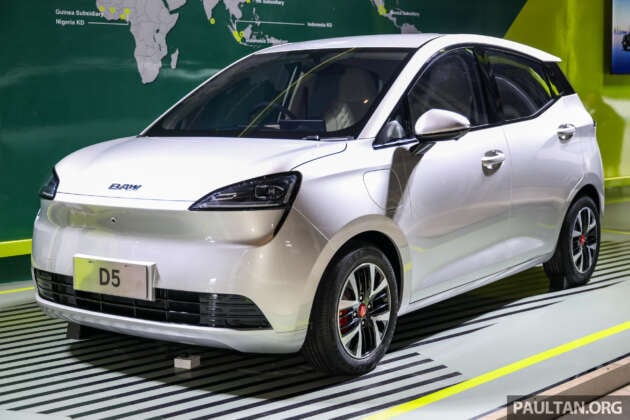
    BAW D5 at GIIAS 2026 – RHD, little city EV takes on BYD Atto 1, Geely EX2 with 82 PS/125 Nm, 330 km CLTC range

    Seven-decade-old Beijing Automobile Works (BAW) is now officially in Indonesia, and besides the M8 MPV, X03 SUV, T01 off-roader and T10 Pro light truck, the brand displayed this tiny cutie at the just-concluded Gaikindo Indonesia International Auto Show (GIIAS) 2026.

    It’s called the D5, and it’s an inexpensive little EV hatchback for the city, like the BYD Atto 1, the Geely EX2, the Chery Q and various little Wulings. At 3,800 mm long, 1,720 mm wide and 1,590 mm tall, with a 2,500 mm wheelbase, the D5’s every dimension equals the Atto 1 except for length – the BAW is 190 mm shorter.

    Wondering how much back seat space there is? “The rear row can comfortably accommodate 3 female passengers when the front row is normally occupied”, the brochure says, ignoring the fact that women come in all shapes and sizes.

    The BAW D5 has a 82 PS/125 Nm front electric motor (0-50 km/h in 4.7 seconds, 120 km/h top speed), a 31.94-kWh LFP battery (330 km CLTC/about 270 km WLTP; can be charged in as few as 36 minutes, max rates and SoC undisclosed), 15-inch steel wheels with hubcaps, 185/60 tyres and a 315-litre boot.

    Also standard are rear parking sensors, auto hold, stability control, a column gear selector, auto LED headlamps and wireless phone charging. There are two variants – the Standard has manual fabric seats, a 6.2-inch instrument panel, a 10.1-inch touch-screen, a reverse camera, powered door mirrors, a manual tailgate, four speakers and four airbags.

    The top variant poshes things up with powered front leather seats, an 8.88-inch instrument panel, a 12.8-inch touch-screen, a 360 camera, power-folding door mirrors, a power tailgate with height memory, four speakers and two tweeters, and six airbags. Optional are rear privacy glass and 16-inch alloys with 185/55 tyres, but there’s no ADAS whatsoever. Thoughts?

     
  • Newly-relocated Chery 3S centre in Alor Setar opens

    Newly-relocated Chery 3S centre in Alor Setar opens

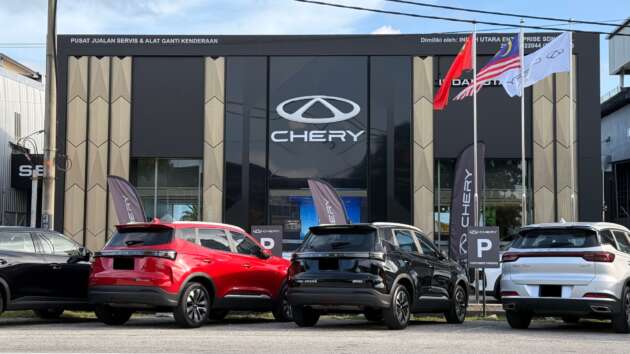
    A newly-relocated Chery 3S centre has opened in Alor Setar, Kedah. Now located at Lorong Perak 16 in the Mergong industrial area, the upgraded facility is operated by Indah Utara Enterprise, which also operates a Chery 3S centre in Sungai Petani.

    The 877 sqm facility features Chery’s latest ‘Generation 4.0’ concept for a more ‘premium, contemporary and immersive retail experience’. It’s the second Chery outlet to feature the brand’s new CI in the northern region.

    The service centre has four service bays while the showroom houses Chery’s full lineup of SUVs that are available for test drives.

    Chery Alor Setar’s showroom is open daily from 9am to 6pm, including public holidays. The service centre operates from 9am to 6 pm, Sunday to Thursday, and is closed on Friday and public holidays.


Sell your car to Carro, get paid in 24 hours

Latest Fuel Prices

PETROL
BUDI 95 RM1.99
RON 95 RM3.77 (-0.05)
RON 97 RM4.35 (-0.05)
RON 100 RM6.30
VPR RM7.53
DIESEL
BUDI RM2.10
EURO 5 B10 RM4.57 (-0.05)
EURO 5 B7 RM4.77 (-0.05)
Last Updated Aug 06, 2026
Fuel price history →

Tools