






















Follow us:
Advanced search
           
Browse all EVs
           
Browse all used cars
           
Sell your car, get paid fastFree inspection · fast payment Sell for a higher price Add paultan.org as a preferred source on Google Add
 

Perodua QV-E review - all the good and bad

Sell your car for a higher price, get paid in 24 hours

Latest Stories

  • Toyota GR Kart launched in Japan – entry-level 215 cc kart aimed at encouraging grassroots motorsports

    Toyota GR Kart launched in Japan – entry-level 215 cc kart aimed at encouraging grassroots motorsports

    Toyota’s current GR line-up includes two sports coupes as well as two all-wheel drive hot hatches. Now, the company has added an entry-level racing kart that was developed to broaden hands-on access to motorsports for children and families.

    Called the GR Kart, it aims to address hurdles faced by those looking to get into karting such as costs, transportation, storage and maintenance. This is in line with Toyota chairman Akio Toyoda’s desire for motorsports to be an activity more people can take up, with karting being the first form of competition many race drivers experience.

    Manufactured by Gamagori GR Kart Workshop, which is located in the city of Gamagori in the Aichi Prefecture, the GR Kart retails for 385,000 yen (about RM10.2k). Through Toyota Production System (TPS) principles, the Japanese carmaker says it is working to reduce costs and create new products that make it easier for newcomers to start and continue karting.

    For the money, the 83-kg GR Kart features a 215 cc engine that is paired with a belt-drive system to eliminate soiling from chain oil. There’s also an automatic tensioner that removes the need to adjust belt tension periodically. Adding to the maintenance ease is a built-in, self-charging battery, which eliminates the need to mount a separate battery and hassle of charging.

    The engine also gets a newly developed diaphragm carburetor designed for four-stroke engines that minimises the impact of fuel level fluctuations caused by lateral g-forces because it does not have a float chamber. Additionally, a primer pump draws fuel into the carburetor before starting, making pre-departure engine priming effortless.

    To make the lives of beginners more convenient, the GR Kart incorporates a rust-resistant stainless steel rear axle shift and internal metal fuel lines in the fuel tank, the latter minimising gasolinse-caused degradation for long-term durability.

    Safety is also of concern, with the kart having a bumper shaped in a way that prevents other karts from riding up onto a rear tire in the event of a collision. There are also hub stopper pins in the rear to prevent the rear hub from detaching, if it ever happens, while the throttle cable has a specific mounting method to prevent the throttle from sticking in the open position unintentionally.

    Meanwhile, the seat has a designated surface on its upper portion for resting hands when getting on or off the kart and shaped to shield hands from a hot muffler. Said seat is accompanied by sliding pedals and a tiltable steering wheel, allowing riders to adjust their driving position. Toyota says its kart can accommodate children and adults from 135 to 185 cm tall. There’s also a weight box capable of holding up to 15 kg of ballast for racing and includes a place to install a transponder.

    At 1,820 mm long, 1,160 mm wide, 670 mm tall and with a wheelbase of 1,045 mm, the GR Kart will fit into most family minivans, such as Toyota’s Noah or Voxy, without needing to be disassembled. When not in use, it can also be stored vertically without needing to first drain the kart’s gasoline and engine oil. This is because of the upright-storage-compatible engine oil catch tank and fuel filler opening orientation, along with the mentioned diaphragm carburetor.

    For now, the GR Kart is only offered in Japan and sold at 36 participating kart tracks in the country as well as certain GR Garage locations, with the company aiming to increase the number of sales locations in the future.


     
  • Ford blasted by Trump administration over deals with Chinese companies including CATL, Geely, BYD – report

    Ford blasted by Trump administration over deals with Chinese companies including CATL, Geely, BYD – report

    Ford and Geely announced a joint-venture in July

    The Trump administration is not happy about Ford’s deals with Chinese firms, Reuters writes in three separate reports. Transportation secretary Sean Duffy urged Ford CEO Jim Farley in a letter on Tuesday to sever ties with CATL, Geely and BYD, saying the Blue Oval’s dealings with Chinese companies were “troubling” and raised “profound concern.”

    The letter said that the transportation department was “deeply alarmed” by Ford’s reliance on licensed technology from CATL at its Marshall, Michigan plant, and that CATL is on the Pentagon’s list of companies accused of ties to China’s military.

    Duffy also said the decision to move Lincoln Nautilus production from China to the US only by 2030 leaves Ford reliant on Chinese manufacturing for several more years.

    Ford blasted by Trump administration over deals with Chinese companies including CATL, Geely, BYD – report

    The Ford Bronco Basecamp a.k.a. Bronco New Energy has Chinese underpinnings

    Less than 24 hours after the letter, the Republican-controlled house select committee on China posted on X that Ford has by turns warned of the threat Chinese companies pose to the US and yet is partnering with some of them. “This is what Ford says vs. what it does,” the post read.

    Republicans were quick to chime in, with senator Rick Scott praising Duffy for “sounding the alarm about Ford’s risky ties to (Chinese Communist Party) companies” and representative John Moolenaar, the China committee chair, commending Duffy “for calling out Ford’s growing reliance on Chinese companies, including CATL and Geely.” Moolenaar added that “Ford should work with our nation’s allies, not our adversaries.”

    Contradictorily, on X on the same day, the White House called Ford a “great American company” that had invested in US production, and commerce secretary Howard Lutnick just weeks ago lauded some of the very moves Duffy panned in his letter.

    Ford blasted by Trump administration over deals with Chinese companies including CATL, Geely, BYD – report

    Ford CEO Jim Farley

    What did Ford have to say? In a statement, the Blue Oval called Duffy’s letter “a wrongheaded attempt to capture ​headlines”, adding that “while others continue to import Chinese batteries, Ford is investing to build batteries ​here in America” and that “Ford owns the plant, controls the operation and employs the workforce.”

    Reuters writes that the mixed messages reflect a broader debate – president Trump wants to protect US industries from Chinese competition and rebuild US manufacturing, but administration officials have signalled differences over where collaboration with Chinese companies is going too far.

    Last week, the Alliance for Automotive Innovation, which represents major carmakers including General Motors, Ford, Toyota, Volkswagen, Hyundai, Honda and Stellantis, urged Congress to pass legislation barring Chinese vehicles before year-end.

     
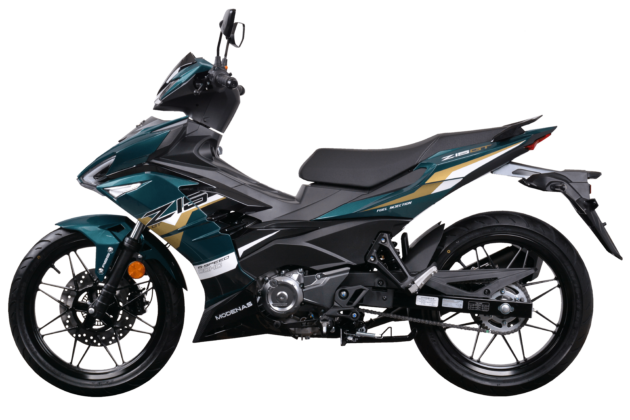
  • 2026 Modenas Z15GT gets seven updates under Care Programme, two new colours, priced at RM8,288

    2026 Modenas Z15GT gets seven updates under Care Programme, two new colours, priced at RM8,288

    Now updated for Malaysia is the 2026 Modenas Z15GT with seven improvements under Modenas’ Z15GT Care Programme, with pricing unchanged at RM8,288. Pricing does not include road tax, insurance or registration and the new colour options are Lime Green and Amazon Green.

    The changes cover a number of areas, primarily aimed at improving component protection and durability. These include improved drainage for the overflow tray, additional coating and sealant around the ignition knob switch, and a revised injector cap bolt and collar.

    The front brake lever now features a low-level indicator line, while the side-cover snap fittings have been reinforced. Additional socket covers have also been fitted to better protect the wiring harness from water exposure while the solder points inside both the left- and right-hand switch pods are better protected.

    2026 Modenas Z15GT gets seven updates under Care Programme, two new colours, priced at RM8,288

    Mechanically, there are no changes to the powertrain. The Z15GT continues with a 149.5 cc single-cylinder, liquid-cooled DOHC four-valve engine, producing 16.8 hp at 9,500 rpm and 13.5 Nm of torque at 7,500 rpm mated to a six-speed constant-mesh gearbox and wet multi-plate clutch, with chain final drive.

    The Z15GT uses a backbone frame, telescopic front fork and rear monoshock. Braking is via hydraulic discs front and rear, with single-channel ABS on the front wheel with wheel sizing 17-inches front and rear, fitted with 90/80-17 front and 120/70-17 rear tyres.

    Other specifications include a 5.7-litre fuel tank, 780 mm seat height, 1,315 mm wheelbase, 140 mm ground clearance and 128 kg kerb weight. Equipment includes a smart key with answer-back function, LCD instrumentation, LED lighting and a USB power socket. The instrument display shows speed, engine rpm, gear position, fuel level, engine temperature warning, trip information, clock and battery voltage.

     
  • LRT Kelana Jaya Line track replacement work to be done in stages until Sept 2027, some changes to schedule

    LRT Kelana Jaya Line track replacement work to be done in stages until Sept 2027, some changes to schedule

    Rapid KL has announced that it will carry out track replacement work on at stations on the LRT Kelana Jaya Line in seven stages over the next year, starting from September 13 until September 2027. This will be carried out on scheduled days across the period, with stations involved in the track replacement work beginning operations at 9.30am compared to the usual 6am start.

    Meanwhile, stations that are not involved will operate as usual, according to the usual schedule. For those few hours, a free shuttle bus service will connect the stations involved to the rest of the line. In a statement, the rail operator said that the improvement work is being carried out to ensure the safety and reliability of the line’s track infrastructure.

    The track replacement schedule will start with Gombak and Taman Melati stations on September 13, 20 and 27, followed by that for Universiti, Kerinchi and Abdullah Hukum stations, on November 15, 22 and 29, The third phase will begin from early next year, and involve Dato’ Keramat, Jelatek and Setiawangsa stations, on January 10, 17 and 24, 2027.

    LRT Kelana Jaya Line track replacement work to be done in stages until Sept 2027, some changes to schedule

    The maintenance work then returns to Universiti, Kerinchi and Abdullah Hukum stations on March 14, 21 and 28, before moving on to Masjid Jamek, Dang Wangi, Kampung Baru, KLCC and Ampang Park stations on May 9, 16 and 23. The following phase will then see work being carried out at Taman Jaya, Universiti, Kerinchi and Abdullah Hukum stations on July 11, 18 and 25, before concluding with Gombak and Taman Melati stations on September 12, 19 and 26.

    During the scheduled maintenance days, ticket machines at each station involved in the exercise will be temporarily closed until 9.30am. Users needing to continue their journey at the next station can obtain tickets at the station counters, with Rapid KL and Touch ‘n Go users continuing their journey as usual with card access.

    Rapid KL said station staff, auxiliary police and ‘Prasarana Troopers’ volunteers will be present to facilitate passenger movement at the stations undergoing track replacement work. Signboards will also be put up and information leaflets will be provided.

     
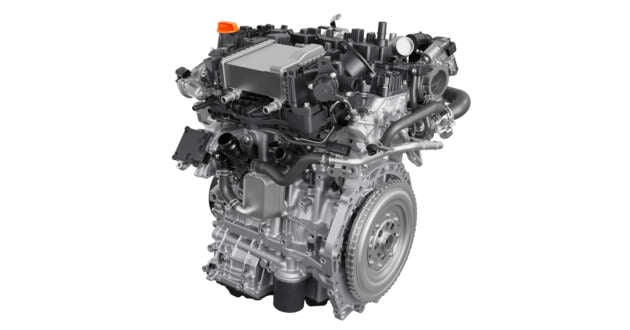
  • Horse Powertrain reveals waterproof B20 engine – 2.0T operational even when submerged up to 1.1 metres

    Horse Powertrain reveals waterproof B20 engine – 2.0T operational even when submerged up to 1.1 metres

    Horse Powertrain – a joint venture between Geely and Renault – has revealed the B20, a new engine that the company says is fully waterproof. Meeting IPX8 waterproofing standards, the B20 can operate up to depths of 1.1 metres and designed for extreme off-road vehicles and deep-water wading.

    The company said its new engine brings all-terrain capabilities to hybrid vehicles, with applications for SUVs and pick-up trucks in mind. To meet the demands of such vehicles, it is also capable of maintaining continuous and stable power output under extreme off-road high-load conditions, including 100% grade climbing. The B20 is already used for the PHEV powertrain in the Geely Galaxy Cruiser 700, paired with Horse’s 3DHT230 three-speed hybrid transmission.

    To achieve the IPX8 rating, the engine uses a fully sealed waterproof structure equipped with torsional vibration dampers and dedicated engine-transmission sealing. The electrical components and sensors are also IPX8-rated, and when submerged in water, the engine’s control system makes automatic adjustments such as limiting power or adjusting the throttle response based on what the sensors feed it.

    In terms of technical specifications, the B20 is 2.0 litre turbocharged inline-four petrol engine that weighs just 130 kg. It features direct fuel injection and operates on the Miller cycle for a brake thermal efficiency of 48.4%.

    Horse Powertrain says the engine outputs between 190 PS (188 hp or 140 kW) and 252 PS (248 hp or 185 kW), with peak torque ranging between 300 and 380 Nm. In addition to hybrid vehicles, it can also be used in plug-in hybrid electric vehicles (PHEVs) as well as range-extended electric vehicles (REEVs).

    To achieve leaner, cleaner combustion and to maximise fuel economy, the B20 gets high-pressure injectors and high-tumble intake ports to enable greater air-fuel mixing. Additionally, the pistons are designed to further promote air-fuel mixing at the peak of the compression cycle.

    For better NVH and durability the B20 uses a gantry-type aluminium block with an integrated exhaust manifold and a simplified balance shaft system. There’s also a variable displacement oil pump ensuring optimal oil flow and pressure throughout the engine. A fully active dual-cooling system keeps engine temperatures at bay.

     
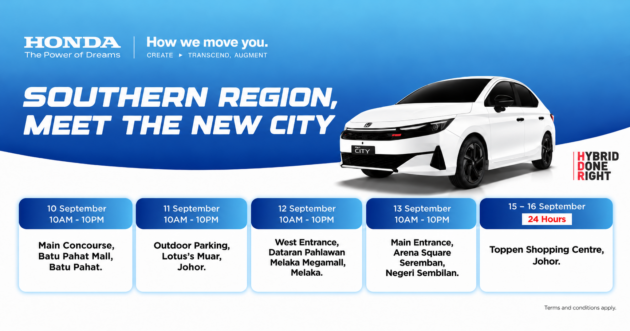
  • 2026 Honda City facelift preview heads to southern region – Batu Pahat, Muar, Melaka, Seremban, JB

    2026 Honda City facelift preview heads to southern region – Batu Pahat, Muar, Melaka, Seremban, JB

    The 2026 Honda City facelift pre-launch tour rolls on. After its Malaysian debut at four locations across the Klang Valley and the ongoing East Coast leg, the refreshed B-segment sedan is heading down south to Johor, Melaka and Negeri Sembilan.

    The southern tour starts at the Main Concourse of Batu Pahat Mall in Batu Pahat on September 10, before moving to the outdoor parking of Lotus’s Muar on September 11. Next up is the West Entrance of Dataran Pahlawan Melaka Megamall in Melaka on September 12, followed by the Main Entrance of Arena Square in Seremban, Negeri Sembilan on September 13 – all four stops run from 10am to 10pm.

    The finale is a two-day stop at Toppen Shopping Centre in Johor Bahru on September 15-16, and like the Klang Valley’s Durian Wonderland stop, this one runs 24 hours.

    Unveiled in India in May before making its ASEAN debut in Thailand a month later, this is the second facelift for the fifth-generation City sedan, which arrived here in Malaysia in October 2020. A mild first facelift surfaced here in August 2023.

    With this second facelift, the GN2 City is near unrecognisable from the front. It now has slimmer headlights (bi-LED projectors, as shown by the RS) as part of a slim ‘mask’, paired with new bumpers. The H mark sits on body colour above the grille and on the RS, there’s a light bar connecting the LED DRL brows.

    The rear and sides look a lot more familiar, but the RS does get ‘albino’ style tail lamps. There’s also an aggressive new bumper, and the RS comes with plenty of black elements throughout, like the Civic RS. Finally, there are new turbine-style 16-inch alloys finished in two-tone. The tyres are Toyo Proxes R57 in 185/55.

    2026 Honda City facelift preview heads to southern region – Batu Pahat, Muar, Melaka, Seremban, JB

    Inside, the familiar GN2 dashboard’s trim on the RS is now a more textured silver finish with a red accent line, as opposed to full red. There’s also ambient lighting, but the most obvious new element is the new and larger 10-inch touchscreen head unit, which will be available from the V variant onwards.

    The new screen comes with the 360-degree camera system that was added to the City earlier this year, and it has been updated with a multi-view angle and moving object detection interface. A switch on the tip of the left steering column stalk lets one cycle through the angles.

    Elsewhere, the seat upholstery on the RS has been revised – the central ‘bar’ on the previous facelift’s front chairs has been deleted, and the reddish contrast perforation surface on the spine has been relocated to the sides – the seats look more simple now.

    The e:HEV RS gets a new wireless mobile charger, but we noticed that the sports pedals are now two pieces instead of three, losing the alloy footrest.

    2026 Honda City facelift preview heads to southern region – Batu Pahat, Muar, Melaka, Seremban, JB

    Safety-wise, the City facelift will continue to have Honda Sensing as standard, setting it apart from national offerings where full ADAS is reserved for flagship variants. The driver assist suite includes autonomous emergency braking, adaptive cruise control with (e:HEV RS-exclusive) stop and go, lane centring assist, road departure mitigation, front departure alert and auto high beam.

    New to the 2026 City is blind spot monitoring with rear cross traffic alert, and this works with the existing LaneWatch camera (still accessible from the right steering column stalk) to now provide alerts to the driver on both sides. So, you’ll get camera feed for the left side and a conventional blind spot monitor for the right side.

    There are no mechanical changes. Petrol models will feature the familiar 1.5-litre DOHC i-VTEC four-cylinder offering 121 PS at 6,600 rpm and 145 Nm of torque at 4,300 rpm. The L15Z is paired with an Earth Dreams CVT.

    The i-MMD system on the e:HEV hybrid is also unchanged. The system consists of a primary electric traction motor with 109 PS and 253 Nm providing drive through a single-speed transmission, with an Atkinson-cycle version of the 1.5L engine acting as a generator to recharge the battery. The ICE does clutch in to provide mechanical drive at higher running speeds.

    Currently, the City is available in five variants (S, E, V, RS and hybrid e:HEV RS), but word is that the range will be trimmed to four. Since both RS petrol and e:HEV variants were shown at the Klang Valley pop-up previews, it’s likely that one of the petrol variants won’t make it.

    No mentions of price yet, but for reference, the outgoing City starts from RM84,900 for the S grade, moving up to RM89,900 for the E and RM94,900 for the V. The petrol RS goes for RM99,900 while the e:HEV RS retails for RM111,900. The City Hatchback will only get this facelift later, by the way. Again, check the 2026 City facelift out this week if you’re in the southern region – locations and dates are above.

    GALLERY: 2026 Honda City sedan facelift, petrol RS

    GALLERY: 2026 Honda City sedan facelift, e:HEV RS

     
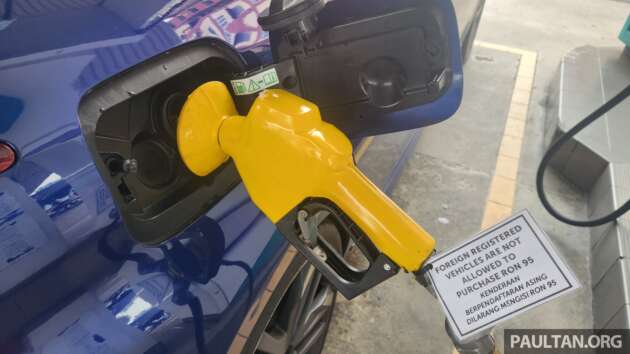
  • Malaysian fuel prices September 10-16, 2026 – up 25 sen; diesel to RM4.92, RON95 to RM4.02, RON97 to RM4.50

    Malaysian fuel prices September 10-16, 2026 – up 25 sen; diesel to RM4.92, RON95 to RM4.02, RON97 to RM4.50

    It is Wednesday, which means it is once again time for the weekly fuel price update, as the ministry of finance has announced fuel prices for the coming week of September 10 to 16, 2026. Following last week’s price drop for diesel and petrol, prices for the main fuel types have rebounded for this week.

    Unsubsidised B10 nd B15 diesel fuels will be priced at RM4.92 per litre in the coming week, up 25 sen from the RM4.67 per litre rate of last week. As such, the Euro 5 B7 grade of diesel, at 20 sen per litre more, will be priced at RM5.12 per litre.

    As of July 1 this year, Malaysians owning a diesel vehicle pay a subsidised retail price of RM2.10 per litre for B10 and B15 diesel blends, with eligible users now allocated a monthly quota of 300 litres as of September 1, still shared with Budi95 (which means the increase from 200 to 300 litres applies to both fuels).

    Private diesel pick-up truck and jeep owners can apply for an additional 100 litres of subsidised diesel per month, bringing the total monthly quota to 400 litres for them.

    Malaysian fuel prices September 10-16, 2026 – up 25 sen; diesel to RM4.92, RON95 to RM4.02, RON97 to RM4.50

    Unsubsidised RON 95 petrol also sees a hike of 25 sen to RM4.02 per litre, up from the RM3.77 per litre rate of last week, while RON 97 petrol climbs by the same amount to RM4.50 per litre this week.

    Subsidised RON 95 petrol under the Budi Madani RON 95 (Budi95) scheme continues to be priced at RM1.99 per litre, and Malaysians holding a valid driving licence are eligible for the fuel at a monthly quota that has been restored to 300 litres as of September 1.

    These prices take effect from midnight tonight until Wednesday, September 16, 2026. This is the 38th edition of the weekly fuel pricing format for 2026, and the 401st in total since the format was introduced at the start of 2019.

     
  • Thailand designing new EV tax policy around investment, export production and higher-value local content

    Thailand designing new EV tax policy around investment, export production and higher-value local content

    Malaysia isn’t the only country in the region where an upcoming automotive policy stresses localisation as a key consideration in determining tax incentives for automotive companies. Over in Thailand, the country’s excise department is said to be in the process of designing the country’s next automotive tax framework around the lines of investment and increasing higher-value local content, as well as the scaling up of electric vehicle (EV) production for export.

    The specific tax measures have not yet been finalised, with the director-general of the excise department, Pornchai Thiraveja, saying that work on the policy remained at the level of setting broad principles, The Nation reports, citing news agency Thansettakij.

    The aim of the new policy is to address the industry’s long-term transition from internal combustion engine (ICE) vehicles to EVs. As indicated by the report, it will be guided by three objectives, which is to ensure that imports lead to domestic investment, expanding production sufficiently for Thailand to become an EV export hub and helping Thai suppliers move into higher-value components, systems and technologies.

    The approach builds on the country’s previous EV3 and EV3.5 support measures, which were introduced to support learning among both consumers and manufacturers. The two programmes have brought eight to 10 factories in, including those from BYD, MG and GWM.

    Thailand designing new EV tax policy around investment, export production and higher-value local content

    Statistics-wise, about 170,000 EVs have been produced domestically, while investment in electric vehicles and parts has reached approximately 140 billion baht. The country now has a potential EV production capacity of up to 380,000 vehicles a year, with the industry creating around 25,000 jobs.

    Thailand has spent more than 60 years developing its conventional automotive industry into an important regional production and export base, but the global shift towards electrification has changed the playbook, requiring it to adapt its manufacturing capabilities and remain competitive as the industry changes.

    Pornchai said EV imports were necessary during the initial phase to allow consumers to become familiar with the vehicles and give the industry an opportunity to learn about the technology. However, the government did not want the country to remain merely a market selling imported vehicles, without generating wider benefits for the domestic automotive industry.

    The two programmes were therefore designed to combine initial imports and market development with new investment and production in Thailand, with the objective being to help the country build on its established ICE manufacturing expertise while developing capabilities in EV technology.

    Thailand designing new EV tax policy around investment, export production and higher-value local content

    At this stage, with battery technology, control systems and intelligent-vehicle technologies continuing to develop rapidly, further incentives are needed to attract new investment and prevent Thailand’s EV development from stopping at its current level, Pornchai said.

    While the country continued to welcome new technologies and vehicle models so that consumers and businesses could embrace and learn from them, these should lead to investment and production in Thailand rather than merely being a point-of-sale. Aiming to expand on the two earlier programmes, the government expects further technological changes and new forms of investment, and said the policy had to continue creating conditions that attract manufacturers and technology providers.

    Once the country has secured investment and established an EV production base, the next objective would be to increase manufacturing scale sufficiently to support exports. As indicated by the department, Thailand wants investments made in the country to look beyond meeting domestic demand and serve as a manufacturing base supplying EVs to international markets.

    The final part of the strategy involves a greater involvement of Thai businesses in component manufacturing throughout the supply chain, with the aim of moving local content beyond basic components such as leather seats, rubber components or general assembly items towards systems and technologies that generate more value.

    Thailand designing new EV tax policy around investment, export production and higher-value local content

    Pornchai said that the aim to increase higher-value local content will require cooperation between Thai manufacturers and overseas investors, stating that such cooperation could create benefits across investment, production, exports and the development of Thai businesses. He added that investors from several countries interested in establishing operations in Thailand have already held discussions with the government.

    The excise department DG added that the future automotive tax policy would need to address both consumption and environmental considerations, saying that changes to the tax structure should therefore not be viewed merely as measures that raise or lower costs for consumers.

    “The goal does not end with having EVs manufactured in Thailand. We must move forward to becoming an export base and ensure that Thai manufacturers participate in higher-value parts of the production supply chain,” he said.

     
  • Zeekr 7X to get new 85 kWh battery in China for MY2027

    Zeekr 7X to get new 85 kWh battery in China for MY2027

    A new lithium iron phosphate (LFP) version of the Zeekr 7X has been approved by China’s ministry of industry and information technology (MIIT), reports CarNewsChina. Set to arrive in Q4 this year, the new variant will be equipped with Geely’s Aegis Golden Brick battery with an energy capacity of 85 kWh.

    This is used to power a rear electric motor rated at 503 PS (496 hp or 370 kW), which is the same output as other rear-wheel drive variants of the facelifted 7X currently on sale in China. The filing also shows the variant will come with a factory dashcam, optional four-piston front brake callipers as well as various exterior configurations.

    At present, the latest 7X in China is offered with three powertrains, including a base option that pairs a 75-kWh LFP battery with RWD and 503 PS for up to 620 km of range following the CLTC standard. This is followed by a 103-kWh nickel manganese cobalt (NMC) battery version that is either RWD (802 km) or all-wheel drive (715 km).

    The upcoming 85-kWh variant is expected to sit between the existing two configurations, although some reports claim the 75-kWh option will be replaced with the newer offering. With the 7X priced between 229,800 and 269,800 yuan (about RM138k and RM163k), there is technically space for another configuration so buyers have more options.

     
  • Company fined RM116,495 for possessing fake Perodua engine oil, also empty bottles, labels, seal caps – report

    Company fined RM116,495 for possessing fake Perodua engine oil, also empty bottles, labels, seal caps – report

    The Shah Alam sessions court has fined a wholesale company RM116,495 after it pleaded guilty to possessing various counterfeit goods, including 1,912 units of Perodua engine oil, two years ago, Kosmo reports.

    Happy Leaders Sdn Bhd was charged with possessing for the purpose of trading various imitation Perodua Genuine Oil (PGO) products, including Fully Synthetic, Mineral SAE, Semi Synthetic SAE and Semi Synthetic SAE 5W-30, totalling 1,912 units.

    The company was also charged with possessing 3,125 empty Perodua-branded bottles, nine boxes of lubricant labels and eight boxes of Perodua seal caps.

    Company fined RM116,495 for possessing fake Perodua engine oil, also empty bottles, labels, seal caps – report

    The offence was reportedly committed at the company’s Kampung Baru Sungai Buloh premises at approximately 2.30 pm on November 5, 2024.

    The charge was brought under Section 102(1)(c) of the Trademark Act 2019 and punishable under Section 102(1)(i) of the same act.

    Perodua has for a long time been warning the public of the existence of fake PGO in the market, saying that PGO is only to be found at authorised Perodua service centres, authorised stockists and selected Petronas stations, and that authenticity cannot be guaranteed with any other source.

     
  • Polestar Formula 2030 concept to debut later this year; design cues preview Polestar 7 and next Polestar 2

    Polestar Formula 2030 concept to debut later this year; design cues preview Polestar 7 and next Polestar 2

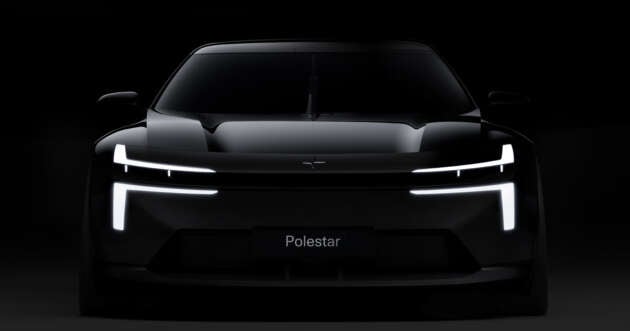
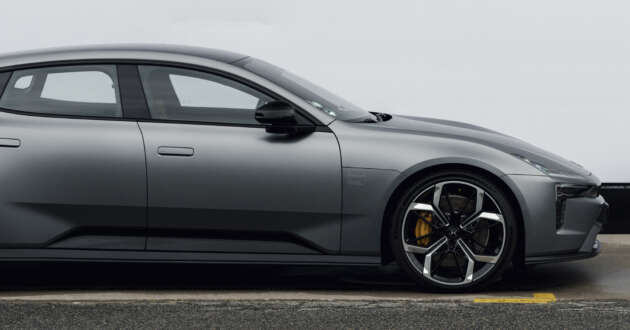
    Polestar has offered an early look at its Formula 2030 concept that previews the brand’s future design direction, with design cues to be found on the next Polestar 2 and Polestar 7 models, which are set for debut in 2027 and 2028 respectively.

    “Polestar’s design and brand is already so strong, it was obvious we needed a bold evolution not revolution of what came before. Formula 2030 delivers this, showcasing our future while respecting brand-defining elements like the familiar Dual Blade headlights ensuring it remains recognisably a Polestar with a strong, characterful identity,” Polestar head of design Philipp Römers stated.

    A previous teaser of the next Polestar 2 hinted at the car’s front fascia, which was depicted to wear the brand’s latest headlamp signature, such as now also seen on the Formula 2030 concept and on recent models, the Polestar 4 and Polestar 5.

    While the next-generation Polestar 2 is expected to carry on as the foundation of the brand, and the car that Polestar “became known for”, the Polestar 7 will be the brand’s premium compact SUV offering that will be produced in Europe.

    Polestar Formula 2030 concept to debut later this year; design cues preview Polestar 7 and next Polestar 2

    Polestar 5

    Speaking to Autocar, Römers said that awareness of the Polestar brand is still growing, and so it needs to build on its existing design language.

    “My first decision is that it would be bad to do a design revolution, because the brand is so young. I don’t want to make a revolution. I want to do a bold evolution built on our values,” he said.

    Recently, the Polestar 4 SUV made its debut earlier this week, bringing a “lifted estate” shape with an upright tailgate and glass rear window to the Polestar 4 form that employs a solid panel in place of a glass rear screen.

    The Polestar 4 SUV accommodated 530 litres when loaded up to the parcel shelf, or 655 litres when measured up to the inner roof, and 1,665 litres with the rear seats folded down. By comparison, the 4 has 526 litres, or up to 1,536 litres with the rear seats folded.

     
  • Ford Bronco Basecamp coming to Australia 2027 – China REEV, up to 900 km WLTP, Malaysia to get it too?

    Ford Bronco Basecamp coming to Australia 2027 – China REEV, up to 900 km WLTP, Malaysia to get it too?

    In what has surely got to be the region’s worst-kept secret, Ford has finally announced that the Chinese-market Bronco New Energy will be headed to Australia in the second half of 2027, badged as the Bronco Basecamp. The electrified SUV will help the carmaker diversify its offerings, as its Ranger and Everest continue to be battered by high diesel prices globally.

    Built by JMC, the Basecamp offers the boxy 4×4 styling of the pukka Bronco, albeit grafted onto a road-biased unibody chassis. Details like a full-width grille with round headlights, wraparound windows and a side-opening tailgate with a full-sized spare tyre are juxtaposed against an aerodynamic front “wing”, slimmer air intakes and pop-out door handles.

    The five-seater cabin is mostly identical to the Chinese version (apart from the fact that it’s right-hand drive, of course), with a simplified design, large 8.8-inch instrument and 15.6-inch infotainment displays, twin smartphone holders with a Qi wireless charger and a distinct lack of physical switchgear.

    Ford Bronco Basecamp coming to Australia 2027 – China REEV, up to 900 km WLTP, Malaysia to get it too?

    Ford has also confirmed that many of the car’s outdoorsy features will be carried over to international markets. For instance, the seats can be folded completely flat, allowing a full-length inflatable mattress (available in the accessories catalogue) to be installed.

    There’s also a Wild Kitchen, which despite its name isn’t a built-in stovetop and sink, but rather a fold-down table built into the tailgate to be used alongside a bottle opener, a magnetised surface and a three-pin power socket in the boot. The range-topping Outer Banks model also gets a 7.5 litre centre console fridge and even an RV-style pop-up roof.

    Measuring 5,025 mm long, 1,960 mm wide and 1,825 mm tall, the Basecamp is 215 mm longer, 35 mm wider and 42 mm taller than even the full-fat Bronco five-door, even though its 2,950 mm wheelbase is exactly the same. That makes the car much bigger than the likes of the Jetour T2, another 4×4-styled SUV.

    Ford Bronco Basecamp coming to Australia 2027 – China REEV, up to 900 km WLTP, Malaysia to get it too?

    For now, only the range-extended EV model has been confirmed, with no sign of the battery-powered variant as yet. Power comes from dual motors providing all-wheel drive, as well as a 1.5 litre turbo four-cylinder generator. No output figures have been released, but as reference, the Chinese version makes 421 PS (310 kW) and 600 Nm of torque.

    The Australian car will get a larger 49 kWh battery for an estimated combined range of between 800 and 900 km on the WLTP cycle. Ford hasn’t provided details of electric range or charging but has confirmed the Basecamp will offer a 6.6 kW V2L function.

    It remains to be seen if the Bronco Basecamp will be made available elsewhere, but it would certainly be welcome in Southeast Asia. That includes Malaysia, where preferential import and excise duty rates for Chinese-built vehicles should enable the car to be priced more competitively – more so than even the Thai-built Everest.

     
  • JPJ seizes 37 excessively-modified cars in KL under Ops Ekstrem – lowered, flaming exhausts, air suspension

    JPJ seizes 37 excessively-modified cars in KL under Ops Ekstrem – lowered, flaming exhausts, air suspension

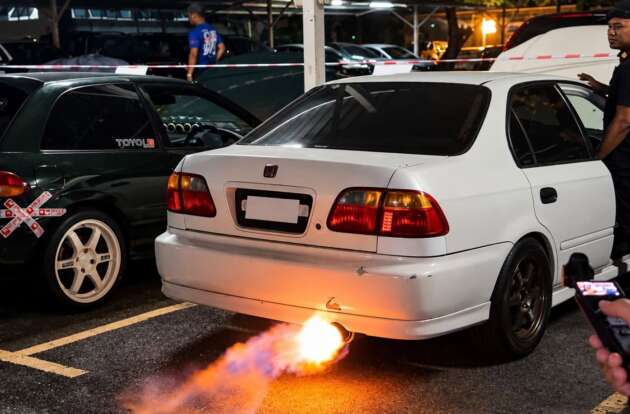
    The road transport department‘s (JPJ) Ops Ekstrem, which began this year targeting excessively-modified bikes, has been expanded to cars. On Sunday, JPJ seized 37 such cars – some lowered, some with flaming exhausts and some even with air suspension, Bernama reports.

    “Some vehicles had been extensively modified, with their bodies lowered to the point of almost touching the road, while some owners had spent up to RM150,000 modifying exhausts to produce flames. Roads are not the place to showcase extreme vehicle modifications that push vehicles to their limits, disrupt public order and endanger other road users,” JPJ director-general Datuk Aedy Fadly Ramli said.

    He added that the seized vehicles will be held until legal action is taken against their owners and the vehicles are restored to their original specifications and condition.

    Conducted between one and five in the morning around KL, particularly along Jalan Raja Laut, the operation took action against 97 of the 156 vehicles inspected, for various offences. 485 notices were used (97 for non-regulation number plates, 77 for exhaust-related offences, 66 for expired road tax, 57 for not having insurance, 44 for tinted windows and 11 for vehicle modifications).

    Aedy Fadly said the air suspension systems, which cost RM15,000-25,000, were initially brought into the capital from Borneo, and that Ops Ekstrem will expand nationwide beginning this week.

    He said JPJ will refer such modifications to the domestic trade and cost of living ministry (KPDN) and the customs department to curb the entry of illegal components and take action against unregistered workshops.

     
  • 2026 MINI Cooper S Oxford Edition now in Malaysia – six units only; RM6k more than normal 3-Door; from RM290k

    2026 MINI Cooper S Oxford Edition now in Malaysia – six units only; RM6k more than normal 3-Door; from RM290k

    MINI Malaysia has launched the new MINI Cooper S Oxford Edition, a special model that celebrates 25 years of the modern MINI’s spiritual home. For some backstory, BMW acquired the MINI brand in 1994 and began development of a successor to the original Mini soon after, which led to what is colloquially known as the ‘New Mini’ that launched in 2001.

    The New Mini was built at Plant Oxford, a factory constructed on the site of Morris Motors’ former plant in Cowley, Oxfordshire. It has been making MINIs, including subsequent generations of the Cooper, and some BMWs since 2001, and the Cooper S Oxford Edition commemorates 25 years of this heritage.

    Malaysia is getting just six units of the Oxford Edition, which is based on the existing F66-generation Cooper S 3-Door with a B48 2.0 litre turbocharged inline-four petrol engine making 204 PS (201 hp or 150 kW) and 300 Nm of torque. This is paired with a seven-speed wet dual-clutch transmission that sends drive to the front wheels.

    2026 MINI Cooper S Oxford Edition now in Malaysia – six units only; RM6k more than normal 3-Door; from RM290k

    Pricing with a standard two-year, unlimited-mileage warranty is RM289,888 on-the-road without insurance, but customers can also opt for the MINI Service and Repair Inclusive (MSRI) that includes a four-year warranty and service package for a total asking price of RM300,288. Compared to a regular Cooper S 3-Door, you’re looking at premium of RM6,000.

    The extra nets you a car that is limited to just six units nationwide, so this one’s pretty rare. As it is a special edition, there are design cues to make it stand out like the Union Jack graphic for the roof, bonnet and rear graphic, while the wheels get matching hub caps and tyre valves. Buyers can choose from Chili Red, Indigo Sunset Blue, and Blazing Blue exterior paint finishes, each one limited to just two units.

    Moving inside, the badge at the base of the steering wheel is in a Union Jack design to go with the exterior, while the side sills and floor mats also get similarly-themed details. To complete the look, even the key fob sports the Union Jack.

    2026 MINI Cooper S Oxford Edition now in Malaysia – six units only; RM6k more than normal 3-Door; from RM290k

    To complement the exclusivity, each purchase also comes with the MINI Lifestyle Oxford Capsule, a bundle of useful daily items styled to reflect the British brand’s character. Included are a traveller bag, T-shirts, a cap, MINI Oxford stickers as well as an umbrella.

    Beyond the aesthetic touches, the rest of the Oxford Edition is as per a Cooper S 3-Door, so you get adaptive LED headlights, matrix LED taillights and 18-inch Slide Spoke two-tone alloy wheels, black Vecsin faux leather, a 9.4-inch OLED infotainment touchscreen, a head-up display, Qi wireless charger, a Harman Kardon sound system, a 360-degree camera and ADAS suite with AEB and ACC.

     
  • Geely Starray EM-i/Galaxy Starship 7 facelift leak: Proton eMas 7 PHEV twin gets AWD, 230 km WLTP EV range

    Geely Starray EM-i/Galaxy Starship 7 facelift leak: Proton eMas 7 PHEV twin gets AWD, 230 km WLTP EV range

    The Geely Starray EM-i – known to you and me as the Proton eMas 7 PHEV – is still pretty new, but a facelift is already being prepared in China, where the car is badged the Galaxy Starship 7. The update for the plug-in hybrid version (there’s also a full-electric variant, oddly enough) has appeared in a filing with the country’s ministry of industry and information technology (MIIT), sighted by Autohome and hiding significant mechanical changes.

    As per the also recently-leaked EX5/Galaxy E5 facelift, the car gets a boxier front bumper with a full-width U-shaped trim piece framing larger main headlights and corner inlets. No changes to the rear, but there are new wheel options at least.

    The big news is that the Galaxy Starship 7 is set to gain a larger 40.06 kWh LFP battery, delivering a WLTP-rated pure electric range of some 230 km. This compares favourably with the current model, which has a WLTP electric range of 83 km with the base 18.4 kWh pack and 136 km with the 29.8 kWh unit.

    Also added is all-wheel-drive, trimming the electric range to 210 km. No details regarding the powertrain as yet, but we assume that this gets the same 109 PS/150 Nm rear electric motor as the version that was just announced for Australia. This should be coupled with a 218 PS/262 Nm front motor and a more powerful and efficient Chinese-market version of the 1.5 litre BHE15-BFN naturally-aspirated engine, the latter making 111 PS and 136 Nm of torque.

    We’ll have to wait and see if the facelift will make its way to overseas markets, including Malaysia. The eMas 7 PHEV was only launched here earlier this year, and the current global Starray EM-i has been progressively updated with a larger battery (which we got from launch) and AWD. What do you think of the new looks?

    GALLERY: 2026 Proton eMas 7 PHEV Premium Plus CKD

     
  • Competitive fares crucial to RTS Link’s ability to attract daily commuters, says urban planning academic

    Competitive fares crucial to RTS Link’s ability to attract daily commuters, says urban planning academic

    While ticket prices and the exact date of operation for the Johor Bahru-Singapore Rapid Transit System (RTS) Link have yet to be announced, competitive fares will be crucial to ensuring the new rail project attracts enough daily commuters, says an academic.

    According to Universiti Teknologi Malaysia (UTM) department of urban and regional planning senior lecturer Safizahanin Mokhtar, fares for Malaysians commuting to Singapore should be competitive with existing cross-border transport options.

    She said that the estimated pricing of between S$5 (RM15) and S$7 (RM22) indicated previously for a one-way RTS trip could make the service less competitive than existing alternatives, including buses, the KTM Shuttle Tebrau, taxis and e-hailing services, The Star reports.

    “For Malaysian workers commuting to Singapore, a reasonable daily allocation would be around SGD7 to SGD9 (around RM22 to RM29) for a return trip, depending on their income, occupation and professional level,” she said. She said that presently, bus trips cost about SGD3.50 (RM11.30) to SGD5 (RM16.10), while the KTM Shuttle Tebrau fare is RM10.

    She added that although the RTS would offer greater comfort and shorter travel times, higher fares could limit its appeal and use primarily to professionals and business travellers. “Lower-income and semi-skilled workers may continue to choose buses or private vehicles if the RTS fare is significantly higher,” she said.

    Safizahanin said that higher ticket prices could result in a much smaller modal shift than projected, with only 150,000 to 180,000 daily users compared with the 300,000-user target, resulting in the rail project having less on an impact on reducing Causeway congestion. Should be this the case, the reduction in vehicles doing the border crossing would be estimated at only 10% to 15%, compared with 40% to 50% under an optimal fare structure.

    She proposed a hybrid cost-recovery model, with fares covering about 65% to 75% of operating costs and the remaining 25% to 35% supported through government subsidies from both Malaysia and Singapore. She said an initial basic one-way fare of around SGD3.50 (RM11.30) to SGD4 (RM12.90), coupled with monthly passes and other fare structures, could help the RTS achieve a higher load factor and stabilise its financial ­operations as ­passenger ­numbers grow.

    She said transport affordability studies generally suggested that fares should not exceed 5% to 8% of a user’s monthly income, while the World Bank’s transport affordability index placed the threshold at 10%.

     
  • 2027 BMW 3 Series – G50-generation ICE variants to get 4-,6-cylinder engines; 443 hp M350 xDrive with drift mode

    2027 BMW 3 Series – G50-generation ICE variants to get 4-,6-cylinder engines;  443 hp M350 xDrive with drift mode

    BMW has released new details on the next-generation, internal combustion engined 3 Series, which has been revealed to feature four- and six-cylinder engines with 48-volt mild-hybrid electrification. Codenamed G50, the ICE-powered 3 Series will be offered alongside the battery-electric NA0 3 Series that is the 2026 i3.

    Leading the regular 3 Series range is the M350 xDrive, packing a 3.0 litre turbocharged inline-six cylinder engine that outputs 443 hp and 580 Nm, sending drive to all four wheels through an eight-speed automatic transmission. This propels the M350 xDrive from 0-100 km/h in 4.1 seconds, and top speed is 250 km/h.

    These output figures are 56 hp and 80 Nm more than the G20-generation M340i xDrive that it will succeed, and is 0.3 second quicker along the 0-100 km/h sprint.

    2027 BMW 3 Series – G50-generation ICE variants to get 4-,6-cylinder engines;  443 hp M350 xDrive with drift mode

    The M350 xDrive offers Drift Moment, a drift mode offered by the xDrive all-wheel-drive system that can send all of the engine’s output to the rear wheels while the dynamic stability control is switched off. Drift Moment will be made available on the M350 xDrive next year through a remote software update to vehicles delivered to customers.

    As an M Performance model, the M350 xDrive gets specific chassis tuning as well as improved torsional and vertical stiffness, and will receive adaptive M suspension, the M Sport differential and variable sport steering as standard, says BMW.

    Production of the M350 xDrive is set to commence in the second half of this year, says BMW. Meanwhile, joining the M350 xDrive will be a four-cylinder engined variant, and this can be expected to be of a 2.0 litre displacement.

    Across the four- and six-cylinder variants of the G50 3 Series, suspension is by a double-joint spring strut arrangement in front and a five-link configuration at the rear. Relative to the G20, the G50 gets a larger footprint courtesy of a longer wheelbase and wider front and rear track widths.

    In addition to the standard suspension setup, the G50 will be offered with the option of adaptive, and adaptive M suspension. Wheels are now up to 20 inches in diameter, on tyres measuring 245/35R20 in front and 275/30R20 at the rear.

    The internal combustion-engined, G50-generation BMW 3 Series is expected to go on sale later this year following the BEV i3, and Autocar reports that UK market deliveries may being early next year.

     
  • Jaguar Land Rover confirms 4,000 jobs to be cut over next two years – UK head office to be most affected

    Jaguar Land Rover confirms 4,000 jobs to be cut over next two years – UK head office to be most affected

    According to a BBC report, Jaguar Land Rover (JLR) will cut 4,000 jobs over two years, with the company’s head office in the United Kingdom set to be the most affected. This comes nearly a month after the interior of the Jaguar Type 01, the first model to lead the brand’s reinvention, was shown to the world in mid-August this year.

    JLR’s restructuring is happening at a time when the company is struggling to fend off Chinese competition while also dealing with United States tariffs. There’s also the transition to electric vehicles, with Land Rover still on that path with the reveal of the Range Rover Electric just a few days ago.

    JLR CEO PB Balaji said the company was “committed to supporting everyone with care, fairness and respect” through the redundancy process. “The automotive industry faces significant challenges, with technological change amidst intense competition and ongoing geopolitical uncertainty,” he added.

    The report pointed out that JLR is hoping to cut jobs through voluntary redundancy initially, with a window open until October 4. Compulsory redundancies with less generous terms would later be made compulsory if necessary. This measure is said to save the company GBP1.7 billion (about RM9.3 billion) over the next two years.

     
  • Penang JPJ seizes 11 luxury cars including Lamborghini

    Ops Luxury continues. The Penang road transport department (JPJ) recently seized 11 luxury vehicles, including a Lamborghini Huracan, for offences including expired road tax and having no insurance, Bernama reports.

    “One of the more eye-catching vehicles seized was a Lamborghini Huracan, estimated to be worth over RM1 million. Inspection revealed that its road tax expired in June. The road tax for vehicles like this can exceed RM12,000 a year.

    “Over RM20,000 in lost government revenue is estimated due to the owners’ failure to renew their road taxes,” Penang JPJ said in a recent Facebook post.

    Penang JPJ has been among the state JPJs with the biggest Ops Luxury hauls, seizing 51 luxury cars in the first half of this year and 73 in the second half of last year.

     
  • Sika holds Malaysia’s first windscreen crash test after live install: SikaTack Drive adhesive cures in just 60 mins

    Sika holds Malaysia’s first windscreen crash test after live install: SikaTack Drive adhesive cures in just 60 mins

    Swiss-based specialty chemicals company Sika held Malaysia’s first automotive windscreen crash test evaluation, certified by the Malaysia Book of Records, at the Malaysian Institute of Road Safety Research (MIROS) PC3 laboratory in Melaka earlier today.

    The test, the firm said, was aimed at showcasing its windscreen adhesive and how a structurally bonded windscreen strengthens a car’s cabin and protects its occupants. To demonstrate this, a Sika-certified auto glass installer performed a live windscreen install on a Perodua Ativa, before the car was subjected to a full-frontal collision at 48 km/h.

    According to the company, a correctly-bonded windscreen holds itself in place, supports the airbags as they inflate, and ensures the ‘bags and crash structure work as designed, in addition to making sure occupants don’t get ejected from the vehicle (although you should, of course, still wear a seat belt). It also reinforces the roof in case of a rollover.

    Conversely, a windscreen installed poorly, either by using the wrong adhesive or letting the vehicle drive off before proper curing, can detach in a collision. Sika added that our hot and humid climate also shortens the adhesive’s working time (i.e. how long the windscreen can be positioned and adjusted before the adhesive starts to set), making expertise in fitting auto glass that much more critical.

    “A windscreen is a safety component, yet it is often replaced on price and speed alone. What matters just as much is the adhesive used and the standard of the installation, because those are what keep the glass in place when it is needed most,” said Sika Malaysia head of automotive and industry Daphne Wong. “We chose to show this in a live crash rather than explain it on paper, so there is no doubt about how much the quality of a replacement matters.”

    The live install used Sika’s latest adhesive, SikaTack Drive, which is claimed to offer a minimum drive away time (MDAT, i.e. how long the vehicle needs to be stationary for the adhesive to cure) of just one hour, compared to about three hours for a conventional adhesive. This is said to enable workshops to get cars in and out faster, boosting productivity.

    As a demonstration, the company set a 60-minute countdown timer once the windscreen was installed, and when the clock struck zero the Ativa was immediately subjected to the frontal collision. The windscreen cracked at the base as a result of the impact but was otherwise intact, as was most of the body structure – allowing all four doors to open (this was a five-star ASEAN NCAP-rated car, after all).

    Sika says SikaTack Drive has been crash tested as part of the US Federal Motor Vehicle Safety Standard (FMVSS) 212, which determines how well a windscreen stays in place in an accident, using 95th-percentile crash test dummies. It added that over 400,000 vehicles in Malaysia get windscreens installed with Sika adhesives every year.

    Concurrently, the company is holding a monthly lucky draw for customers getting their windscreens replaced at a certified workshop from September 15 to December 31. Those who submit a photo of their workshop’s Sika-branded signboard together with their receipt will stand a chance to win a petrol card worth RM100.


Sell your car for a higher price, get paid in 24 hours

Latest Fuel Prices

PETROL
BUDI 95 RM1.99
RON 95 RM4.02 (+0.25)
RON 97 RM4.50 (+0.25)
RON 100 RM6.25
VPR RM6.98
DIESEL
BUDI RM2.10
EURO 5 B10 RM4.92 (+0.25)
EURO 5 B7 RM5.12 (+0.25)
Last Updated Sep 10, 2026
Fuel price history →

Tools